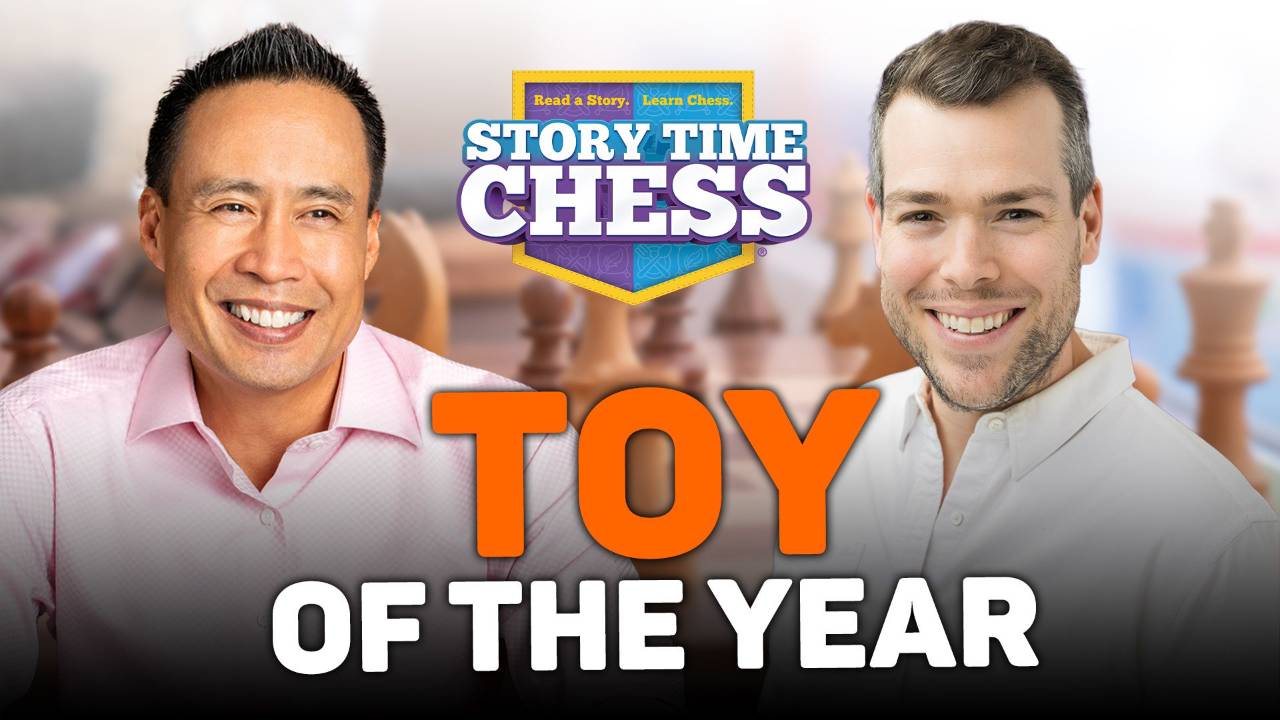
Time Magazine Winner Built a Chess Franchise
Sep 01, 2026This is a transcript from Episode 53 of The Franchise Champion Show.
Listen to the full episode on Apple Podcasts, Spotify, or YouTube.
Alan Regala: My guest today didn't come from business or education. He came from a completely different world and stumbled into building something Time magazine named one of the best kids' inventions of the year. He's the co-founder of Story Time Chess, and the story of how it happened is worth hearing. Jon Sieber, welcome to the show.
Jon Sieber: Alan, thank you so much for having me on.
Alan: Whoa, all right. That sounded like a little Story Time music or something. That was great.
Jon: Yeah, and no, that was perfect timing. That was a Slack notification that came in that I declined. We could dance to it as well. So I apologize about that.
Alan: Hey, no worries at all. That kind of actually goes along well with what I envision as the culture of the business you have and how fun the graphics are and all that. That noise just kind of draws me in. It's perfect. Jon, I'm super excited to speak with you. Story Time Chess is a brand that I've just learned about recently, and I'm excited to hear about the business. But first, take us back before Story Time Chess. What was your life like before all this?
Jon: Yeah, so I studied philosophy in college, and I was planning to get a law degree with that. I was enrolled in law school in Minnesota, and my brother was finishing med school at the time. He called me and was like, "Do you want to be a lawyer?" And I said, "No, I just feel like I should go to law school because that's one of the things you can do with a philosophy degree." And he was riddled with a bunch of debt and finishing tons of difficult exams. And I was like, "You should reconsider that unless you really want to be a lawyer."
So I dropped out of law school very early on, and I got involved in children's theater. I was living in Chicago at the time, and I had opened my own insurance brokerage. And there was a small community theater that would go to underserved and underprivileged areas in the North Shore of Chicago. We told wholesome family stories with values, just good feeling stories. And that's where I first discovered what I call the transformative power of storytelling.
In the audience were children and families that did not have much. Life was very difficult for them. But for an hour, they would sit and listen to these silly stories and have huge smiles. We were able to transform them away from their current living circumstances and just bring them joy and happiness. And I loved it so much that I packed my bags. I moved to New York, and I decided, "I'm going to be Steve from Blue's Clues. I am going to be in children's theater. I don't know what that looks like, but I am going to tell stories to kids for a living." And that brought me eventually to New York and eventually to the business. But yeah, that's what I was doing prior to Story Time Chess.
Alan: Wow. That's quite a change from what your original plan was. Okay, so you found the power of story teaching these underprivileged kids in Chicago, and then you moved to New York. So keep going with the story. I'm excited to hear how this transformed into what this is.
Jon: As you can imagine, in New York there's a lot of people that are pursuing creative endeavors, whether it's musical theater, film and television, or modeling. And oftentimes these individuals work jobs to pay the bills so they can fund their dream. So many people you talk to, it's a very common theme, are either waiting tables or bartending or nannying. They do that at night so they can audition during the day. And that was my life. I was waiting tables and bartending at a spot in Brooklyn, and during the day I was auditioning at Nickelodeon and MTV and anyone who would let me.
A friend of mine who was also in New York was paying his bills by teaching chess. He was the head chess teacher at the Village Chess Shop, which is exactly what you imagine. It was a chess shop in the heart of Greenwich Village, where tourists and old men would gather for hours around a chessboard playing chess. When a woman asked him if he would teach her three and five-year-old, and she was willing to pay slightly better than an hour at the Village Chess Shop, he showed up to the address. And it was not her children. Instead, she was the principal of a preschool, and it was a classroom of 20 children. There were 80 kids that needed to learn chess. And that's kind of where the story continues.
Alan: Wow, that's really cool. So I'm seeing the formation here of your storytelling ability, and then a friend of yours. Did you know this person ahead of time? This is a friend?
Jon: Yeah, he was a good friend of mine who was looking to pursue jazz performance. And like I mentioned, he was a creative and he had learned how to play chess, so he was teaching chess lessons on the side. And at the time, in 2010, chess was mainly reserved for math-inclined little boys or parents who wanted their children to learn critical thinking and math skills and had an aptitude for chess.
And that is what I call the vicious cycle of chess. You have a little boy who is inclined in math and coding and systems and STEM, and they're attracted to the chessboard, and they become a chess grandmaster after 15 years. They then go back and they teach chess, oftentimes to the same child that they were 15 or 20 years ago. And as a result, if you look at who plays chess or if you go to look at many chess schools, very male dominated. The students are mainly little boys, or parents who want their children to excel in math.
And that is where we saw a massive opportunity. The things that you learn from chess, the critical thinking, the grit, the social and emotional intelligence, the executive function, should not just be for little boys who like math. It should be for little girls who like princesses, and athletes, and everyone in between. And so we saw an opportunity to widen the aperture of who was exposed to chess. And luckily for us, storytelling and silly characters was the vehicle we found that was the best way to deliver that.
Alan: That's great. That's so cool. It's so true. And I want to dive deeper into each of these things that you're talking about. But I would love to hear that connection now. How you got from what happens after he goes in, he's got a class of 80 students that he's trying to teach. What happens?
The Trojan Horse Method
Jon: What happens when a traditional chess teacher goes into a classroom and starts teaching anyone is they start with rules, rote memorization, and all of the difficult, heady things about the chessboard. There's 32 pieces, some move diagonal, some move straight, some move forward and backwards. Well, if you're telling that to a three and four-year-old, you've already lost the game. They don't know how to spell it, they don't even know what diagonal means. They want to know the rule, they want to know why. We call it getting "why to death." Why are there green squares? Why are there white squares? Why does this piece have a ball on its head?
And quickly you will realize at that age that the traditional way of teaching chess fails. And in this case it did. The children were uninterested and unengaged. And so what we discovered is that if you throw out that rulebook and instead tell a silly story, the children will discover the rules themselves.
Let me give you an example. Traditional chess, you have the king. It can move forward, backwards, diagonal, one square at a time. A three-year-old, a four-year-old, they're bored out of their mind, not interested. Instead, we tell a story about King Shakey. And King Shakey is afraid of everything. He's afraid of bees, trees, smelly cheese, even his own knees. And because he's scared of everything, he lives in a castle made out of pillows. And so when he goes outside, King Shakey is very scared. His hands tremble and his knees shake, and he tiptoes one slow, scared step at a time. He's worried that the grass is going to hurt his toes, or the clouds are going to fall on his head. But he's courageous when he goes outside and he tiptoes.
We then put the king on the chessboard and we ask a four-year-old, "How do you think this piece moves? How do you think he moves?" And without ever hearing the rule, a child will pick up the king and tiptoe him one scared step at a time.
That is that moment of self-discovery where a child hears a story about an empathetic character, relates to the character, and then discovers a chess concept. That is our secret sauce. That is how we Trojan horse these executive function, grit, critical thinking, the benefits of chess to a three-year-old, by using a silly story.
Alan: I love it, I love it. It's amazing. Learning how to learn is such a skill. And to be able to teach someone a game that can be relatively complicated, as early as three years old, and teach it in a way that is exciting for them and they get it without the rote memorization and the boring stuff. That is really, really cool.
Jon: Yeah. What's interesting is this is done in so many other areas, but with specific things like chess, it's not. When you teach a child to play baseball, you start with tee ball, and then you move up to coach pitch, and then you go from there. There's a scaffolded approach to develop the skills to play baseball. I have a three-year-old. I would never hand her a baseball bat and expect her to hit a home run on her first try. If you teach someone how to bowl, there's the first thing where you push the ball down, and then there's the bumper lanes, and then eventually you scaffold up from there.
We take a similar approach to chess. We do not expect our three-year-olds to be sitting in a park sipping a latte, hitting a chess clock, playing full games. We scaffold things up as they learn. We may start with one piece or four pieces. We may start with what are the best moves, or how do you make a simple plan? And as they get older and as they are more familiar with the concepts, we layer on complexity, we layer on strategy, and we layer on how to win with grace and lose with dignity, and the emotional side of chess as well.
Alan: I heard in the description of the business that from when I learned about Story Time, I heard that part, and that really resonated with me. Just learning how to win and lose with grace. That is especially big at that age. To be able to understand that failure is part of the process of learning and getting better is huge. I have little ones that I know of in my life that maybe haven't gotten that experience yet and have a very difficult time when it comes to losing at any kind of game we try to play. There's just a lot of stress and anxiety, and they take it really personally if they're not winning all the time.
Jon: Yeah, and that makes sense. As a father, I want to protect my children as much as possible. And I want to limit the amount of pain and anguish that they go through. But you and I both know that learning to lose, and learning to learn from your losses, is what really can build character and make you a complete person.
And so it's really difficult as an educator to find an environment in which a three-year-old will consistently lose and have to process and manage those experiences in such a low-stakes way. And so we have what we call little mini games. It's using chess pieces, maybe not the whole board, maybe not all the pieces, but these quick little mini games that any three-year-old can play, in which the teacher loses, the student loses, a whole bunch of times. And we kind of develop this pattern of, "It's okay, you lost. You lost your queen. No big deal. What did we learn? What can we do better? How can we do this differently?" That is a very important part of what we do.
And on the flip side, how do you respond when you win? Are you going to be bragging? Are you going to make fun of the person you beat? Those are all very real feelings that a young mind is going through, and we want to equip people to manage those emotions as well.
Alan: Yeah, that is phenomenal. I love it. We were talking before this interview started about these kinds of values, these principles. And I told you about the HiPer8™ principles of high performance that I promote. And it falls right in line with all of this. Learning how to improve in so many different ways, including this social and emotional part. Having empathy for other people and being able to not just lose with dignity, but also win as well. That's really cool.
So let's fast forward a bit. These were the seeds of what became this business, and it seems like you had no intention of starting a business out of all this at the beginning, right?
Jon: No, I did not set out to start a business.
Alan: So what happens? You start doing these classes, you're integrating the stories and all that. How does this turn into what it is today?
From an Accidental Business to a Franchise
Jon: That spark, that moment of self-discovery in which a child discovers a concept, led to them loving what they were doing. They were proud of learning something. They would talk about it. They went home, and these little children told their parents how much fun they had playing chess. Which is extraordinary because I have a three and five-year-old, and when they go to school, I say, "What did you do?" They usually tell me that they had bananas for a snack or whatever.
But all these little minds ran home and they told their parents. And I woke up to 40 emails in my inbox from parents saying, "My child will not stop talking about chess. I did not even know you could teach a three-year-old to play chess. Will you come teach them at home as well?" And I said, absolutely.
The secret here, the wild thing here is, at the time, I did not know how to play chess. I was not a chess player. I was a storyteller. And I would learn a piece, we would create a story, and I would go tell that single piece. And so I thought, "There's 40 kids who want chess lessons. Let's hire a chess player."
So I hired a grandmaster from, like, Belarus, to go teach chess to a group of three-year-old girls. And I've never made a bigger mistake in my life. The grandmaster could not believe that the kids would not pay attention, that they were picking their nose, that they wanted to eat snacks while learning, that they had to do constant bathroom breaks. He was so frustrated that they were not perfectly still little seven-year-olds sitting in their chairs. Vice versa, the three-year-olds were not used to this man sitting there kind of angrily barking orders at them. They were mutually afraid of each other.
And that is when we very quickly discovered that chess players are not the right ingredient to teach children at that age through stories how to play chess. So I called a friend of mine who is a stage actor named Harlan. And I said, "Hey, do you know how to play chess?" And he's like, "Not really." But I knew he was a great storyteller. And I said, "Here's a silly story about a king. Will you go read it to these little girls?" He read it to those girls, and he woke up with 40 emails in his inbox about wanting lessons.
And I said, chess experience is not what you need to teach chess to this age. You just need to be engaging, animated, and empathetic. And so we started hiring those creatives I talked about. Those nannies, those bartenders, those waiters who were in New York to pursue the arts. We provided them an opportunity. And what was really cool is when you take a woman who is a Broadway singer who plays Belle in Beauty and the Beast, and you give her the skills to teach chess and put her in front of a group of girls, then 50 girls are obsessed with chess now and want to learn how to play chess.
And what we saw is this aperture widening even more. As 50% of our tutors were not chess players, but actors and engaging females, it even grew larger. We even had more students want to come and play chess. And so that was kind of unlock number two. Unlock number one, stories are the vehicle to Trojan horse these complex ideas into a young mind. Unlock number two, you don't need to be a chess expert. As a matter of fact, we don't want you to be a chess expert. You just have to tell a good story and you can teach our curriculum.
Alan: That's awesome. It's really cool on multiple levels. Obviously how they are able to communicate the lesson in such a fun way, and for it to be the right method for a young person to absorb it. But from the other standpoint, which we'll get into shortly, for a franchisee, someone who wants to run this business, is being able to find people that don't have to have that skill set of knowing chess. That's very cool.
So obviously you got a lot of responses from parents. And I imagine other schools like people that wanted to bring this into schools.
Jon: Yeah, exactly. We had tons of schools who wanted to bring us in as their enrichment provider, both in-school or after school. The New York City Department of Education reached out and we got a contract with them. And then we started receiving inquiries outside of New York. We started receiving inquiries in California and Hong Kong and Singapore.
That eventually led us down the path of franchising. We tried several ways to work with the schools where we didn't have tutors. Some areas we were able to set up strong tutor markets where we could service those schools, like Los Angeles and San Francisco. Other areas we were not able to. And so we attempted to license the program where we would train the teachers, or we would try to find a general manager in the area to work with the schools.
Eventually, through the education networks, I became really close friends with the founder of a soccer franchise. And he said, "I know what you need to do. You need to franchise this business. There are individuals who want to make an impact in their local communities, who will have skin in the game, and will work with these schools and certify tutors." And so that started us down our franchise path.
Our mission is inviting all children to experience the profound benefits of chess. Our vision is a million children around the globe sitting across from one another at a table, not an iPad, looking at each other and having a good-game handshake. And if we want to make that happen, we need individuals in their communities to find those tutors, to find those schools, and send those people in. Which is our franchise model.
Alan: Love it. Okay, so for those, obviously we've spent a lot of time talking about the journey to get here. If you were meeting someone for the first time who knows nothing about this business, in a couple quick sentences, how would you summarize what Story Time Chess is for a potential franchise owner, someone who's looking at starting a business?
Jon: Yeah, we're a mobile youth enrichment brand that requires very little overhead in terms of physical space, in which you would send in a certified tutor into the school to run a group chess lesson.
Alan: Nice. That is beautiful. You mentioned a couple things in that one sentence that really spark some joy in me. So one thing you mentioned is mobile. So you're going out. You're not needing a brick and mortar. There's no build-out, correct? And low overhead. It sounds like there's very little as far as assets and overhead go. Is that correct?
Jon: Yeah, at the end of the day, there are some marketing materials that an individual will have to buy. But for the most part, when you go into a lesson, it's a chess board and some chess pieces. We have some chess tools that the tutors can use, but that is what you're using to generate your revenue. It's a simple board and pieces and maybe a couple pieces of paper as a guide.
Alan: In the grand scheme of things, overall this is a very low investment compared to a lot of the other options people are looking at. Which is fantastic. So let's talk about your customers. You mentioned individuals earlier, and then you also mentioned schools. Can you give us an idea of what the breakdown might be, one-to-many versus small groups or individuals, as well as who you're actually marketing to?
Jon: What we advise all of our franchisees to do is to start with the one-to-many model. Your main customer is the schools, the early childhood education centers, the libraries, spots where children are gathering. And you want to start especially with the one-to-many model because of the super high margins that you can generate. One tutor teaching many children can give you some really comfortable margins. From there, if there's an appetite in your territory, then one-on-one tutoring certainly is a great option as well.
But we generally advise the one-to-many model, and we have some strategic partnerships with some of the largest early childhood education centers and private preschools in the country. These are schools like Lightbridge Academy, or we have a partnership with the Goddard School, or Learning Care Group, where they want our program. It's not a guarantee that every Goddard School that is in your territory will invite you in, but the corporate partnerships exist. They want their children in their system to have Story Time Chess. And for the most part, the franchisees in those territories are looking for an enrichment like ours.
Alan: That's fantastic that you already have some relationships with these national schools, national organizations. So potentially you have a little bit of a head start on some of those clients, which is amazing.
Once someone gets started, obviously starting off with the one-to-many, and eventually hopefully they'll add some privates, what does the daily life look like for an owner?
Jon: If any of your clients continue conversations with me, they'll get sick of me sharing this. But the way I describe the business is that there are two repeatable, scalable loops that a business owner is responsible for.
The first loop exists over here. That is building a relationship with a school in your territory. Marketing to the school, setting up a demo day, and providing the lessons to the students, enrolling the students, generating the lessons.
On this side, it is hiring the tutors that you're going to be managing. Taking them through our proprietary hiring systems and onboarding them onto our curriculum and ensuring that you have a really good loop of tutor candidates to service those school lessons.
So your day-to-day will be spent doing business development, marketing and selling to schools, libraries, community centers, religious organizations, and interviewing candidates, interviewing creatives to distribute the lesson. I just had an interview with a candidate in Nashville today. For the interview, she created her own King and Chef puppet and did a demo lesson to me. I was blown away. Which brings me to the point that these creatives are not just in New York City. Every city, every community, every township has individuals who would love the opportunity to tell stories to kids for a living. And it's your job to find out where those individuals live, what colleges they go to, what coffee shops they're hanging out at, what community shows they're putting on, and connecting with those individuals to get a good tutor pipeline.
Alan: That's awesome. That is a great example. I assume you hired her?
Jon: Yeah, absolutely, immediately. I was like, "If this is for your interview, you are going to excite and delight so many children. When can you start?"
Alan: No kidding. Talk about going above and beyond. That's some good pre-interview homework.
Jon: Yeah, she's a perfect example. She's a musician here in Nashville who loves volunteering at her church's preschool. We ran a simple Indeed post saying we're looking for storytellers with creative experience, and she just could not believe that this was a job that we were offering her. You will find the people. We have an owned and operated business in Singapore, and when you think of Singapore, you do not necessarily think of a wildly creative culture. But even over there, we find people who love telling these stories, who want to connect with children, who want to empathetically share these silly stories with kids. And so we have success finding tutors almost anywhere in the globe.
Alan: That's so cool. Okay, so you've got the two loops, the business development loop and the people hiring, training, management loop. How about for owners who long term, they definitely want to be a part of this in the beginning and they know they're willing to grind it out and get things up and running, but their eventual goal is more semi-absentee, where they want to kind of manage the manager or step back and not be in the day-to-day. Is that possible with this business?
Jon: Absolutely, with the understanding that there needs to be a person who's responsible for ensuring that those loops are spinning. So if the goal is to put someone above both of those to manage both of those, that absolutely can work. What the franchisee would need to understand is that that might require more upfront cost to invest in that manager to manage both sides. But yeah, definitely possible. And it would be someone that we would want to work with them to hire, to vet, and to bring to our training, to make sure that both sides feel comfortable that it's the right person to grow the business.
Alan: That makes sense. And it sounds like this is an option that can be done from the beginning, as long as you have the right person in mind that can go to the training. That's fantastic. So what's the ideal franchise candidate for you guys?
Jon: I think the first thing that I would look for is someone who's, and you probably hear this all the time so it's cliche, but someone who's mission aligned. Our mission and vision is to benefit the world by empowering young children to receive the benefits of chess. And if you are someone who doesn't like working with children, who doesn't believe that the next generation is capable of great things, this might not be the right franchise for you.
We promote and push analog, face-to-face learning. So these children are not going to get a mountain of AI insights. We certainly use AI in the business development of our product, but our delivery mechanism is with a teacher sitting on the floor telling a story face to face with children. And so if you don't see the power and the benefit of that, this might not be the right franchise for you.
We are looking for someone who wants to be a part of their community, to bring an enrichment program that will benefit the lives of young children in their community, and who wakes up every single day excited on how to do that. How to bring more little girls, more young athletes, to experience the benefits of chess, and not just make it something that STEM-y little boys like. It has to be someone who gets excited to work with people, to work with the tutors, to drop boxes of donuts off to all the directors that they're trying to win over. That type of individual is who we're looking for.
Alan: That makes complete sense. I love it. I think there's a lot of people out there who are looking for something that is meaningful, finding that purpose, that motivation, having a good purpose behind the business. And teaching young kids, it's more than just chess. These are real life skills, and the chess is the vehicle. It seems like they learn so much more.
What Keeps Him Up at Night
Alan: So what's the hardest part of being on the franchisor side? And remind me, when did you guys start franchising?
Jon: So we actually started in 2023. We had an FDD. We didn't do anything with it because I went and launched our business in Singapore. So we focused on our international expansion. We got Singapore up and running. It's doing incredibly well over there. There's a huge appetite for it over there. And then we came back and I said, "You know, I really want to focus on the United States. I'm sick of taking calls at midnight over in Southeast Asia. I want to focus on the states here." And it coincided with my family. I moved away from Brooklyn, down here to Nashville, which is where we do our franchise training. And I said, "Okay, this season is all about developing and bringing chess to as many kids in the States as possible." So in 2025, we officially refiled our FDD and started selling franchises and training people. So it's been about a year.
Alan: That's great, that you're bringing it back to all the hungry people in the states that could use this service from both the customer side as well as the franchisee side of things. So tell me, being a franchisor now is much different than just running the business and having your tutors and doing the business development and managing that team. But now you've got all these owners who are hopefully carrying out your mission within their local markets. What have you found to be the toughest part in this?
Jon: I think about this a lot. I compare it to 2012 when we were hiring hundreds of tutors, and your desires for all those tutors to be wildly successful, to never have to wait another table or bartend again, and to have this be the job that will carry them until they're winning their Academy Award. And oftentimes that happened. We've had tutors who embraced this and were wildly successful, and others, it didn't work out.
And as an emerging franchisor, I want desperately, it keeps me up at night, for every franchisee to be incredibly successful. And I know that my success as a franchisor equals the success of the franchisees. I will do everything humanly possible to ensure that they are successful. But I can't guarantee that someone is successful. I can show them the processes, the procedures, the opportunities. But at the end of the day, the franchisees are the ones who are going to have to interview the tutors, knock on the doors of the preschools, and sell this program. And that's the hardest thing. Realizing that I don't control that. That is going to need to be someone else's motivation to get out of bed and do that.
And the fact that there might not be people who do that, that's really hard. Because I look at the map of the United States and I look at all of our territories, and I want to hold them all very close. I want to say they're so precious to me because it represents thousands of kids who could receive the benefit and the confidence of this great program. And I want to be very selective and very controlling over who is what. But I need to trust the process that we have put in place, the consultants that we work with, the sales team that we've partnered with, that we are going to find the best people to award these territories to, so that they develop it and nurture it and reach the kids in the right and responsible way. So that's hard for me, to let go of some of that control.
Alan: Yeah, I bet. You definitely do have to let go at some point. If you want this to grow, you can't do it all yourself. Wow, that says a lot though. Just the passion that you have is evident. And the care that you have for not just the brand and your baby, but the success of all the people that you're bringing on. I'm sure you want to have them succeed, just at a personal level as well, for them.
Awards and Advice
Alan: So let's talk a little bit about this amazing recognition that you've gotten from the toy industry and national media. Can you tell us a bit more about that, how that came about, and then how that is helping your brand and your franchisees?
Jon: This is the hardest part for me to talk about, because I just don't want to. It's just difficult for me to talk about the successes that we have had. But in 2016, we packaged 10-cent versions of our stories, and we created a product for kids who take our classes in schools could then play with at home. It was a game called Story Time Chess. It was actually the first time we used the name Story Time Chess. Prior to that, we had a name called Chess Ed 3.
A lot of things collided. Right when we started manufacturing it, board games became wildly popular because of COVID, and The Queen's Gambit came out on Netflix. So everyone was super into chess and chess streaming became big. And our little game went on to win quite a few awards in the toy industry. We won in 2021, we won the Toy of the Year, which is like the Academy Award of Toys. To beat a Pokemon product and all these other insane franchises and win that award was a really humbling experience. And then we found out we were recognized by Time magazine as the Kids' Invention of the Year. So I got to go to the Time magazine banquet and see some truly impressive, amazing people who are doing really cool stuff.
But what that's really helped us with is it's allowed us to push our brand forward really quickly. No matter where I am in the country, if I have my little tent that I'm helping a franchisee promote, someone will come up and be like, "I have this game. My grandmother, the kid's grandmother, bought them this game, and we love it. It's amazing." It allows instant brand recognition for a lot of our franchisees.
I was visiting, this is a quick story, I was visiting my parents who retired in northern Wisconsin, the most remote place you can imagine in the country, a town of like 97 people. I just did a little four-week camp for my kids and I invited other people. And so we were at the city festival on the 4th of July, and I had a little tent. Three people in this little town came up to me and were like, "We have that game. It's amazing. We love it." I was like, okay, if people in northern Wisconsin have our game, it's far reaching.
So yeah, it's global. It's translated in 20 languages or something like that. There is some recognition that comes with it. When people are buying the franchises and are marketing it, there will be a lot of people who already recognize it and want to explore that.
Alan: That's so cool. That is really awesome. And I mean, I know you're a very humble person, and I can see that. But you've got to be able to toot your own horn sometimes, and this is an amazing thing that you've built. So congratulations on that.
Can you speak at all to any financial performance? I know I think there's some information in the Item 19 you have in the FDD?
Jon: Yeah, I tend to stick pretty close just with what is made available in the Item 19. So if people want to dig more into the financial performance, the margins of the business are generally very healthy, very appealing. The startup costs, which is also listed in the Item 19, has the all-in cost at what we think is a very appealing number for a mobile enrichment business. But for the most part, I'd ask that people check out the Item 19 and see what's listed.
Alan: Yes, it's quite good. I will just say that because I have seen it, and Item 19 is very impressive. And the cost, especially if you were looking at the Item 19 and then you look at the costs from the Item 7, the investment cost is, like we talked about before, very low relative to a lot of other concepts that people are looking at. So that's amazing.
For anyone that's out there, maybe in the corporate world, or maybe they're exploring their dream of being on stage or anywhere else, and they're thinking about a career change and looking at franchising as an option, what advice would you have for someone at that stage?
Jon: I tend to try to be realistic with people. When people are talking about franchising or starting any business, it lays the foundation to a very beautiful life, a life full of opportunity and time and freedom. But that path is not an easy one to walk. As someone who has been working for themselves at a company that I've built, there are a lot of challenges. And I love your HiPer8 principles, and that one of them is grit, because overcoming an obstacle is a habit that you'll need to develop as an entrepreneur.
People I talk to come from a corporate background. I am not saying that that is an easy path. I know corporate America, and navigating that, I probably could never do it. But if you are thinking about stepping out, just know that there is an opportunity for a wonderful, freeing life with much opportunity. But there are challenges as well, and you need to be mentally prepared to overcome those hurdles and push through.
And every single day, wake up, try to 1% improve your business, and try to just improve every single day. I'm a big consistency over time person. If you can make one 1% change every single day, after a year you'll be in a way different place than you ever could think possible. And that's kind of what I try to help people explore and understand.
You don't need to start a business and have 10,000 customers the first day. Get your first customer, and then get your second customer. And then after a year you'll have 100 customers. It's okay to just keep pushing forward.
Alan: Love it. That's awesome. Well, Jon Sieber, it's been a pleasure speaking with you today and learning about your story and how you started this business, and sharing all of your nuggets of wisdom. Thank you so much for joining me, and congratulations on being a Franchise Champion.
Jon: Thank you so much for having me. And again, I apologize about that jingle that started at the very beginning.
Alan: It's all good. It's all good. All right. Take care.
Jon: Thank you, Alan.
Don't miss a beat!
We hate SPAM. We will never sell your information, for any reason.