The Loan Question That Almost Stalled Their Franchise
Jun 23, 2026This is a transcript from Episode 43 of The Franchise Champion Show.
Listen to the full episode on Apple Podcasts, Spotify, or YouTube.
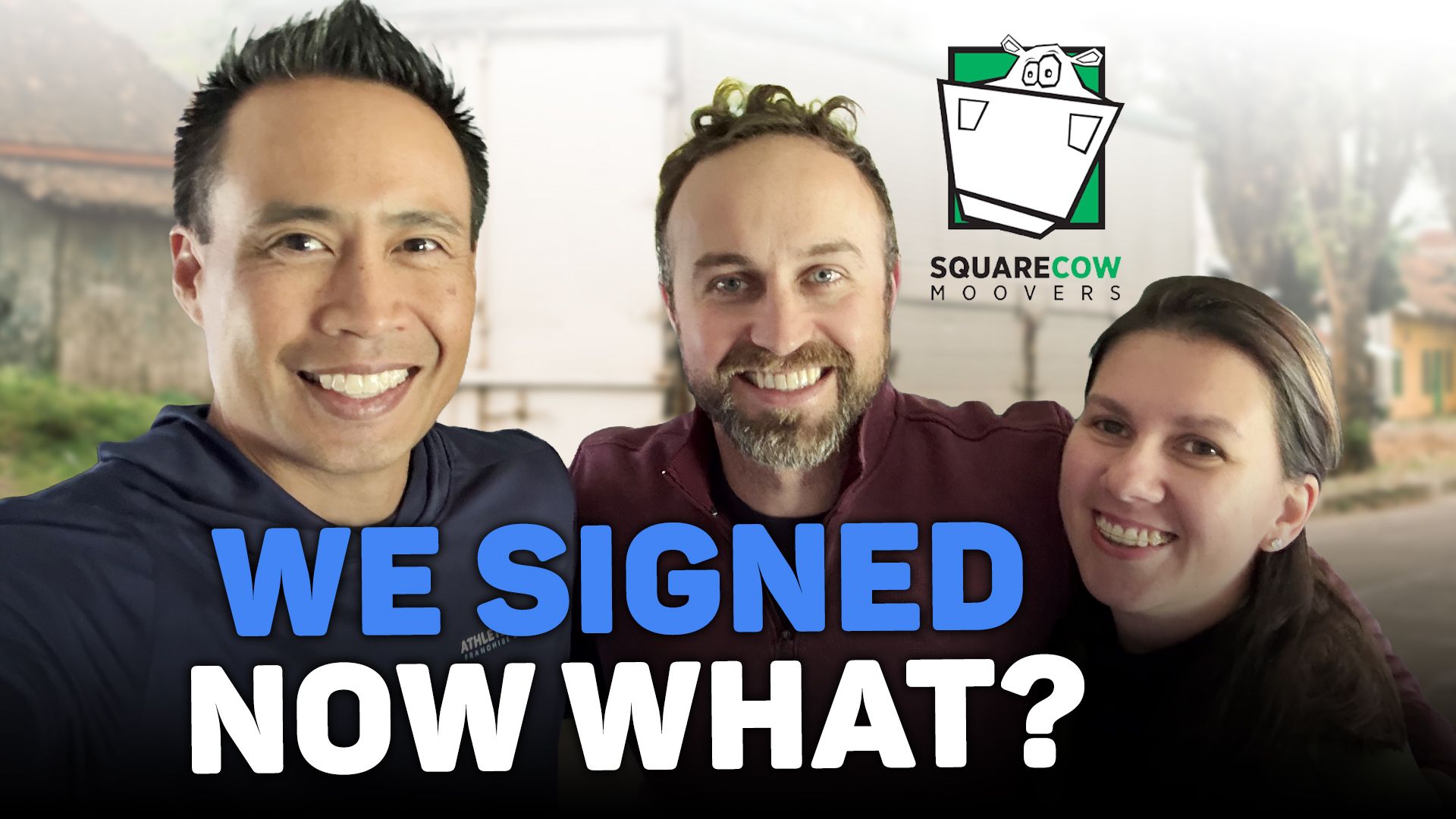
Alan: My guests today are a couple who just signed a franchise agreement together with SquareCow Movers. One of them spent 14 years coaching Division III college tennis and has been exploring this for months. The other joined the process partway through and, from what I saw, became a pretty decisive voice in the final call. They just signed, and the first couple of weeks have already thrown them a curveball. This is episode one of what I hope is a long series. Steve and Iara Anschutz, welcome to the show.
Steve: Thank you, Alan.
Iara: Thanks, Alan.
Alan: I am so glad to have you guys on board. We have been working together for months and you guys just recently signed, and I'm so excited to tell your story. As I mentioned, I hope this is the first of a little mini-series where we check in with you and see what progress you've made and how things are going throughout the course of building your business. But to start, Steve, take me back to before any of this started. What did life look like before we met, and what was making you restless?
Steve: Yeah, like you said, I am, slash was, right, kind of between right now. I was a Division III tennis coach, was doing that for a long time. I mean, going into my 14th year. And really, it got to a point where I work a ton, right? I'm recruiting all the time, I'm working with players at practices, on weekends. We have matches. It worked out to every year being about 30 to 35 weekends away from my family, and we have two little kids at home, and it just became a little too difficult to manage it all. And being a family man, I wanted to be around them more. So my wife and I kind of sat down, actually maybe a little over a year ago, and said, hey, it's probably time to start looking into a different career path.
So I tried that first, right? I was applying for jobs, applying for jobs, applying for jobs. But my job was still good enough that I didn't want to just take any job. So nothing really came up in that search over a year that really hit the mark. And I was sitting on my computer, it was January, and I got an email from the ITA about franchising. And it was you, Alan. And I was watching this and it just spoke to me. Everything it said just made sense. And I was like, this is my path. This is where I'm supposed to go. And so I reached out to you, and that led us down this process that we're going to talk about today.
Alan: Wow. That's really cool. And it's good to know some of the marketing I'm doing works. So I would love to hear what that process was like for you. From your perspective, you know, from that beginning stage, I think you did download my book. Tell us a little about that, and then what the process was like over the next couple of months.
Steve: Yeah, I don't really go into anything without doing a lot of research. And so when I saw your email, I was initially really intrigued. And luckily, today's world we have AI, and so I did a ton of research with AI on franchising. What does it mean, what does it look like, what does a franchise coach do? And then I downloaded your book, and I remember I downloaded it at like 9:30 at night because we have two little kids, I go to bed pretty early. So I was like, I'll just read like a page or two. And I believe it's like 50-some pages, or something like that. And I read the whole thing that night. Just every time I was reading it, I was like, oh my gosh, I love this more. I love this more. Like because I started really thinking about the process and what it meant for me and the future that I could hold for our family. And so I couldn't put it down. And I went to bed that night thinking, this is where I'm headed, this is where I'm going. And I literally emailed you that following morning telling you I read the whole thing, and I want to start working with you, and I want to know what the process is.
Alan: That's so cool. Yeah, I remember reading that and being like, wow, I love it when stuff works. So what is that process like for those who have never looked into franchising at all? You know, what does that process look like if you were to explain it from a 30,000-foot view?
Steve: I mean, I think the first thing I really realized is I wanted, I'm a coach already, and I see the value in coaching. And I saw value in a franchise coach. Obviously any individual could reach out to any franchise and start going down that process, but that didn't make a whole lot of sense to me because I was new to franchising. I don't know a ton about it. Whereas you had 14 years of experience, you'd been through it all. And the other way I looked at it was just listening to you talk and everything. It made sense that you would get to know me and kind of who I am and my needs and wants, and lead us in the right path.
So when we had an initial call, you kind of affirmed all those things I was already thinking. And then I think by our second call, we had a really in-depth interview to talk about the needs and the wants, our cash value, how much we'd like to spend, what are we looking to make out of this, what kind of business. Do you want something in home services? Do you want something with pets? All the different industries. So we had a really in-depth interview. And then once that was complete, you took, I think, less than a week, and you came back with several different businesses for me to look at. It was like our third or fourth meeting, and you presented six businesses to me. All six I thought were really amazing. They all kind of met what we were looking for, which is again why we wanted to work with a franchise coach. But you gave us the tough process of narrowing that list down, because when you listen to them all, they all sound so good. They all have great marketing, they all have a great why and a mission and values.
So I remember you told me I had to get down to two or three, and I came back and we went back and forth in a very peaceful, good way. And I listened to you and I came down to three. Then once I had three, it was really me taking the bull by the horns and leading the conversation with each franchise. I reached out to all of them, connected with them via video, started the process, started talking to all of them, and it was very interesting. All three worked in very different ways. One started with a video call, another was just a regular call, one sent me like a survey to start. They all kind of started in their own ways. And then throughout that process you do validation calls with owners, and you talk to the franchise representative a few times just to keep going through the process. And through that whole process you're just narrowing that list down.
So it was really funny, my number one pick got eliminated within a week because they came back and said they couldn't service our area, someone had just bought it. So then I came back to you and said, can I add one? And the one I added back in is the one I actually ended up with. So I originally had six, got down to three real quick, went through the whole process of talking to all of them, one got eliminated, a third one came back in, and then through all the validation calls and everything, I eventually got to one, and we signed with SquareCow Movers.
Alan: That's awesome. And I think it's going to be really helpful for people who have no idea what this process looks like to hear it from you. And you did an amazing job. I will say people are in different stages of life and have different amounts of time to commit to this process. But you did a fantastic job of doing the homework. You scheduled the calls, you got on the calls when you were supposed to be on them. And I think that says a lot, because franchising has systems and processes and things you need to do. Will you do them or put them off? And the franchisors are interviewing you as much as you're interviewing them. They see this, they see the work, and they want people who are going to follow through.
Okay, I'm going to jump over to your better half. I actually never met Iara until I visited Wisconsin for signing day, which was so much fun. I don't even think we'd spoken on the phone before then. And I remember early on in the process, I told you it's a good idea to get your spouse involved early and she's welcome to join the calls. And you definitely did that. So, Iara, I want to hear about it from your perspective. Since you have a full time job, you're a mom, you've been super busy but very supportive of Steve throughout this process. What was it like before he got into all this?
Iara: So it has been challenging to see Steve go through his career, and I was wanting to spend more time with the kids and have more weekends together. So I was always encouraging him to look for a different opportunity. But I always told him, if you don't make a move, something is going to make you make the move, right?
So situations started to arise that I was like, there it is. Right? Flags starting to show, flags starting to show. And then he started getting more and more interested in franchising. So I did not get into this process at first. He was talking to me about it and I was on the same page with him, but I didn't get involved until one day he's like, hey, I need to be at two validation calls at the same time. Can you sub for me in one of them? And I was like, yeah, absolutely. What do you want me to ask?
So I got in, and I'm pretty sure the first call I was on was with SquareCow, with the two owners. And I'm like, I'm here to sub for my husband. I have a few questions. So I asked a few questions. And it was so funny because that's basically the first one I got involved in, and then I was like, wow, this is actually really super exciting. And then I got to go to the other room for the other one, and I thought, oh boy, this is a really good one too.
So both of us were like, okay, now we're between two. What do we do? But I told Steve this before, and he has seen it as I moved jobs a year and a half ago. I don't know how religious people are, but things start to show to us. Things were starting to talk to us and signs are starting to show up. And then that is how we ended up with SquareCow Movers. Besides everything that we liked about them, we liked the other company as well, but certain things start to happen. And we're like, all right, I think we're narrowing down more and more.
So I'd say for everybody that's listening to us, trust your gut. Watch for signs. They are all there. And once you see them, you can't unsee them anymore. They just start showing more and more and more. So please make sure that you're paying attention to the signs because they do exist.
In this case, we were actually almost thinking about going with two at the same time. We're like, well, we can't handle two at the same time. We first have to start one, right? Let's grow this one and then we can get into something else. So yeah, we're excited about this opportunity. And I'm seeing now that things are starting to get more realistic and difficult, right? Because the beginning is very difficult. And I'm sure you're going to talk more about it. But it's still very exciting for our family. Although the weekends aren't going away right away, we're still possibly working weekends in the beginning. We're super excited to leave a business for our kids and build a great future.
Alan: That's awesome. That's really the whole goal, the whole dream, creating an asset, something that you will have for your family, for yourselves, that you can either pass on or sell, which you just can't do with a job. And I love how you bring up the fact that this is going to be hard work in the beginning. Yeah, it's a sacrifice you have to make short term for those long term goals. But the work isn't different, right? Like, Steve was doing such hard work for his company, but is he getting rewarded for all the work and the time he's putting in? That's going to be different now. You have your own asset and you are being rewarded for all the work you're doing.
Steve: Yeah, for sure. All that hard work that you put into your own business, it doesn't feel as demotivating as if you were doing it for someone else. When you're doing it for yourself, it's hard work, but you know it needs to get done, and it's not a drag on you mentally like it would be for someone else.
Alan: Yeah, that's great. Okay, Steve, let's talk about SquareCow Movers. For anyone who's never heard of them, tell me what this business actually does and what makes it different from any other moving company.
Steve: I think the thing that initially made us interested in SquareCow Movers was really the mission and values. They're about high-level service in an industry that might not be well known for high-level service. They really care about the people that work for them, the franchisees, and about making great leaders. All of that just spoke to us as people, right? The high values, taking care of others, serving others, making leaders out of your employees and yourselves, serving your local community. Everything they said just spoke to our values.
And then the real service they do is they're a moving company. They do commercial and residential. Most of the business is obviously residential, and you can do packaging and the moving of materials. There's a whole gamut around that. But the thing that really attracted us to SquareCow Movers were the values of the owners and the values of the company. A lot of companies will say they have values, but they bring it up once and you never hear it again. With SquareCow Movers, it was brought up every single call. And to me, again, that spoke to me because I know how important culture is. I know how important it is to hold yourself to a standard. I felt like they were doing that. They had those values but they didn't just talk about it from a marketing perspective. It was truly who they were, and they wanted to see that from all their franchisees.
Iara: Can I add something, Alan? They also were not trying to sell themselves to us. They were interested in us first. They wanted to know who we were and if we were a fit to their culture. And I think that's important because in the end, we would be part of their family, right? We're going to be sitting at a table with them. Does what we do or how we talk or how we live, does that work with the values that they have? So for a while they were interviewing us a lot, not in a super formal way, but like they were willing to talk. They want to hear about you. And not even about the business. They're like, I'm not talking about the business today. Let's talk about ourselves.
And even when we were there to do an in-person validation to understand more about the business, they were not trying to sell themselves. In fact, they were doing the opposite. They were trying to talk you out of it, to see if you were resilient. Because this is really a tough business and this is how they work. They just want to find out, is this the right thing for you? Because if you left that place knowing, after all the problems they showed you, all the problems they went through so you don't have to go through them, if you still left knowing that's what you wanted to do, they knew you were ready. But they could also say, actually, if you're in doubt here, I'm not sure if you're the right candidate. So that's what I value a lot about them. They're just great people, very upfront, and you didn't feel like they were hiding anything or trying to sell themselves.
Alan: I love that. I love that. And you know, for what it's worth, that's what you want to see in a franchisor. If someone's super eager to sell you their franchise and they're not asking a lot of questions about you and what you're looking for, that's a red flag. Because if they want you to be successful, they need to know who you are and if it's a good fit. What I've observed is that the best ones are exactly as you describe. Not trying to sell, but trying to vet their franchisees just as much as you're vetting them. And so that's a great sign.
Steve: And can I add one more thing? Because it's important, it's something that spoke to me a lot too. Going through the process and comparing all of them, there was one that was kind of just starting out. There's just a bunch of DIYers doing it around the country where this was like a professional organization trying to make it into something real. And so that made a lot of sense to me, and I could see value in it. But throughout the process, my gut feeling was that that was just not going to be the right fit for me. It would probably be a great fit for somebody else, but just not for me. So again, it wasn't anything in particular, it was just kind of that gut feeling. And so they got eliminated.
And then we came down to our final two, which was SquareCow Movers and another one that we absolutely loved. And we did, we loved both of them. And I felt like that was a great situation to be in because, kind of like Iara said, SquareCow Movers wasn't really selling themselves on us, which we liked. They were more about, hey, come learn who we are and we want to learn who you are, and we'll see if it's the right fit. And what we said was, well, if they feel like we're not the right fit, we feel like we're in an awesome place because we have this other one we still love.
So it's really a great and a tough situation to be in. It's kind of like being a tennis coach when you see two people play amazing tennis and you're like, oh my gosh, somebody's got to lose. And that's terrible because they're both playing so good. We had two amazing businesses, we loved them both. But financially we had to make a choice on one, which also probably makes sense for our future. And so going through that process was much harder because my heart and my gut were both saying, man, I could see us doing both. But we had to make a choice.
And so I sat down, we listened to our gut, listened to our heart, and SquareCow Movers just kind of stood out to us a little bit more. There was a little bit more data once we got down to two. We did look at the financial numbers, we did look at territories. And one thing that spoke to us is we want to crush this, we want to grow, we want to have a great impact in our communities. The other business already had a pretty good presence in Wisconsin, so the ability to grow just wasn't quite there. But with SquareCow Movers, there was way more impact we could have in Wisconsin. And that really intrigued us even beyond the emotional feelings we had.
Alan: That makes a lot of sense. That's great.
Quick pause. If you're someone who knows how to get things done, like Steve, and you're interested in putting your hard work into something you actually own, franchising is something I'd encourage you to explore. The book Steve mentioned is called The Franchise Fit Playbook: A Champion's Guide to Choosing the Right Business. It's only 50 pages or so, but it's packed with great info. Download it now for free at athletetoowner.com/playbook or use the link in the show notes. Now let's get back to Steve and Iara.
Alan: Okay, well, there's a moment in almost every process, especially this franchise matching process, where the numbers get real. The finances, when you're starting to look at the loan and do all of that stuff, anxiety can come into play, fear can come into play. What was that like for you, Iara?
Iara: Like I'm going through it right now, right? It's getting more real every day, I think. But I never feared, to be honest with you, because when we're sure of our decision, we're like, okay, this can happen. We can crush this business. I think there is some hesitation, but I feel like Steve is super disciplined and I know he has it in him. He's eager to start this and get this going, and I know he's going to be very successful. So I don't have fear on that part.
I think there are some things we're going through right now. Like, once you see the money go away from your account because you have to start paying for things, you're like, okay, we should be rethinking how we use our money for a little bit, right? We're very conservative in our finances, to be honest. So this was a big move for us. It's not something we took lightly. We're not really big risk takers. This was probably the biggest risk we've ever taken. But both of us feel good about it because we know the discipline is there, the drive is there, and we want to work it and make it happen.
Now, going through the process right now of getting the loan approved and the other documents they ask you for, and then if you don't have the truck but you don't have the place to park it, and everything is interconnected, and you're like, okay, someone's got to give here, right? So this process now is a little more tiring. But at any point, SquareCow Movers always coached us from the beginning about what was going to come. They're like, although you think you're ready to go, just wait. Because now it's going to come like a rain of documentation that they're going to ask you for that you're not expecting. They call these "rocks," things we have to overcome.
So other than that, it's just about having patience and keeping in the back of your mind that this is a whole process we have to go through. But once we're through it and we have our truck and everything is ready to go, just have the good mentality that we're going to crush this. Keep it positive. I'm trying not to let any of the noise get to me. Not the "what ifs." I want to stay positive. This is what we need to overcome to get to where we need to be to make the business successful.
Alan: I love it. And that's a really key mentality that both you and Steve have, which is you're not focused on the problems or the what-ifs or "can I?" You're asking how can I? It's, how can I crush it? It's going. And knowing it's possible and focusing on the things you can do that will make it successful, instead of the things that could be in your way. And that's where I think a lot of people get screwed up in business ownership and even in this process, focusing too much on what can go wrong. Obviously you need to plan for the worst, hope for the best. But going in with the right mindset is so important, and I love that you express that so well.
Steve, how about for you? The numbers becoming real, the anxiety, how has that played into this process?
Steve: Yeah, it never felt like much of a risk to me. Again, everything I go into, I do with a lot of research. And if I'm going to go in, it's because I believe in it. And so right now I feel really good. I even thought when we had to pay the initial fee, I thought, oh boy, I'm going to get super nervous around that time. And it never hit me. I just keep feeling good. I'm just so determined, so determined to get after it, so determined to prove myself, so determined to do well for my family that nothing is really dragging me down yet. And I'm not even going to call it a high. It's just this level of determination that I've got to get this done. I'm going to do this. So I'm really not seeing anything as roadblocks. It's just, what's next on the list so I can kill it? What's next on the list so I can crush it? What's next so I can get after it? Just give me the list and I'm going to get after it.
Alan: That is so good. Essentially you're betting on yourself and you're just so confident in your ability to get things done. And combined with asking good questions through the process, the reason you probably didn't have as much anxiety is because you went through the process of learning, and fear gets combated with knowledge. Right? Once you understand more about the brand and you've asked your questions and done the research on the financing and all of that, you've squashed those fears because you now have more information. And then you can move forward making an informed decision, knowing that yes, of course there's going to be risk in everything, but at the end of the day you're betting on yourselves, and you know you can get things done.
Okay, so you guys signed last month. It was super exciting. It just happened to be that I was going to Wisconsin to pick up my daughter from her freshman year of school, and I figured I'd come a day early and swing by Milwaukee, visit with you guys. We got to play pickleball together, had dinner, went through the signing. It was so much fun and great to meet both of you in person for the first time.
Tell me what it was like going through signing day. Were there any nerves?
Steve: All reality, no. Just so excited. For me it was like July 4th, like let's celebrate, fireworks, let's go. And it was almost kind of magical that it all worked out that you could join us. You were through the process with me the whole time, helping lead me through it. And the fact that it worked out that you could be there with us and go through that celebration of signing with us was just so cool.
The day before was maybe the most stress we had, which was still very little, just because we were looking at our accounts and putting all the money together to actually pay the fee. Like, how much should we take out of this account to put in this account? So just doing the math. That was maybe the most stressful part, and it took maybe 20 minutes. It wasn't that hard. And then we get to signing day and, again, I think a lot of people might get nervous about that process, but we were still prepared for it. And we were just so excited to move on to the next step and get this started that it really didn't faze me at all.
Iara: I just loved how during the signing, they're hitting the cowbell, right? Like they're playing the cowbell and we're all very excited. I'm excited to be part of the SquareCow family. They have a conference room at their office that has this big map, and we became a pin in Wisconsin. I'm just excited to put many more pins in Wisconsin. It was just a very happy moment for our family.
Alan: That's awesome. You know, one thing that was really unique. I've never been to a signing for someone else. I had my own many years ago, but being there for someone else was really cool. One thing I had never seen before was they went through an additional document. What was it called, Steve?
Steve: They called it their Leadership Moment.
Alan: Yes. Tell us about that. What was that?
Steve: So again, what we love about SquareCow Movers is just the high values that they have and living that every day. So you're signing the franchise agreement, but that second document is the Leadership Moment, where they go through it piece by piece. Basically, you are agreeing with each line on how you're going to act as a person, how you're going to act as a leader, how you're going to act as a franchisee. They call it the Leadership Moment, so you really understand the leadership that you're taking on. And again, we love that. That's part of what we love about them. And it makes you better as a person, which we love.
Alan: Is there one you can read to us?
Iara: I like lots of them, but one of them, the first one that's very important, it says: "This is not passive income. I acknowledge this business requires my full engagement. I commit to active, accountable leadership." Right? So for example, one more that is really good: "Obsessive execution wins. I acknowledge that success comes from disciplined execution. I commit to being obsessive about operations and sweating the small stuff, because exceptional service is built on small details." Right? So they have a whole ten topics like these things. And they actually read that with us when we were there for the in-person visit. They said, the day of your signing, you are going to listen to all of these again, and I want you to say yes to each of them as we read.
So it was just so cool. Even when we were at their office, I'm listening to all of that and I'm like, should I say yes now? Not maybe. We talked to Steve afterwards. We went to our hotel and we were like, I think that was yes for everything. But let's talk more. As we were looking at numbers and figuring things out. But yeah, it's just great.
Alan: That is so cool. I just remember listening to those ten things and thinking afterwards, you can't not be successful if you truly believe and do all of these things. If you just stick to those, you'll be successful. I love that about those guys. That was a unique experience for me.
Alright. So you guys have been in it for a few weeks since signing. Steve, tell me about what's happened since then and what you're dealing with at this point.
Steve: Well, I think the first thing that's very important for people to know is I still have my job. Because even as you get the loan, they want you to keep your job until the loan actually closes. So I'm still working as a Division III tennis coach. But once I get the loan and the business starts, then I'll be transitioning to that full time.
So since we're still going through the loan process, it's in maybe three different steps. You have the first step, which is just getting all your initial paperwork in, your taxes, your pay stubs, and so on. Then you move into underwriting, and at underwriting they go through all the stuff again and ask for more documents or more proof of things. The underwriting process for us was actually the easiest so far, less than three days. Really quick. And now we're in the last stage, which is called closing. And this one, it's a behemoth. It's a lot. We just got the email and it was so long. I just kept scrolling and scrolling and they're just like, we need all of this by this date so you can get your money by this date. And I just looked at it and said, hey, it's a long list and we are going to get after it because we got to get after it. So again, we're not scared. We know we're going to get it done. Let's do it. Let's get after it.
The loan process has been a lot, I think, but it hasn't frustrated us just because we've had other loans for cars and our mortgage and everything like that. So we kind of knew the bank was going to ask a lot of us. All we do is they ask for something, we get after it. And that's been working really well. We don't let it slow us down. It's been very objective. Let's get after it, let's do it. And SquareCow Movers, they're like, wow, you guys are really moving through this. And I feel like that's funny because I actually don't work on it a whole lot. I just see the list and I knock it out when I can.
Alan: Nice. Okay, so that's great that you're going through the process. But I want to hear about the challenges happening around the loan process. So people know that sometimes it's not as straightforward as it seems.
Steve: Yeah, so one thing we're running into is I think it's just more or less the communication between the bank and everything. In our case, we are getting a loan and the loan is hinged upon us getting trucks for our business because we need big trucks to move people. And the phrase they used was that we needed a purchase agreement in order to even start the loan process. So when I had the call with the lady, I asked what exactly that was, you know, because you hear it but what are you actually saying? And she's like, I need a signed copy of you buying a truck. And I questioned her on it. I'm like, that's why I'm getting the loan. I'm getting the loan to buy the truck. So how do you want me to buy the truck if I don't have the loan yet? So there was kind of a back and forth on that.
And so that was an interesting part of the process, because they're not going to budge on that. But at the same time, that's what the loan is for. So eventually what happened was I got really lucky. The lady I was working with was on vacation, and someone else took over the loan. He called me and said, why is this holding the loan up? This shouldn't take so long. And so I called him back and I said, well, I haven't really bought a truck yet. I haven't signed any paperwork because I need a loan. He said, you don't need a purchase agreement, all you got to do is send me a quote. So once he said that, we moved on to the next stage within 20 minutes because I had tons of quotes. I just hadn't signed with anyone yet because I didn't feel like we were far enough along in the loan process, because I would have had to put down money on a truck and then tell them to wait probably two or three weeks until I could actually finance it. But now that we're further along, I feel much more confident. We'll probably be signing on a truck within the week because we should have the loan within the next 10 to 12 days.
Alan: Nice. But then it doesn't stop there, because then you had insurance. And then insurance wants to know where you're going to park your truck, but you're not going to have the right numbers until you have your DOT number.
Iara: Right, so until you have those numbers and you tell the insurance company where you're going to park your truck, which needs to be properly zoned, you also need to talk to the city about where you're going to park your truck. So it's like everything is like this, and we are trying to cross things off and move on with the process, but we're like, we can't really cross this one yet because X, Y, and Z needs to be answered. So that is the part that has been very challenging. We haven't been frustrated, but we're trying to find a way, which is one of the things that SquareCow says, find a way. And in this case it was just a communication barrier, I suppose.
Alan: Yeah, there's a lot of details that have to get hammered out and figured out. And you mix in communication challenges and it makes things more challenging. But you guys are pushing through it and you're getting things figured out. That's really what matters. And you know, if I gave that lady a little bit of doubt, like if you would have had a signed document for a truck, things would have gone even faster. She was probably just trying to get you ahead of the game. But to move on to underwriting, all you needed was the quote.
Steve: Yeah, it just depends on how fast you want to go through it and how fast you can move on things.
Alan: All right. So for each of you, did anything surprise you about this process, going from knowing nothing about franchising to where you're at today? Anything you wish you'd known earlier?
Steve: Overall, no. Everything was explained very clearly by you and by the franchises going through it. I think the only thing, and I mentioned this to you once before, the only thing that surprised me was how drastically different all of them go through the process. Maybe based on, you know, like SquareCow Movers, no selling to you. They are not selling to you. It is more just let's get to know you, you get to know us, and let's see if there's a good fit. Whereas there was a different franchise where they were all about selling themselves to us. And then even just how they conducted the validation calls, how things were set up. I just thought it would be very similar from each one. Like, for instance, there was one franchise where they really wouldn't do anything. If you didn't take any steps, you wouldn't be moving on. Luckily, I was taking steps every week and I was crushing it. And then other franchises are on top of you. They're emailing you, they're texting you, they're calling you to keep you engaged and keep you through the process. So it was just really interesting, surprising to see how they all act differently through that whole validation process.
Alan: Yeah, that's very true. Different franchisors will have different levels of experience. Some, if they've been around for a really long time, know exactly what works and have a very structured process. And some maybe don't have as good of a process, or some franchisors will outsource that process entirely to a franchise sales organization. So that's another thing. But yeah, it is very interesting how different they can be.
For both of you, for anyone out there listening that's considering leaving their job and jumping into franchise ownership, what advice would you have for them?
Iara: Don't fear, and do a lot of research. I'd say I'm going to give my husband all the applause, because he's the guy that does all the research in our house. He does not buy a sock without doing research or looking at the evaluations, right. I'm more of an emotional mover type. But I think lots of research and lots of validation, not just doing the research and talking with the companies itself, but talking with the other franchisees. Right? What are they doing? How do they feel? And we've been to lots of those calls, and I think that's what got us most excited, because there are some people out there who have the discipline and are really crushing it.
So just, I feel like, do not be afraid, and talk a lot with others to understand how they feel about the franchises. And for my perspective, I continue to be doing my corporate job. I really love my job, I sell chocolate, so I cannot not love it. But in my future ideas, if we're really crushing it in this business, I think that Steve will rob so much of his happiness that maybe we're going to be stepping out and I'll be creating my own territory, right?
Steve: Yeah, I think she stole mine a little bit because, like she said, she doesn't do a lot of research. It's always me doing the research. So for her to say that kind of steals my thunder. But yeah, I feel like because of the amount of research I put in at every step, I'm feeling confident because I've exhausted all of the research, I've exhausted all of the questions, and that allows me to feel like I've overturned everything. I've looked at it the best that I can. And because of that, I have the confidence to move forward and go into it.
The other thing that I would suggest, and I think it's really important, action overcomes fear. And I never had fear, I think, because I was just taking so much action. Like every week I wanted to knock things off the list. Every week I wanted to talk to all the franchises. I didn't want to take a week off. And again, that's not hard, every week. It's maybe an hour per franchise. Usually it's less. I would say 20 to 40 minutes on average with each franchise. So if you look at one week, maybe that's at the least an hour, at the most maybe three hours, because if you have three franchises, you're taking action with each one of them. So the research and taking action every week is what led us through the process. I thought in a very efficient manner. Not too fast, not too slow. And it allowed us to get to a point where when we made the decision, we were ready to make it.
Iara: Can I add something? I also want to say that having a coach like you is very helpful, because we don't know what we don't know. We didn't even know franchises existed. I mean, maybe Culver's. But other than that, it's just like, we don't know what to ask. So having a coach help you on what kind of questions you should ask, because you don't know what you don't know and you haven't been in the business, you're not in that mindset. You come from a different type of background, right? And then you were there throughout the whole process, not telling us what to do, but more like a guide. Providing a perspective, asking questions that made us think. I see you kind of like a psychologist in a way. Like trying to guide us through how we are going to get there. The decision is really ours, and that's very important. So I would definitely recommend that to whoever is listening to us here.
Alan: Awesome. Thank you for adding that. Thank you so much for joining me today to share your story about going through this process, getting into your business, and everything that came along with that. And I'm so excited to catch up with you guys again, hopefully in a few months, to track your progress. So thank you so much, and congratulations on becoming Franchise Champions.
Steve: Thanks, Alan.
Iara: Thank you so much, Alan. We're so excited.
Don't miss a beat!
We hate SPAM. We will never sell your information, for any reason.