Bringing Your Spouse Into The Franchise Decision
Aug 06, 2026This is a transcript from Episode 49 of The Franchise Champion Show.
Listen to the full episode on Apple Podcasts, Spotify, or YouTube.
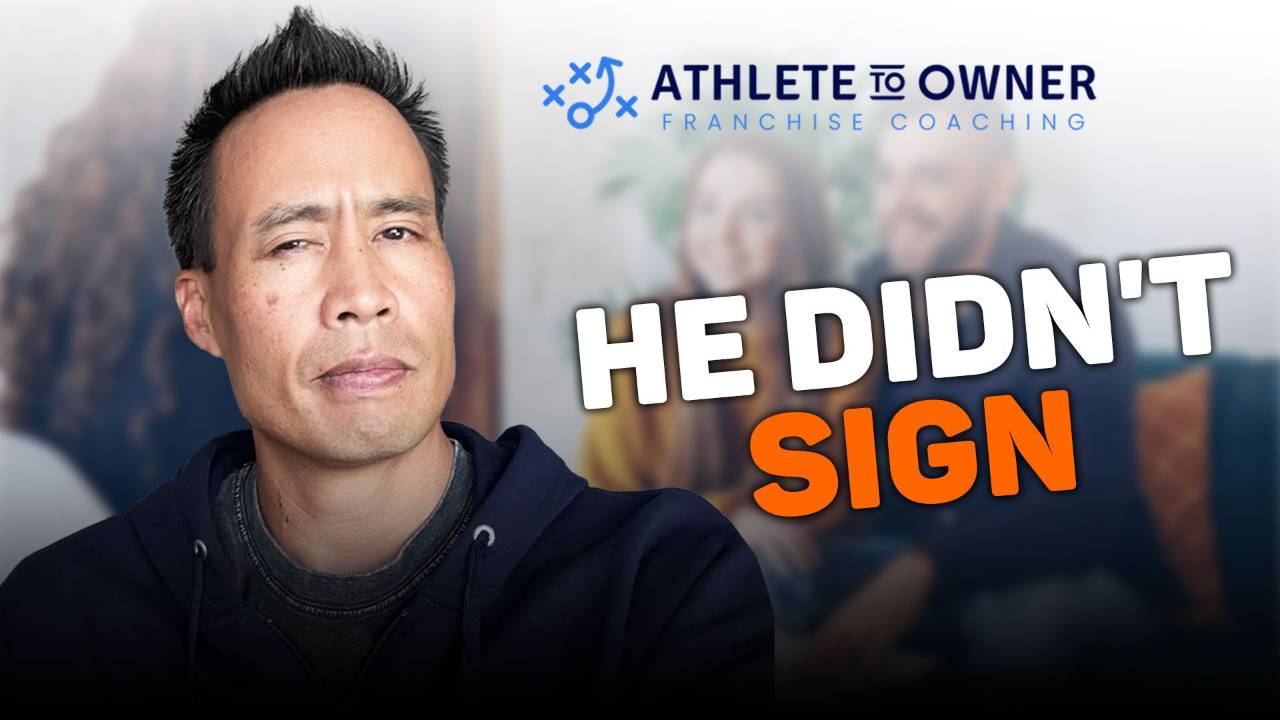
Alan: I had a client who was ready to sign a franchise agreement. He had done all the work, coaching calls, franchisor presentations, validation calls, financial planning. He was excited, he had found the right brand, and he was ready to go.
His wife wasn't part of any of it. The night before he was going to sign, he sat down and had a real conversation with her. It wasn't about the money or the business. It was about his time.
He didn't sign.
That conversation could have happened three months earlier. In this episode, I'm going to walk you through what it actually looks like when you bring your spouse in from the beginning. Why most people don't, and what happens when they do.
Why This Is a Life Change, Not Just a Career Change
Franchise ownership isn't just a career change, it's a life change. It affects both people in a marriage or partnership, whether the spouse is involved in the business or not. There are two dimensions this touches, and both matter.
The first is financial. This is a six figure decision that changes the family's money picture. That much money moving requires both people to buy in, not just consent, actual buy-in.
The second is lifestyle. The first year or two of ownership is going to consume a lot of your time and energy. School pickups, evening events, weekend availability, the household division of labor, all of it shifts. If your spouse hasn't been part of shaping that picture, they get handed a version of your life they didn't help design.
And here's the part that most people miss. Your spouse may see things about you that you can't see yourself: your blind spots, how you handle stress, patterns you've had for years that you don't notice anymore. That input is valuable early, not at the signing table.
Bringing them in isn't a courtesy. It's not a checkbox. It's how you make a better decision.
The Three Excuses I Hear
There are three versions of this that I hear, and each one deserves a real response.
The first is, "I don't want to overwhelm them until I know what I'm doing." The intention is protective, you want to have your ducks in a row before presenting an option to your spouse. The problem is, by the time you have your ducks in a row, you've usually fallen in love with a specific direction. And now your spouse is either endorsing your choice or being the person who kills your excitement. It's not a fair position to put someone in.
The second is they're too busy, or they don't want to be involved in the details. Sometimes this is true, and sometimes I can accommodate that. What I ask for, at a minimum, is that they know what you're exploring, and that they weigh in on the big picture, the goals, the investment level, the timeline. They don't need to be on every call. They need to be part of the direction.
The third one is, "I'm in charge of this decision, I handle the financial planning." This is the one I push back on the most. Not because I don't respect the division of labor in a marriage, I do, but I've noticed something. When a client insists on keeping their spouse out entirely, I usually see other signs of a lower commitment level as the process goes on: delayed responses, missed calls, not following through on the next steps. I don't think the isolation causes the low commitment. I think both are signs of the same thing, not being fully invested in making this happen.
It's not that this has to happen, that there's an obligation to buy, but there's an investment and a commitment in the process, the process of learning. And that's what I'm after. The spouse conversation is often a proxy for something bigger. We'll come back to that at the end.
What We Actually Cover When a Spouse Joins Early
Let me get practical. When the spouse comes in at the beginning, before any brands have been discussed, here's what we cover.
First, involvement. Is the spouse going to be part of the business? Some are, some aren't. Both are fine, but the answer changes what we focus on. If they'll be in the business, I interview them the same way I'd interview my client: background, skills, interests, what they enjoy doing, what drains them. If they won't be in the business, we skip most of that, but we still cover the parts that affect the marriage and the household.
Second, location and life logistics. Where do you want this business to be? Are you willing to move, or are you rooted in your community? What does daily life look like right now, and what's going to change?
Third, financial goals. And this is where the conversation often shifts in interesting ways. When both people are in the room and hear the goal spoken out loud, something clicks. I've had spouses say, "Wait, if this is realistic, maybe I want to leave my job and be a part of this." That completely changes which businesses we look at. That would not have happened if the spouse wasn't in the room.
Fourth, lifestyle goals: more control over time, more flexibility, more presence with kids, a specific retirement timeline. These are the things that make the financial goal meaningful, and both people need to chase them.
Fifth, category exploration. We look at different business categories and see what excites each of them and what repels them. Some spouses get animated about certain kinds of businesses and completely shut down about others. That input is signal, not noise.
The tone I'm trying to set through all of this is collaboration. This isn't me presenting to a couple. This is me helping the two of them get on the same page about a vision that's still forming. The more accurately we can paint that picture together, the better everything downstream works.
Two Client Stories
I want to tell you two client stories. They show the two directions this can go.
I had a client who ran a general contracting business. He was exploring adding a complementary business, something like cabinets, to increase his revenue. Smart idea in principle. He and I met a couple times, and I strongly encouraged him to bring his wife to the deep intake meeting. And he did.
In the middle of the meeting, he was walking through his goals and what he wanted to build, and she said something that stopped everything. She said with the time he had, he had no time to do this. He was already so busy he couldn't add more to his plate. He needed to hire people for his current business first, to get to a point where he had time to build something else, and then come back to this.
And she was right. His responsiveness during our early meetings had already been a signal to me. Her observation crystallized it. We paused the project. It was completely worth it to have her in that meeting. Without her, we would have kept going down a path that would have failed for reasons he couldn't see about himself.
The second story is about Steve and Iara, who I've had on a previous episode of The Franchise Champion Show. Steve started the process solo. He kept her informed but didn't want her on the calls, she had her own job and was pretty busy. As the process progressed, she eventually joined some of the validation calls and franchisor conversations, and she got excited. Genuinely excited. By the time they were narrowing down between two brands, she liked one and Steve liked the other.
At one point, they were thinking about each starting a different business at the same time. I told them that was a really bad idea, and they pulled back. But I loved the energy and I loved the excitement. Here's the point: they ended up moving forward with one of the brands, and now they're both bought in, both energized, both ready to build it together. That kind of energy going into a new business is worth an enormous amount, and Steve wouldn't have had that if she had never joined the calls.
In one story, the spouse helped avoid a bad decision. In the other, the spouse became a genuine partner in a good one. Both of those outcomes required her being in the room. And watching couples go through this, I noticed something bigger, something that goes beyond the spouse conversation itself.
The HiPer8 Principles Hiding in the Process
Here's what I've learned after doing this for a while: how you handle the exploration process is a preview of how you'll operate as an owner. That's not a judgment, it's just what I've observed.
Communication. If you're not responding to emails or texts within a day or two during the exploration, that's a pattern. Franchisors are going to need responsiveness. Your team is going to need it. Your clients are going to need it. Now is when you build that muscle.
Follow-through. If commitments during the exploration process consistently slip, that's information. Business ownership is one commitment after another, and no one is going to enforce them for you.
Purpose. How strong is your motivation for doing this? Is it clear enough that it drives you to make the time? Or does it get squeezed out whenever something more urgent comes up?
Accountability. When something doesn't happen, whose fault is it? If the answer is always something external, that's a pattern that's going to show up in your business too.
Empathy and communication with your spouse. How well do you understand where they're coming from? How well do you communicate with them? Those same skills are what makes someone a good leader of a team.
The willingness to bring your spouse in is one signal among many, but it's a meaningful one. It tells me you're treating this like the partnership decision it actually is, and it tells me you're building the habits early that will serve you when you're running the business.
These are principles from the HiPer8 framework I use in my coaching: communication, accountability, empathy, purpose. These show up in the exploration process long before they show up in the business.
Bring Them To The Call
If you've been exploring this without your spouse or partner, I'd encourage you to change that. Not because you have to, but because the process gets better and the decision gets better when both of you are shaping it.
If you're ready to have that conversation with someone who has helped a lot of couples work through it, I do free intro calls at Athlete to Owner. And when you book that call, I'd love to have both of you on it. That's when this works the best.
Don't miss a beat!
We hate SPAM. We will never sell your information, for any reason.