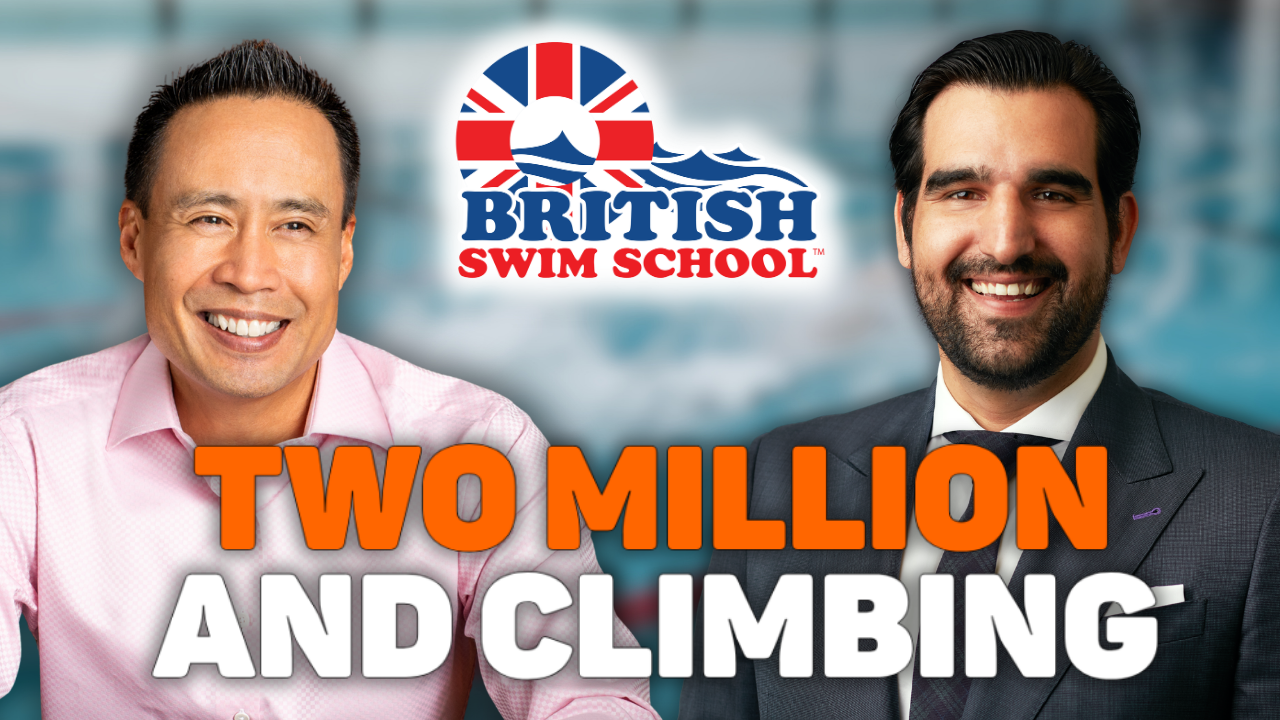
He Built a $2M Franchise, Then Hiring Became the Real Job
Nov 03, 2026This is a transcript from Episode 62 of The Franchise Champion Show.
Listen to the full episode on Apple Podcasts, Spotify, or YouTube.
Alan Regala: My guest today had already built and sold one business before he ever looked at franchising. After bouncing between roles one too many times, he decided to bet on himself again, and now he owns British Swim School locations across San Diego, Temecula Valley, and South Orange County. Jamal Motlagh, welcome to the show.
Jamal Motlagh: Thanks, Alan. Appreciate it. Happy to be here.
Alan Regala: All right. Well, I'm excited to hear from you today. It sounds like you've got a very interesting background, especially since you had already owned a business before going back into the corporate world and then jumping out and owning another business. I'd love for you to give me a bit of your background and tell us a little bit about that first business.
Jamal Motlagh: So, I grew up in Southern California. I was an athlete, similar to you. I played water polo in college and played semi-pro as well. I had Olympic aspirations but never got there. But I think being an athlete really was the basis of a lot of my success in business, for sure.
Alan Regala: That's awesome.
Jamal Motlagh: So I started my first business, custom apparel, out of business school. I graduated from business school in 2011 and started that business with the idea of how technology and clothing could come together, and how you could revolutionize or customize clothing. We used 3D body scanners, and the idea was to use digital technology to improve how patterns are made and how clothing is made, and to democratize custom clothing. Instead of spending $1,000 on a suit, could you spend $400? But more than that, it was about expanding outside of just suiting, which isn't as popular as it used to be 20 or 30 years ago, right? So how do you make custom denim, or custom polos, khakis, chinos, sweaters, all these things you'd wear outside of just a suit?
I had a co-founder. We eventually ended up opening a retail store in SoHo, New York City, which is still there to this day, focused on menswear and custom men's clothing. We had a really great run of it. We raised a few million dollars and spent a few million dollars, some of it poorly, and learned a lot through that experience for sure.
We ended up selling the business in 2016. It wasn't a huge win. We'd come to the end of our rope and our capabilities, and it was time to figure out what was next. I had just had my second child, and we had a partner who was interested in taking over, and they did, and they're still operating it. Every time I'm in New York, I get to go by the store and see what we built, which is pretty cool. People are still wearing our clothing, and I still have a bunch of it myself.
It was a great experience and a real challenge. That was true entrepreneurship, from an idea, a simple concept, to the name, the website, the brand, the logos, the designs, the manufacturing, the logistics, and building a retail store. We actually built an app in our store, and I think we were the first retail app with Square connections. Now every store has an app, and every store associate has one they're using, but that didn't exist 15 years ago. So that was something we were really trying to be innovative about in that space. A lot of learnings, a lot of lessons, a lot of challenges, but definitely an interesting part of my life for sure.
Alan Regala: We could probably have a whole episode just on that business, I'm sure. It's super interesting. I also had my own independent, start-from-scratch business out of grad school. You mentioned all the things, and you're in charge of everything, which gives you a lot of control, but it does mean you have to do everything.
Jamal Motlagh: Yeah. And you spend time on the wrong stuff all the time, right? Which I think is one of the differences with a franchise. Some of that stuff you don't have to worry about, so you aren't distracted by "Let's change this logo" or "Is this URL better than this URL?" Those things matter, but they take a lot of time and they aren't about finding customers, servicing them, helping them, and trying to do more and more.
Alan Regala: Yeah, I think you said it well there. You only have so much time in the day, so what are you going to focus on? When you have so much responsibility, oftentimes you focus on the things that feel important, and probably are important, but may not be the things that are driving profit and those long-term goals.
Okay, so you had this really cool business that you started and then sold, and kind of like me, it maybe didn't produce exactly what you wanted, as far as being that multimillion-dollar experience you could retire from. So you end up getting back into the corporate world. Tell me how you decided to go that route, and then what led you back into owning your own business.
Jamal Motlagh: Practically, I needed a salary. Two kids. I wouldn't call the startup a failure, but it wasn't what I had intended or hoped for as an exit, obviously, something life-changing. So I needed to get back into it. I did a little bit in retail with a shoe startup, and then I started working at my buddy's private equity firm, which was looking at different investments in consumer products. I ended up joining him as chief brand officer, helping him build a few different brands and consumer products, most of them in the wellness space. But I really bounced around between projects. From there I started getting into some other consumer products companies and wellness. We did some hemp CBD stuff in the early phases.
But the challenge with a lot of these startups is that one minute they're flush with cash and they have all these ambitions and ideas, and six months later it's the opposite. I really found myself bouncing around, sometimes twice within a year, between different companies. Again, it was the great times, when everyone thought these businesses were going to be huge and really successful, and it was kind of the buzz, CBD and that kind of stuff. Hemp was the buzz for a while, and super exciting. And being one of the higher-paid employees, you're also the first person they want to take off the balance sheet when there are challenges.
So I couldn't find the right fit, I bounced around a bit, and I ended up in a place where I was like, okay, I'm spending my entire day in meetings, going from one meeting to the next, and what work am I actually doing? I had great roles with ownership and management, but I was never running the ship. I was just always being told, "Okay, do this now," and then two days later, "Okay, now we're going to do this," going back and forth. The meetings really killed me, to be honest. All-day meetings, and I kept asking what the purpose of this was. That really got to my core, and I started thinking, okay, I'd love to be back in control of running and starting my own business again.
I don't want to do what I did before, which was start from scratch with a brand new concept, brand new idea, brand new sales pitch and market, trying to create something that doesn't exist. I want to do something that exists, something simpler, that people have been doing, that I can just plug into and succeed at. For a few years I'd been getting those LinkedIn franchise broker emails, whatever you call them. I always stored them in the back of my mind as, okay, that's interesting. I know franchises exist. People are obviously successful and make a lot of money doing them, and some are highly scalable.
I finally got to the point, after my fourth or fifth job in as many years, where I said, okay, I need to rethink what I'm doing. What am I building? What do I want to really be a part of? Is that something I can do working for someone else, where every minute things change? At the time, after my job, I was looking at other roles. I had a CEO role, again, that was going to be super exciting, but it was one of those things where they had a bunch of money and then it kind of fizzles out. I finally took the leap and said, "Okay, let me talk to some of these consultants." I probably saw seven, eight, nine business concepts, and took two or three of them pretty seriously. That process was super fun, by the way. From a business person's standpoint, it's almost like a case study. And then I really fell in love with British Swim School and decided to do that. We launched at the beginning of 2023, it's been a few years now, and I'm super happy about the decision and excited about where it's taken me.
Alan Regala: That's so cool. All right, that's awesome. So you were tired of bouncing around between these different roles, and you decided to relent to the multiple messages you were getting from people reaching out, the franchise brokers, franchise coaches, consultants, whatever you want to call them, and decided to give it a shot and take a look, right? That's awesome that it worked out and you found your fit. For people who don't know what British Swim School is, can you tell us what that is and why you chose it?
Jamal Motlagh: Yeah. British Swim School is a franchise business. We teach swim lessons, mostly to children, although we teach all ages and all abilities. It's a great program in the sense that, from a physical standpoint, we partner with a lot of existing locations and pools. We have existing corporate partnerships, so I don't have to build a pool. I can go into an existing gym, rent their space, and set up shop. So it's a lot of low overhead and low cost, high scalability without a lot of cost. That was something that really interested me.
But in the end, having been a water polo player, with swimming being such a big part of my life, I really connected with it. It has taken me around the world and given me all these experiences and all these life skills, and all of that came from the fact that, at some point, someone taught me how to swim, although my parents say they just threw me in and I kind of knew. With a lot of these franchise businesses, great businesses, there are positives and negatives. In the end, the product you sell probably doesn't matter as much to a franchise owner, but in this case, on the high end you might be saving a life, and on the other end, at the very least, you're giving someone a skill where they can go to a pool party, go to the ocean, have fun, become a lifeguard, use it as a career, join a swim team, play water polo, whatever it is. It's a skill you have for the rest of your life. Especially in places like Southern California, it's not as important as being able to walk, but it's pretty close.
So giving that to kids and adults, the whole age range, is a really wonderful mission and feeling that, to me, was better or more exciting than, I don't want to say negative things, but cutting trees or killing mosquitoes or painting parking lots. Those are good businesses, but this also had the added effect that it connected with what I've done my whole life, and the outcome was awesome and the experience is great too. You're mostly hanging out with kids at the pool, they're having a good time, and it's a fun, enjoyable environment as well. So I really fell in love with British Swim School, and I'm thankful that I found it.
Alan Regala: That is so cool. And I was going to ask, you mentioned you played water polo very competitively in college and beyond, and you mentioned a few other industries, like, hey, those are fine businesses too. I'm curious how much of your decision to go with this particular brand was the business model, the simplicity of the model, like you mentioned, low overhead, asset-light, things of that nature, versus your connection to swimming. I get very curious with people about how important that connection, that passion, if you will, is.
Jamal Motlagh: I mean, let's say I never thought about monetizing my ability to be good in the water. It was never, "Hey, I'm going to use these skills to make money somehow," at least not in a real way. It was a piece of it, and I don't know if it was the tipping point, but the business model was the most important. First of all, you have a certain amount of money you can probably buy in with, and obviously people take loans, which is available to them. But I kind of knew where I wanted to be from an investment standpoint. I did see a bunch of other businesses that were exciting, but to scale, they required an additional doubling of that investment.
If you want to go cut trees, you need equipment, trucks and vehicles and motors and ladders and whatever else you need. If you want to double your business, you need two of those, and then three, and then four, and now you've got $4 or $5 million of equipment and loans out there, or whatever it is. So the thing I liked about British Swim School was that the model is super scalable. What do you need to scale? You need people, which is very difficult, and I'm not going to undercut that. But I don't need to build a $2 million pool. There are franchise swim schools where you do build a pool, and that's a thing. For us, it's find another pool partner, open that location, and for a few thousand dollars I can have a second location running. I can scale with employees as opposed to scaling with a bunch of equipment and assets, which is a real challenge, because then you've got to be good at taking out those loans and paying them back and keeping that moving.
Versus, I've only closed one pool to date, and closing it wasn't a big deal. We just said, "Hey, we're not coming." We ended our lease terms and took all our stuff away, and that was it. And again, a lot of franchises have a retail location and you're locked into a five- or 10-year lease. If you chose the wrong location, or something happened to your street or block or sidewalk, your business is really impacted by things you can't control. That's all business, I guess, but in this case, if I chose the wrong location, it's bad, I've lost some time, money, and effort, but I'm not out on a five- or 10-year lease, having spent however much money rehabbing a building and fixing it up. So for me, the business model was super important.
I would say the product was important as well, not just because it was swimming. I looked at mosquito eradication, and I'm like, do I want to be known for just killing a bunch of mosquitoes? Not that I love mosquitoes, I hate mosquitoes. But, like, my purpose on earth is just to eradicate this insect. So the product being mostly kids swimming, enjoyment, happy, skill-building, saving lives, which is super critical, right? Drowning is still top five in accidental deaths for kids under five. It's a real problem still, and swim lessons are the solution to that problem, other than keeping kids away from bodies of water. That really mattered to me.
And then the last part was, okay, cool, I have this connection, and maybe it'll help the business to know I was a really good water polo athlete. I think in the first few months, when I was on deck interacting with parents, it gave me some credibility and some insight, like, "Oh, your kid can't do this stroke, I can help." I intuitively know how to do that and can teach them, even though I was never actually an instructor. So I think those things help. But I think if it had been basketball, I would've been just as excited, because the business was great and the product was great, as opposed to, "Oh, I love basketball, and I played my whole life."
Alan Regala: Well, you bring up two really important things here. One, I think it's making this distinction on passion. It's kind of having a certain passion for something beforehand and thinking, "Gosh, I really want to do this, whatever this business is, I should already be passionate about it." I think it seemed more like happenstance that this had to do with swimming, and your background had swimming in it. More importantly was the business model. You were excited about the business model and what that provided, which is the other point I'm going to bring up.
But the product, the service that you're providing, is something you believe in, something you can really get behind and feel passionate about, even if you didn't have it as a hobby or whatever beforehand. You just feel like this service is truly meaningful to the clients you serve, and that's something you can really get behind. And that, combined with the business model and all that other stuff, was more important than finding something that involved a hobby or a sport you were affiliated with. Does that sound right?
Jamal Motlagh: Yeah, I think that's right. I mean, you can sell anything if you know how to sell, right? But if you feel connected to it, it's more authentic and you're better at it. It's hard for me to quantify whether someone else who didn't love water polo and swimming as much would have been as successful if they took over and did what I did. Probably. Did it help me? I think it did, in undefinable or intangible ways. It gave me confidence, and some feeling that I knew what I was doing, because I'd experienced stuff like that before. But in the end, it's a business. You've got to make the money and the numbers work.
If you like what you're producing and selling and have some connection to it, that does help. But it wasn't a defining reason for why I chose this business, and I don't know that it should be. People say, "Love what you do and you'll never work a day in your life." I don't know if that's true. In franchising, I love playing video games, and there's probably a video game franchise where you come with a truck and set up for birthday parties, but I wouldn't use that as the number one factor. Being connected to the product, or feeling good about it, helped, though. I didn't feel great about killing mosquitoes. Or I don't know anything about trees, so the learning cycle to learn about trees and different types of trees, because all businesses are going to require some subject-matter expertise, is higher than being taught how to teach swim lessons, which was an easier thing to do, maybe. Or maybe easier for some, harder for others.
Alan Regala: Quick pause. Wouldn't it be great to run a business that gives you real purpose, like saving lives, and makes you great money? I'd love to help you find that right franchise. I'm a former franchise owner, 14 years with a multi-million dollar exit.
First, I learn about you, your goals, your skills, your investment level, and then I match you with a handful of opportunities from over 600 brands. I support you all the way through the process, and you get to decide if franchising is your path forward or not. My service is completely free. I'm only paid by franchisors after you find the right fit and if you move forward.
Book an intro call today. Just go to athletetoowner.com/fit. Now, back to Jamal.
Alan Regala: Yeah, and the other thing you brought up, which I think is huge and a lot of people don't think about at the early stages of exploring different options, is scalability. Some businesses are just way easier to scale than others.
My business, ShelfGenie, was a home improvement business that was very similar in concept to what you do at British Swim School, as far as the ability to scale. We were helping people in their homes, so it was a home-based business. We didn't have a retail location or even an office, really. We just worked out of home offices, and product got shipped to our installers, who brought it over to people's homes. It was small enough that they didn't need giant trucks or vans to carry everything.
So to scale, it was simply adding more zip codes and hiring people, the team aspect, like you mentioned, to cover those areas. It's pretty great to be able to scale without having to buy more vehicles, set up a new brick-and-mortar location, or buy more equipment and any of that other stuff. That's huge.
Jamal Motlagh: I agree. I think it's definitely worth thinking about. I'm sure they exist, but franchises where you only have one unit or one territory and you're super successful with just that one? If you live in New York City, you can probably crush it in one little area or zone. But most of them are going to need additional territories, additional expansion, additional people. You have businesses that require expansion through capital and investment, like retail stores, building out stores, restaurants, food trucks, whatever it is. And then you have others that are a little more about people, and both need people, obviously.
To me, it was important to ask: if I want to get this from the tier one level to the tier two level, how are people doing that? What does that look like? How expensive is that? There are totally different versions of it. Some you just need to buy another van, and that's maybe $50,000, which is not nothing. But it's also not buying a $250,000 piece of equipment, or putting five months down on a lease and then spending hundreds of thousands to renovate a physical retail store. And those are all things you can't really take away with you when you're done. A van, I guess you own, so you can do that. But having run and operated physical spaces before, that's a challenge I don't think people who haven't done it understand. At any time there could be a problem, a leak, a window, people don't show up, this breaks, that breaks. And that's in addition to operating the actual business itself, whether that's food or whatever it might be.
Alan Regala: That's a good point. Even if the store isn't open, it's still something you've got to worry about, because, like you say, a leak or something else could happen. Wow.
Jamal Motlagh: And I worry about our pools with our pool partners all the time. But if there's a huge leak or the heater breaks, it's not necessarily on me. I have to change and cancel and do things for my customers, which is very painful. But it's not like I now have a $50,000 water heater issue that I've got to fix. So that was very attractive to me, in addition to the life-saving aspect of British Swim School.
Alan Regala: Sure. So what was the biggest fear you had going into this, and how did that play out?
Jamal Motlagh: The biggest fear was whether this was the right business for where I was trying to go. You're in San Diego, there's a ton of other swim schools, a lot of competitors. You're looking at a territory map from the franchise owners, here's where kids are in different zip codes, and you're trying to take this conceptually large issue and ask, okay, is this the right decision? Are these the right zip codes? Is this the right territory? Should I start here versus there? Is there a need for more swim schools? How do the swim schools that are already there exist?
So the whole thing was one big leap of faith. Am I making the right decision? And within that, we had three pools we could open with. What's the right pool to start with? That was probably the biggest question. Which one should I open with? Luckily, I got that right, and it made a real difference for my business. Had I opened a different pool, which we eventually opened later, it just wasn't as successful, and my business would've probably taken a lot longer to grow and scale.
There are probably 10 of these decision points for every business, where you just have to jump in with the limited information you have and go for it. If I'm thinking about retail stores, why this location versus that? Other than the rent, there's parking and traffic and what it's next to. All those things matter, but putting them in a pot and trying to decide yes or no is a little bit like putting your finger up to feel which way the wind is going.
I think that's what's scary about any entrepreneurship, any business. There are a bunch of decisions you have to make with limited information, and if you don't make them, that's a decision in and of itself, and it could be hurtful. If you're not comfortable making decisions in that kind of environment and dealing with the consequences, it's going to be a challenge and you're going to be stuck in limbo a lot. The beauty of a franchise is that you have a lot fewer of those. When you start your own business, you have a million of them. When you start a franchise, you have 50, which is way less and way more controllable and ownable. I'm a huge believer in franchise businesses because of that, because it lets you focus. You do something that works and just make sure you can achieve it.
But yes, where to start was definitely a question. You look up swim schools in San Diego, there's a bunch of them. So what was I going to do that was different or better than everyone else to be able to succeed?
Alan Regala: Yeah, I'd love to hear more about that, because that's a fear a lot of people have. They find a brand, they look up their area, and they say, "Wow, there are already a dozen of these," or whatever it is. How do you decide whether it's saturated or not? How do you decide whether there's room for more?
Jamal Motlagh: It's hard. Partly it's understanding where you live and what the dynamics are geo-culturally, I don't know if that's a word. I've seen other people open swim schools in other locations, and I've asked why I was successful and they weren't. They had different cultures, different states, different interests, their setups had more local pools versus not, whatever it is.
So there's an aspect of knowing where you're trying to open this and what the overall need for the product and business is. The beauty of swim school is that every year there are new kids born, and those kids need to learn how to swim. Even if I don't have the kids now, can I compete for the new kids coming up? So part of it is knowing where you live, what people are going to want, and what their needs are, to a certain extent. Part of it is whether your product is better or differentiated than everyone else's. Are you just another version of what already exists? If you are, maybe that works, but then you have to make sure you have the nuances of location and all that kind of stuff.
And at some point it's about taking the leap and making decisions when you don't have all the information and there's no clear-cut answer, like "Yes, this town needs another coffee shop," which it probably doesn't. But they keep opening coffee shops. It's kind of crazy. Some franchisees, I'm sure if you go to McDonald's, have much better analytics. They can put in how many people live in this zip code, what the five-minute radius is, the household income, how many other quick service restaurants are there, how many sell burgers. They probably have some sort of formula that says this location is going to be more successful than that one, or has a better chance. But there's still that last little leap of faith you have to take, which can set people back or stop them from actually doing it.
A lot of that you really won't know until you're in it. That's the risk. If there was no risk, everyone would do it. In the end there are going to be some risks and some challenges and some decisions made with little to no information, or less than you want, and you just have to feel it. And you hope your franchisor can give you some insights and set you up for success. That's really about who they are and what their focus and goals are. In the end, hopefully they're making money not from selling you the franchise, but from your success and their royalties off of that success. If it's just about selling the franchise, their job is done as soon as you sign that document, and it's on to the next one. Versus, yes, it costs a lot of money, but we also put a lot of time, effort, and energy into you and getting you there. Once you're there, we need you to succeed so we can also succeed.
You want that relationship, because if you don't have it, and they just want to sell you that extra territory, or sell you more napkins or whatever it is they produce, that's not where you want to be. Your success and their success aren't aligned. So you want to have some alignment, or feel like there's alignment, because you won't really know until you're in it. One of the big things is talking to other owners and trying to figure out where the franchisor is, how they're doing, what their strategic goal is, and what they're trying to do.
Alan Regala: Well, tell me more about this. I agree, a good franchisor will support you as you're getting up and running, and continue that support. They should be trying to make their money on royalties and your success, not just that initial franchise fee. So tell us a bit about British Swim School, how the franchisor supports you, and what the culture is like among the owners. And I'm going to throw one last thing in here. A little bit about the differentiation you mentioned earlier. Are you going to be the same as everyone else, or is your product different? I'd love to hear what you guys do differently.
Jamal Motlagh: Having a franchisor that supports you and is there for you is obviously critical to your success. They're always going to want more franchisees, because that allows them to be more successful. So there's always a little conflict between "I'm an existing franchisee, I want you to spend all your time on me and having me be successful" and them saying "we also need to go sell more franchises," because that's how they define success.
British Swim School was originally started by Rita Goldberg in England. She brought it to the US and ran it for probably 20 years, maybe 30 years. It was bought in the last seven or eight years by Buzz Franchise, which is kind of a private equity franchise conglomerate, where they have a few different brands below them. The owners have had success in other areas of franchising, which has been great as well.
From a Buzz standpoint, they've been great at getting you set up. I guess there are two or three things you care about. Product, the actual thing you're doing and selling, and what that looks like. Operations, meaning how are you booking, how are you collecting payments, what does the system or systems look like. And then marketing is probably the third major bucket. A lot of franchisees run their own marketing program, so what does that look like, and how are they doing in that category? A lot of the time you're just paying them money, with some input, and hoping that it's successful.
From a product standpoint, that's where research comes in. You talk to other franchise owners, you go on websites and see. British Swim School specifically, the product is amazing. If you teach kids the way they taught me to teach kids, the kids are going to learn, they're going to grow, they're going to succeed, and they'll do it in a reasonable amount of time. And one thing about the program is that it's been around for 40 years, so it's gone through a lot of iterations. A lot of the other swim school programs are based off of what Rita did so long ago.
One of the things we talk about a lot, and I'm sure others have something similar, but it is important to us, is a concept we call Showtime. There are different ways to teach swim. There's a way where you throw the kid in the pool and it's sink or swim. That works, but it can also be infinitely traumatic. There are people who say, "Yes, it's a tough love kind of thing." The way we teach it is fun, gentle, and simple. We think that if the kids are having a good time, they're going to be engaged and they're going to learn more. Parents are happy they're not dragging their kids to swim practice, all that kind of stuff.
So Showtime is not just about knowing what to do at the five-minute mark and the 15-minute mark and the 20-minute mark of a lesson. It's how you're performing. Are you singing songs or playing games? Are you engaging? Are you meeting the kids at their level? I've been to swim lessons where the instructor looks like they don't want to be there and their face is stone cold, and that's bad for everyone. It doesn't create any energy, no one's excited, and you look like you're doing them a disservice. You can be good at teaching the lesson, but you're not an excellent teacher until you have some of these less tangible things.
That's a big thing for British Swim School. The product is amazing, and if we teach it with gusto and excitement, and the instructors are having fun and the kids are having fun and the parents are part of it, all of that matters. It also helps me sell the product for a higher price. I don't want to downplay a community pool, which has some lifeguards teaching lessons, but they do 100 things and this is one of them. It's not as much of a focus as it is for me, where my only business is teaching swim. I'm not making money off any other thing, really. So product is super important.
Then operations. How are you booking lessons? How is the website built? That's more challenging to understand from the outside, what that looks like and how good it is. Do we use tools that I wish we had better tools for? Yes. We have some systems that are a little older and outdated, and it's always a push to get them updated and fixed. I understand why they don't want to change them, because they work. It was a bit of a learning curve to figure out the logic I had to use for a program that was probably built 20 years ago, and make sure it flows. So operations are super important. What's the phone service? What's the website? What's the booking and scheduling service? All those things matter. They give you a template, you can add some stuff on if you want, and in general most of their templates should work for you. But if the product's good and you can't deliver the product or the service, it doesn't matter. That's a super big part of it.
And then the third bucket, marketing. If you have the first two and you don't have the third one, it's going to take a lot longer. Everyone's going to say they're great at marketing, and it's hard to quantify what that means when you're on the outside. Talking to other owners during the process of getting into a franchise is super helpful. What are they doing for marketing? Do you feel like your money is being well spent, or is it just being spent? Is it self-service? Are you doing a lot of work, or are they doing all the work? You want to really understand that.
Buzz and British Swim School have gone through a few variations and edits of that, and I think there are positives to having it in-house and positives to having it not in-house. The landscape has changed a bunch. Now you're talking about AI in marketing, and websites are very different. Cookies are very different. My leads have gone down significantly in California, because now you have to opt in to being tracked, and who's opting in? Last year you were spending X and getting this many leads, and now you're spending X plus and getting fewer. Is it fewer because they don't exist, or because they don't allow us to track? That's a fundamental challenge, and whoever is doing the marketing needs to stay on it.
In the end, one of the big franchise benefits people will sell you is that a lot of mom-and-pop businesses get sophisticated operations, websites, and marketing capabilities for something that was typically two guys doing it on a phone. If you're a plumber, you're just responding to people calling you, versus marketing plumbing services in a way that gets you more demand and more interest. That's the fundamental pitch for a lot of franchisors. The business model works, we'll give you the toolkit and the business in a box to set it up, and we're going to bring better marketing than some other person.
That's a little less certain now, because there are so many franchise businesses. If I'm competing against a local swim school, my marketing is going to be deeper and more powerful because I have a team they probably don't have. But if I'm competing against another franchise swim school, which obviously exists and there are many of, my advantage in marketing isn't that high. My advantage needs to be in product, and in how we hire, train, and teach the lessons, versus just spending more on Google because you're not spending any money on Google.
Alan Regala: That was great, and you led me to the next thing, which is your team. You just mentioned the people you hire, the ones out there providing the service to your clients. Tell me a little bit about that demographic, who it is you're hiring, and what you've learned about hiring, training, and managing your instructors.
Jamal Motlagh: One of the things I totally mistook when I started the franchise was this. I looked at reviews of other businesses, and one of the common negative pieces of feedback is that the instructor keeps changing. "I've had three instructors in three months and my kid can't get used to them." I thought, we're not going to be like that, we'll have the same instructors, no problem. And boy, was I wrong about how challenging it is to hire, train, manage, and keep really good instructors.
It's for various reasons. For our business, the instructors are part-time, and a lot of them are students, whether high school or college. The job is not their number one priority. Frequently it's not even their number two priority. So when their whims change, or their schedule changes, or a party comes up, it's easy for them to say, "I don't need this to feed myself." It's for pocket change and fun money, maybe. Some of them do need it to pay for school, but for a majority of them it's not a requirement for their lives. So it turns out to be very difficult to keep them excited, engaged, and happy, and to keep them showing up at 8:30 on Saturday and Sunday mornings to teach swim lessons.
That was a real, real challenge. I will say my first employee is still with me. She's now my aquatics director, and she's been amazing. She was very young, in her first year of college when she joined me, and she didn't even finish college. Now she manages a team of 40-plus employees, and she's a total rock star. She's gone from being a swim instructor to literally managing multiple locations, multiple managers, and multiple teams, dealing with the complexity of it. I got extremely lucky that I found her and hired her, and I think I did a good job of keeping her engaged, keeping her growing, and increasing her salary and hourly rates, so she wants to stick with us and grow with us. I hope I continue to do that.
Having that first employee be crucial and amazing allowed me to separate things. She was in the water, I was on deck and on the phones. She was able to deliver the product well, and I was able to sell our product to other people and bring them in. So I got extremely lucky. I know that's not typical. I've seen a lot of other businesses not succeed because they didn't have good employees and good people.
It's a lot harder when you're smaller, and I found that scale really helped with this problem. When you're really starting out and you only need two or three people, you're super reliant on them. That's great, but as soon as one of them leaves, that's 30% of your workforce. At least in our business, it's not like I have a good Indeed interview and I'm hiring the guy two days later. Maybe I do, but I still have a month to train him before he's valuable to me. I'm spending all that money on training and doing everything we need to do, in the hopes that, one, they'll be good, and two, they'll stay with us. It was a real challenge in the beginning, because we didn't have full-time hours. You can't find people who need to work unless it's a second job, and if you find that, it's generally useful and helpful. But finding good people, keeping them engaged and trained, and then being able to refresh and replenish and keep going has been a challenge.
Through scale it's become easier. We're not always hiring, but I've always got job postings out and we're always collecting resumes. We know where the dips and troughs are, like school changes and summer. So we have a better way of saying, "Okay, I think we're going to need employees." I still do all the first-round interviews. I put the posting out, find resumes, and interview people. I probably have a 50% rate of people showing up to interviews they've scheduled themselves from my calendar, and it's probably less than 50%, to be honest. It's a real slog. We pay better than most of our competitors, and better than most first or second jobs, I think. But finding them, training them, and then keeping them trained and happy is a real, real challenge. In the end, the product is important, but if the person delivering the product is not any good, the product sucks.
I guess that's any business. Other than if you're selling electronics, where you're not making the electronics, I'm sure there are other examples. But if the guy can't make the hamburger well, the hamburger's not going to turn out well. Teaching swim is a lot more involved and complicated than the steps of making a hamburger. If the people aren't good, if they aren't happy in the water, if they're not teaching the lessons well, if they're showing up late or canceling last minute, all those things are real. That's the flip side of a people-centered product. If you don't have the people, the product isn't any good.
It's been my number one challenge. It's continually a challenge, and I don't think it'll ever not be. It's even more crucial when you're smaller, to have the right people and have them involved.
And from an owner standpoint, there are franchises that sell and say you can still work your nine-to-five job and run this business. Maybe that's kind of true, but are you going to be good or successful at running that business? How much more successful would you be if you're involved day-to-day? For me, a big step was that this was my focus. I wasn't doing other things. I was on the pool deck when I needed to be. I was on the phones at all times, because who knows when someone's going to call. That's part of it, because then you understand the business, and you can understand what makes a better employee, what kind of training they need, and how to manage them. It was a different type of person than I was managing in my corporate days, with different needs, different salaries, a different life. So it was eye-opening for me. I think it's everyone's challenge, especially if you're hiring hourly employees.
Alan Regala: Yeah. Well, thanks for sharing that. It's something I think a lot of people have concerns about, hourly employees, and especially younger folks. What it sounds like, at the end of the day, is that through experience, unfortunately, your earlier expectations were different from reality. It's hard to have the kind of consistency you would like and the parents would like. But it comes down to creating systems and processes for recruiting. You have to have a pipeline. You're always recruiting. You don't always have to hire, but you always recruit, so when you need to, you can pull the trigger and it's just part of the process in this industry. And there are others like this as well. People just have to have that expectation upfront, that it's going to be part of it.
Jamal Motlagh: Yeah. You've got to put the effort in. You've got to have a plan. There's no quick solve to this, and no marketing gimmick that's going to get it there. I hear it from every other franchisor too: "People, people, people, that's the issue always." It really will differentiate success from failure. Getting good at hiring, getting good at managing, and sometimes you've got to fire people, takes effort and experience. I think it'll still be part of my job five or 10 years from now, just making sure that's going well. Because in the end, if it's not, everything else kind of crumbles from there.
Alan Regala: Well, one thing I don't want to miss here. You've been crushing it at British Swim School, one of the top producers in the system, President's Club two years running. Would you mind sharing with us maybe some of your numbers?
Jamal Motlagh: So this is our third full year running. This year we passed 1,000 enrollments, so more than 1,000 kids enrolled at once. I think our highest was probably 1,250, although it fluctuates month to month, and we're in the slower months now. We've done over $2 million in revenue this year already, which is not double last year, but it's getting close. I can't say we've doubled every year, but it's probably 80% plus every year.
This year I took over our second franchisee. I've now bought two other franchisees out, and Orange County was an addition to that, so we're expanding a little farther north from where we are here. We've got 11 pools and 40 to 50 employees now, with over 1,000, 1,200 kids, like I said. It's been super successful. The margins have been pretty decent as well, and a lot of that comes down to how fast you scale employees and making sure those numbers work.
My focus has been aggressive expansion, because the limited resource I see is indoor pools. You can do swim lessons outdoors, but it's not as good, and in December you're not going to have many kids. So we focus on indoor pools. In Southern California there are pools everywhere, but why build an indoor pool when you can use an outdoor one nine months out of the year, generally? That, to me, was our limiting factor. There are only so many indoor pools, and there are other people who want to use those pools for similar reasons.
So my strategy has been to expand when I think we can, even at the cost of our margins sometimes, because I've found some of these locations might take a year or a year and a half to really ramp up. And I've had other pools where you get in there and three months later it's humming and buzzing, and you say, "This is great, and it's going to be gravy." I've seen other pools that are a little slower, and if I judge them against my successful pools, I'd say, "Let's get these out of the system, because they're not anywhere near as profitable." But what I found is that over time the enrollments start building and the momentum builds. There are pools that two years ago I would've said, "We should probably close this," that are now really big, really profitable, really great for us.
So again, my strategy has been to expand, try to grow, and acquire some of these other owners who weren't as focused on the business as I was. Bring those businesses into our fold without having to add a bunch of additional backend costs, and keep growing and expanding to a point I think is reasonable. I don't know if we're going to go geographically much farther than we are now. It's hard to send someone from San Diego to Orange County. Not that we do that all the time, but you need to manage and stuff like that.
But we've had a ton of success. More than my financial success, I think my work-life balance success is even higher. I work when I want to work. Nothing is really reliant on me other than billing and some stuff like that. They need me when there are emergencies, and I'm always available for them, but that doesn't mean I'm working, if that makes sense. I can pick up kids and take them to practices. If four o'clock comes and my kids aren't in an activity, they're here hanging out with me. That's not what it used to be, or what it would even be if I worked at one of my other corporate gigs, where you're busy until 6:00. Also, I traveled a bunch at those jobs, jumping on planes and going for three, four days. I barely travel now, other than when I want to.
In that sense, financially we've been successful. I want to be more successful. I want to get bigger. I want to become the biggest swim school operator in Southern California, if I can, that isn't a city or a county. But the non-tangible life benefits have outweighed even the financial ones, to be honest. Having that freedom, being able to be and do what I want, where I want, and knowing that the business runs. That doesn't mean I'm absentee. I'm very involved, but it doesn't require me anymore to run. It requires me to scale and do some stuff, but on a day-to-day basis, if I went two days and didn't turn my phone on, it's not going to be the end of the world. My team's going to get through it, and we're going to figure it out, and kids are going to learn how to swim.
Alan Regala: That's what it's all about right there.
Jamal Motlagh: That is the win in my book. Being able to have a good life and enjoy it, and not have to clock in and clock out all the time.
Alan Regala: Love it. Well, thank you so much for joining me today, Jamal. I appreciate you sharing your nuggets of wisdom about British Swim School with all of our listeners, and congratulations on being a franchise champion.
Jamal Motlagh: Yeah. Appreciate it. Thanks for your time. Hopefully this was helpful and insightful, and I encourage people to look into franchising. Check out British Swim School.
Don't miss a beat!
We hate SPAM. We will never sell your information, for any reason.