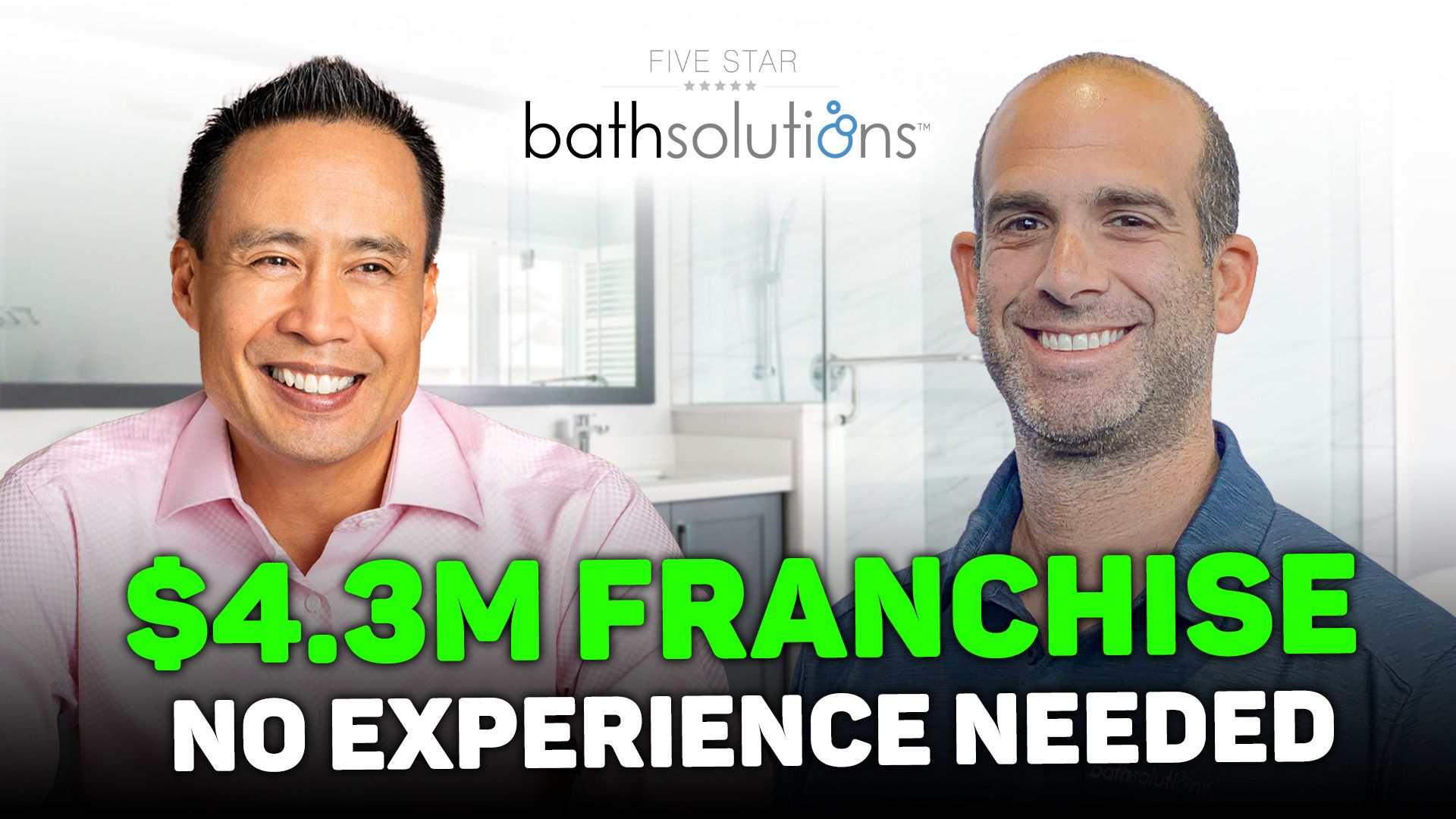
Corporate M&A Exec Builds $4M Bath Franchise
May 19, 2026This is a transcript from Episode 38 of The Franchise Champion Show.
Listen to the full episode on Apple Podcasts, Spotify, or YouTube.
Alan Regala: My guest today walked away from a high-powered corporate career to bet on himself, and in less than two years with Five Star Bath Solutions of Orange County, he's built something that most seasoned business owners would envy. Mike Sarfity, welcome to the Franchise Champion Show.
Mike Sarfity: Thanks for having me, Alan.
Alan: It's great to have you here. I'm excited to learn more about your history and your business. Take us back to before franchising. What were you doing, and how did you get into this?
Mike: Yeah, interesting you ask. So I was in corporate America. I was at a Big Four consulting firm doing mergers and acquisitions, doing the standard 60, 70, 80-hour week.
Alan: I don't know how you did that.
Mike: It was brutal, but it was kind of par for the course. I was on the path to partner, and if you wanted to make partner, you really had to put in the hours, satisfy client needs, and grow business.
I want to say it was my daughter's seventh birthday. It was the weekend, and I had all these deliverables due on a Sunday morning, which was kind of ridiculous to begin with. I was just working away at like one in the morning after the party ended, and my father-in-law came in and said, "What are you doing?" And I kind of had this moment where I was like, what am I doing?
I realized I needed a little more control over my professional destiny. I think I was going to be dead by the time I made partner, and I just wanted to do something else. I felt like I was starting to miss a lot of time with my family, whether it was traveling or these crazy deadlines.
So I continued working at my job, but I started looking into other businesses. My thought was I'm looking for a boring business -- something I don't need to be a genius to master, but something that fills a real need. Everyone is into AI and cutting-edge technology, but there are still a lot of more basic needs that people have.
I went down that path and looked at different websites. I looked at coin-operated laundromats, food trucks, a lot of things. Then I met someone who was a franchise consultant -- not a business development rep for a specific brand, just a consultant who thought franchising might be a good fit for me.
At first I wasn't sure, but we spent a couple of hours over about a month chatting. He came back with a few options, with Five Star Bath Solutions being one of them. We honed in on in-home services -- things without a massive startup cost and businesses that had a level of maturity, where I wasn't starting from scratch. If I was going to take this risk, I wanted a proven model that I believed I could implement.
The options he presented were Five Star Bath Solutions, a roofing company, a pipe cleaning company, and an alternative-to-epoxy flooring company. I met with all of the leadership groups and really just resonated with the Five Star Bath Solutions team.
Alan: What was it about them that you liked?
Mike: They seemed very put together. They'd been in business for about eight or nine years before I came along. One of the other companies had only been around about six months, and you could just tell -- you'd basically be a guinea pig. Especially in California, where a lot of rules differ from other states.
Five Star Bath Solutions had solid unit economics. One of the other companies was projecting a 40% profit margin, and in my head I was thinking, in home services, that's just not realistic. Five Star was more straightforward and honest about the numbers.
I also thought about it from a consumer standpoint. If I had to choose between redoing a roof, doing epoxy floors in my garage, or redoing my bathroom, the bathroom had a much more universal appeal. There's an obvious need and a clear want there.
And the leadership -- the president, Dean Hartley, is someone I can call almost any time of day and he'll pick up and spend an hour with me. He's not just doing that for me, he does it for everybody. He really believes in what he's built. And everything they told me going in has been pretty much true. I can't think of a single line that turned out to be just a sales pitch.
Alan: That's great to hear, because definitely not everybody can say that.
Mike: And it's not just me that benefits. There are business coaches, sales coaches, marketing coaches, production coaches -- coaches for a lot of my managers too. When I joined, they explained that yes, you're running your own business without a safety net, but there are a lot of resources here. And everything they promised has delivered.
Alan: That's really interesting -- having coaches available for your leadership team is pretty unusual. So tell me, you mentioned earlier that you're probably the world's least handy person.
Mike: Yeah, I told some of my friends about this franchise and they all looked at me like I was crazy. Screwing in a light bulb is a challenge for me. They were thinking, you're walking away from a good living, a prestigious title at a prestigious company, to do bathroom remodeling? And honestly, every time I have a home project, I have to bring a friend over because I don't have the skill set to do it.
But it's not about installing. It's about running a business. And the franchise helped me find good sales reps, helped me evaluate installers -- things I would have had no clue about on my own. When I was looking for my first installer, the production coach told me he thought the first candidate was overselling what he could do, and that the second was more humble and would be a better fit. I'm just reading a resume and listening to someone sell themselves. Hiring is a crapshoot in general, but especially for a function I don't understand the intricacies of.
I still meet with other franchise owners once a week. We talk through whatever's going on -- seasonal trends, macro and micro conditions, things we're implementing. I meet with my coach once a month. My team meets with their coaches as needed, and if we've had a dip and want to reset, sometimes we'll all get together with the corporate team and walk through our challenges.
Not that we can't solve things ourselves, but it's good to have an objective voice. Sometimes you start defending why things are the way they are, and when you talk to someone who's not part of it, they can look at the numbers differently and give you feedback or share what's worked elsewhere.
Alan: Having both the community of other owners and the perspective from your franchise coach -- I think that's one of the things I really love about franchising. There's just a lot of support and peer knowledge sharing.
Mike: And no one's hiding trade secrets. When the brand does better nationally, it does better locally. Everyone's rooting for each other in their own way. No one has anything tucked away in their back pocket. Everyone is pretty open about what's working and what's not.
Alan: Okay, so I want to circle back to this -- you had no background in home improvement or remodeling. What was that like going in?
Mike: I mean, I can talk about it, but if you had me install your bathroom, you would not be happy. And I think that's actually one of the really cool things about franchising -- it makes ownership accessible to a lot more people. You don't need experience in the specific industry.
Alan: Was that scary, or did you feel pretty confident because it was a franchise?
Mike: Definitely scary. It's like jumping off the high dive for the first time. You get your foot to the edge and you're like, am I really going to do this? Am I crazy? But if you just rip the band-aid off and go, it's going to be okay.
I'd gotten to the point where my other career just wasn't worth it to me anymore. So I kept telling myself, what's the worst case? This fails, it's a complete and utter embarrassment, and I go find something else to do -- which I believe I could. The rock bottom isn't as rock bottom as you're making it out to be. And that was the courage I needed to jump off the cliff.
Once we started, we had a huge checklist of things to do -- with the state, vendors, systems like QuickBooks. Each week you'd start to feel a little better about getting set up. Then right before launch, I went out to Michigan with the corporate team and we spent about 50 hours that week going through everything again. Not that I didn't know it, but we went through it at a much greater level of detail. That really gave me confidence.
We kind of hit the ground running. You know, I sold services in the M&A space, but those sales cycles are months long or more. In home services, the sales cycle is 90 to 120 minutes. So as much as I knew about sales, I didn't know much about this type of selling. It's very different.
But once we got going, it was like the basketball player who hits a few shots and suddenly can't miss. Confidence built. Those first seven or eight weeks were great.
Then we started doing installs. We had stayed about eight weeks out in the beginning to make sure the installation team was ready. The first project went well, and we started ramping up. But pretty quickly I realized I didn't have the skill set to directly manage the installers. When they had technical questions for me, I had nothing to offer.
Alan: What did you do?
Mike: The biggest thing we did was bring on a production manager -- probably earlier than most would. I just knew it was a skill set I didn't have. I hired someone who had run his own construction company for 20 years. He loved the construction side but didn't enjoy the selling side. So I told him his only job was to communicate with the production team and the customer, handle whatever challenges came up, and break it down in a way anyone could understand.
Once that piece was in place, I felt much more comfortable. We were taking deposits, and now I was confident we'd deliver a product we could be proud of. That was the really big scary moment -- about two months in.
And as we've grown, we know what to expect. We rarely see a surprise anymore, which has also calmed the nerves.
Alan: Yeah, you're drinking from a fire hose in those first few months. The real learning happens once you're actually out there doing it.
Mike: Absolutely. Make a few mistakes and you learn not to make them again.
And not having the technical background actually turned out to be a bit of an advantage -- it forced me to hire earlier and stay at a higher level. When I started, I helped with outbound calling, some material ordering and staging in the warehouse, building pay sheets. But now I don't order materials, I don't do project management or production scheduling. I have four people making outbound calls to leads. We have between four and seven sales reps depending on where we are. I've been able to build out a shows and events team. And as that manager grows into the role, I'll eventually step back there too and find the next strategic thing to focus on.
I'm happy that I'm out of a lot of the day-to-day. And I think not having that technical background helped me get there faster.
Alan: That's a really good point. Someone who comes in with the technical background might wait too long to hire and end up too deep in the weeds to step back.
Mike: It's funny you say that, because stepping back is something I deal with every day. I know enough about every area now where I can challenge timing or approach, but I'm happy being a step or two removed. And I think the team is too -- nobody wants me watching over their shoulder all day.
Quick pause -- if you're grinding 70-hour weeks and watching someone else build equity, that's exactly the problem I help people solve. I work with driven professionals to find the right franchise opportunity, and I do it at no cost to you. Head to athletetoowner.com/ready. Alright, back to Mike.
Alan: Okay, so let's take a step back. Tell us what Five Star Bath Solutions actually does.
Mike: Five Star Bath Solutions is a bathroom remodeling franchise focused mostly on the wet area -- meaning the shower and bathtub space. There are niche players like us and then general contractors who are jack-of-all-trades. We're more of a master of one. We've started doing some dry area work too, like vanities and flooring, because customers sometimes need more done in a small space. But we really stick to shower remodels.
One of the things we're proud of is that a typical installation -- a tub-to-shower conversion, shower replacement, or similar -- we can usually complete in two to three days, which is significantly faster than most general contractors. I think of us almost like a Ford assembly line. Our installers only do installs, nothing else. They can execute with a high level of proficiency and efficiency.
About 85% of what we do is wet area remodels. If you want something done right, wouldn't you want someone who does only that one thing? If you were having heart surgery, you wouldn't bring in a general surgeon -- you'd bring in a heart surgeon. That's the pitch.
There is a stigma in home services. Everyone knows someone who got taken advantage of by a contractor. So we're dealing with that uphill battle every day -- proving that we're a company that stands behind what we do. But I actually enjoy that challenge. We're not Apple or Nike. We don't have that brand recognition. But we're woven into the local community. When you're a customer here, everybody knows who you are -- from the installers to the sales reps to the call team. You're more than just a number. And there's something rewarding about earning that trust from scratch.
Alan: What's been the biggest surprise coming from corporate America into this world?
Mike: Managing people -- and the funny thing is, I used to manage a lot of people in my old job. But this is a different type. In corporate, it was mostly white-collar. Here it's a mix of white and blue collar.
In the corporate world, when I sent an assignment to someone, they'd deliver it with 30 assumptions documented and a full explanation of their reasoning. That doesn't happen here. A lot of times when you ask someone to do something, they'll do exactly what you asked -- nothing more, nothing less. In the beginning I'd think, how come we didn't think about the next step? And then I realized, that's just not this world. That's not what they're paid to do. It's my job to think three or four steps ahead and give them that information. That was a bit of a shift.
The other surprise was working with our customer base. Most of our customers are 65 and over. Great people, just from a different era with different expectations. Sometimes a customer would finish a project and hold off on final payment because they wanted something added after the fact. And I'd be thinking -- we just built this whole shower for you. But I understand it now. A lot of these folks have a stigma about home services. Once I pay, I'll never hear from them again. That's just not true for us, but they don't know that yet.
Dealing with that was a learning curve. But we've gotten used to it and we're more prepared now.
Alan: The bar for customer service in the home improvement industry is pretty low. There are a lot of bad experiences out there.
Mike: Absolutely. And I kind of enjoy having to earn it. We're not the biggest fish in the sea on day one. There's something rewarding about proving your worth every day.
Alan: Mike, would you be willing to share your financial performance over the first couple of years?
Mike: Sure. We launched at the end of April 2024. From then through the end of the year, we did $1.9 million in revenue.
Alan: Wow.
Mike: In the 2025 calendar year, we did $4.3 million in revenue. And this year, from January 1st through about April 28th, we've already done about $2.3 million.
We've really been fortunate to have a great team that believes in what we do. The numbers have been great, and I think everyone gets excited about them. We're pretty transparent -- we share that information with almost every employee in the company. We want them to see the growth. For our management team, we've come in and taken market share. For the people installing and calling, we're making an impact in people's lives.
Last year alone, we installed bathrooms for 242 customers. That's a lot of bathrooms. Some people wanted to refresh their home, but others couldn't step over the tub. Bathing was a real challenge for them, and we were able to solve that problem. The numbers are great and we're proud of them, but we're always grateful that we're helping people with problems that many of us haven't faced yet.
Alan: That's fantastic. And you combine the business success with what you're really doing for people -- allowing them to age in place, to stay in their homes longer. That's an amazing service.
Mike: Absolutely. And sometimes when you're in the day-to-day, you forget about it. You're dealing with a difficult customer or making sure you have enough team to support the growth. Not too long ago, we did a project for an organization that supports abused women. They had a bathroom that needed to be repaired, and we went and did it. Myself and one of our managers went separately to their headquarters, just to learn more about the organization. We were super inspired -- just the passion that they had for helping others. It was a good reminder to me and to a lot of the team that it's more than just a business.
When we started, it was a business -- that's all that was in my head. As I've seen the success stories and how we've helped people, I've realized there's a lot more to it than the dollars and cents. And that gives us a real purpose for why we do what we do.
Alan: Something I learned from Lisa McLeod -- she wrote Selling with Noble Purpose -- is that having that purpose at the forefront and building around it for the whole team is a real competitive advantage. It improves performance and increases morale.
Mike: When people believe in what we do, they want to do more. That starts with me and goes through everybody in the organization. People waking up motivated to do their jobs -- knowing there's a paycheck but also some moral satisfaction -- you can't get that everywhere. We try to share those success stories to remind people there's more to it than the numbers.
Alan: Last time we talked, you mentioned you were a wrestler in high school and you ran a marathon last year. How have those things worked their way into how you operate in business?
Mike: Our high school wrestling team won a state championship 25 years ago, and we were just inducted into the school's Hall of Fame. I was bummed I couldn't make it -- it was spring break.
Wrestling really gave me a lot of mental toughness. Having to cut weight to make a match, learning to outwork your opponent, having a coaching staff that knew how to push different people in different ways -- some people need praise, some need more of a push. I grew a lot as a person through that experience. Mind over matter. I could do more than I thought I could.
I carried that through college and into corporate America. Getting to the end of a late night and wanting to quit -- no. We're going to finish the assignment and do it to the best of our ability. Those principles from wrestling stayed with me.
And then the marathon was kind of similar. I'd never run that much in my life. My longest run before was maybe four or five miles. But I'm goal-oriented. If I don't have something to reach for, I struggle. After the holidays, a couple of friends in the community were running the Long Beach Marathon and I kind of just said on a whim, I'm going to do it with them.
And then I realized -- okay, if I said I'm going to do it, I've got to do it. There were a lot of Sunday mornings at 6 a.m. doing long runs. Ten miles. Twelve. Fourteen. Sixteen. Eighteen. Twenty. If you don't have the mental toughness for it, you're not going to do it. I wanted to finish in under four and a half hours, and I finished in four hours and fourteen minutes. There's a physical aspect to it, but it's mostly mental. That mindset is second nature to me now.
I try to pass it on to my kids, though sometimes I think I do it when they're too young. But no one's handing you anything in life. You've got to go take it.
Business is just another competitive sport. The people who want it the most are going to do it.
Alan: I love that. Well said. Running has always been one of those things where it's mostly mental. I hate running just for the sake of running, but there's a lot of thinking time out there.
Mike: We were fortunate to run as a group a lot, so you're talking while you're going. But I've done some of the long ones alone, and yeah -- you don't always want to be in your head that long.
Alan: Alright, for those listening who might be in the corporate world, maybe recently laid off, or thinking about a career change -- what would you tell them?
Mike: The first thing is that complacency is real. You can get stuck in the day-in, day-out routine. For me it took an event -- really feeling like I was missing family time -- to wake me up and say, hey, you have one life here. Financial success is very important, but doing things that are motivating to you is equally important.
I would say: believe in yourself. Everybody started somewhere. Whether you started in corporate America or playing baseball for the first time, you didn't know what you were doing, and you had someone to guide you -- parental figures, coaches, mentors, colleagues. There's a good community out there that I think people don't realize they have.
Keep a positive mindset and leverage your network. There are so many more people who've built smaller businesses or taken risks than I ever thought, until I started doing it and talking to people. It's certainly possible. It's about making sure you know you're not alone -- even if it feels that way, you really aren't.
The support of my family was huge. My wife had a full-time job and insurance for the family, so I did have some safety nets that made it more manageable. But just the ability to keep pushing yourself and believing there's more you can do -- I think that's true for the vast majority of people. When you get put in a situation where it's sink or swim, a lot more people swim than they think they would.
Alan: I love it. Well said. Great advice, Mike. Thank you for joining me today on the show and sharing your knowledge and experience. And congratulations on being a Franchise Champion.
Mike: Thank you. I had a great time. This was awesome.
Alan: Hopefully we'll check in again when you're at $10 million or whatever's next.
Mike: Sounds like a plan. Thanks, Alan.
Don't miss a beat!
We hate SPAM. We will never sell your information, for any reason.