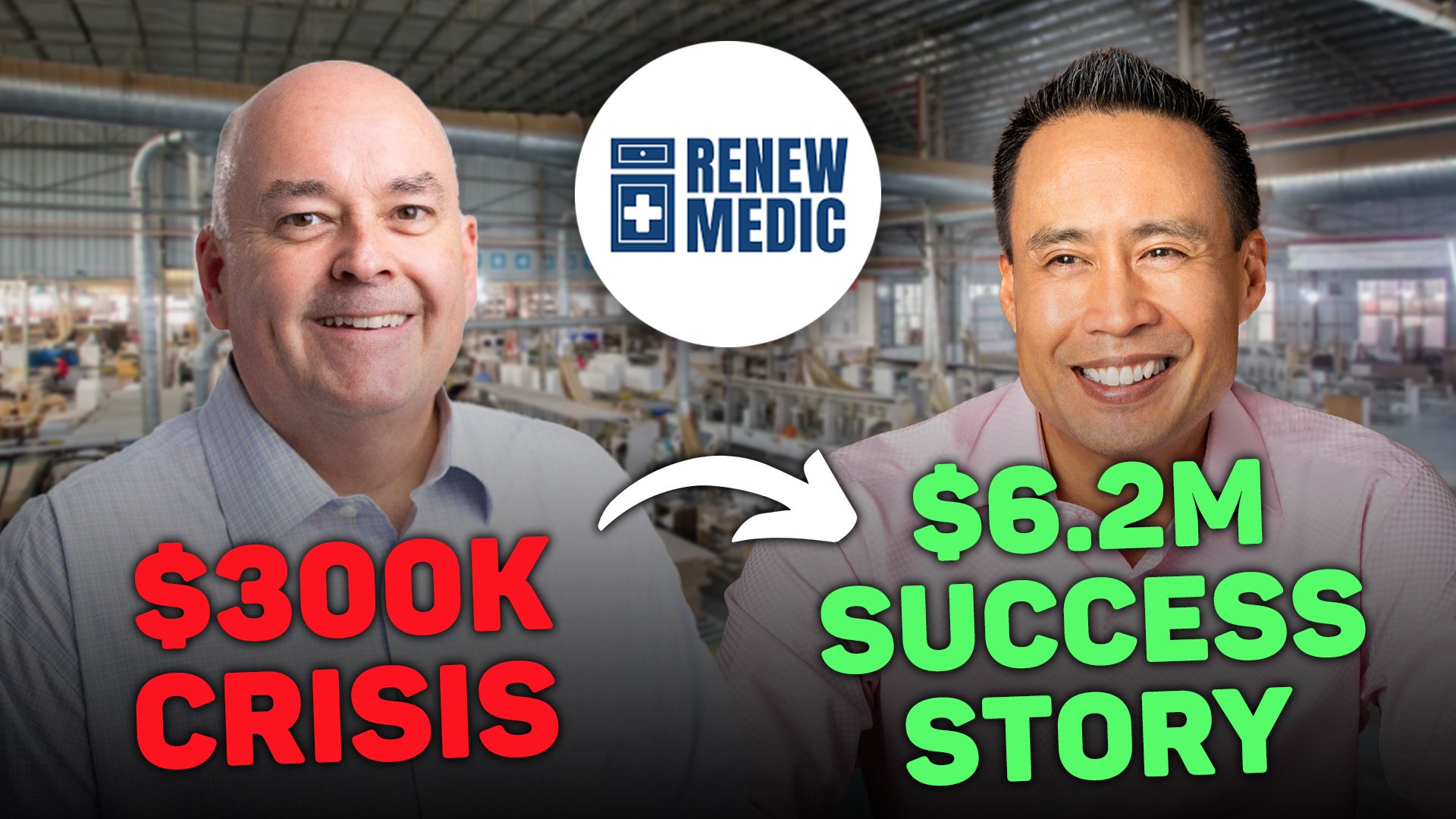
From $300K Crisis to $6.2M Success: Building Renew Medic With His Son | Joe Steffens
Dec 02, 2025This is a transcript from Episode 16 of The Franchise Champion Show. Listen to the full episode on Apple Podcasts, Spotify, or YouTube.
Alan Regala: Our next guest has built not one, but multiple multi-million dollar franchise businesses over the past two decades. But what really caught my attention is his decision to bring his son into the business at just 17 years old, and how they've grown together to build a $6.2 million operation. I'd like to welcome to the Franchise Champion Show, Joe Steffens with Renew Medic. Welcome, Joe.
Joe Steffens: Thanks, Alan.
Alan: Great. Well, start us off and tell us—how did you first get into franchising?
Joe: I first got into franchising probably close to 20 years ago. I was in corporate America, and I was kind of tired of climbing the corporate ladder. A friend of mine reached out to me and just said, "Hey, I have an opportunity for you to buy into a ServiceMaster franchise." So I looked into it, talked to my wife, tried to calm her down a little bit—told her I was going to walk away from a nice-paying marketing job. And we went ahead and pursued it and bought my first franchise back in, I think it was somewhere around 2002. And I've been doing that since.
Alan: Wow. Wow. So you just decided you were done with your corporate life and you had to convince your wife that you wanted to do something different and leave your job to start a business?
Joe: Right. And I had always had more of an entrepreneurial feel and wanted to do something that I could run myself. So that was something that interested me, and it was very scary, but it ended up working out pretty well.
Alan: Wow. So what exactly was it about your corporate job that you didn't like?
Joe: I think just the feeling that you were constantly having to climb the corporate ladder and get to the next level and, you know, try to impress the next boss to be the person that got the next promotion. And I just—it wasn't me. It wasn't something that I really wanted to do, to climb over other people to get to where I wanted to be and achieve. And I felt like I'd like to do that for my own business and then reap the rewards of that directly.
Alan: Yeah. Yeah. I think that's super common. It feels like, you know, people—at least like with me, I felt very similar. I didn't feel like I was maybe valued as much as I should have been or just, I don't know, I felt like if I'm going to work really hard at this and put a lot of my time and energy into this, that it feels like I should be putting this into something that I own. And the politicking is definitely something I wasn't a big fan of—trying to kind of move up the ladder. Yeah. So I think a lot of people can definitely relate to that.
Sure. Okay. So you ended up having a friend just get you into a ServiceMaster business. Is that right?
Joe: That's correct. Yeah. And my initial business was a commercial cleaning franchise for ServiceMaster.
Alan: Okay. Okay. And so—and tell us how that went.
Joe: So it was interesting as my very first entry into my own business, and I actually had something bad happen where I was contracted to clean some windows on a post-construction cleaning job, and I hired a subcontractor, and the subcontractor ended up scratching all the exterior windows of two buildings—a two-story and a three-story building. And I thought I had coverage for it, and I thought that the sub had proper insurance and he did not. And so it was one of those situations where, you know, pretty quickly you felt like, "Wow, did I make the right decision?"
And so I actually started through that insurance claim—the insurance company initially denied the claim. When it was first starting out, it was probably about a $300,000 claim.
Alan: Holy cow.
Joe: And so just kind of let that go on and ended up working its way out, and it did get covered eventually, but it was enough to scare me out of business. Yeah, no kidding. And so I ended up going to work for another franchise and worked for him for a couple years in the Chicago market. And then at the end of that two years, throughout the period of time I was with—I was thinking, "Why did I sell the thing? Why did I jump out of it so quickly with just one bad thing that happened?"
Alan: Okay, so you sold the cleaning business before you went and worked for another?
Joe: Yes. I actually sold it to another ServiceMaster franchisee. And he hired me on as his director of marketing. And so I worked for him, helping him grow his business for a couple of years. And we did grow his business quite a bit. And then I started thinking, "Maybe I got out of this too quickly." And then started to look into another franchise—similar franchise with ServiceMaster out in the Denver area. And so I moved my family to Denver, opened up another franchise, commercial cleaning ServiceMaster franchise in the Denver area. And from there, it just kept growing, and eventually added on another line of business, which was furniture restoration and repair. And we just continued to grow from there.
Alan: Wow. Wow. Okay. And then how long were you in the Denver market?
Joe: I was in the Denver market for 14 years.
Alan: Okay. So that's pretty significant. Yeah, definitely a big move from Chicago to Denver. And I'm curious—you know, when you got into—when you started up that second business with ServiceMaster, the commercial cleaning business, I mean, at that point you obviously knew what you were doing. Like you had just done this, you sold it. You helped someone grow their own business. So you kind of came in with a lot of experience already in the business.
Joe: Yeah. I mean, there was definitely a learning curve—you know, doing it in a different market. You know, I had no contacts initially in the Denver market. And so, you know, I started small. I just had literally it was me. I was it. And, you know, I had about maybe $50,000 in sales my very first year, and I was doing all that sales. I was doing the work—or actually I had a couple subcontractors that I had built relationships with that were doing most of the work. But, you know, I was trying to grow that from the very beginning. And I think within about five years, we had grown to about a million dollars in sales.
Alan: Wow. Wow. And is this still on the commercial cleaning side?
Joe: This was still on the commercial cleaning, and then we, you know, we added on the furniture restoration side within that first five years.
Alan: Okay. Got it. Got it. And where is Furniture Medic in the ServiceMaster structure of things? Like, is that a separate business?
Joe: It is. It's actually operated separately from commercial cleaning. When I first started the furniture side, it was under the ServiceMaster brand.
Alan: Okay.
Joe: And then they—ServiceMaster had the decision that they were going to franchise all of their businesses separately. And so at that time, I was told that I needed to rebrand that piece as Furniture Medic. So it was a, you know, a little bit of a learning curve with that because I'd built some brand awareness with the ServiceMaster name. And then all of a sudden I had to change all my signs, change all my marketing collateral, everything, to Furniture Medic.
Alan: Okay, got it. Got it. And then with—so with that transition, I'm curious, like, how difficult was that? Did the customers just—like, were you able to then start marketing under Furniture Medic? And the customers that you already had were just totally fine with that?
Joe: Yeah, for the most part, it wasn't a huge deal because, you know, a lot of the customers that we did furniture work for were very much just focused on the work that we did and not necessarily the brand behind it. You know, a lot of them knew us by the name of the company, which was essentially just my last name with ServiceMaster or with Furniture Medic. So it wasn't a huge deal. The bigger part was just all the, you know, the cost of rebranding—all the signs, all the marketing collateral, all of that had to change. So that was a, you know, that was probably the bigger impact.
Alan: Yeah. Yeah, that makes sense. Okay. So you're building both of these businesses. And then—so how did you get into Renew Medic? What's the story there?
Joe: Yeah. So about eight years ago, I had an opportunity to, well, I was approached by someone to possibly sell my business. And it was a ServiceMaster—it was one of the larger franchises, a larger franchise group, multi-unit owner. And so he came to me and said, "Hey, I'd love to acquire your business." And so, you know, we went through the whole vetting process and due diligence and everything. And so I ended up selling my ServiceMaster commercial cleaning business to him. And I retained Furniture Medic.
And so from there I was able to really focus 100% of my time on building the Furniture Medic business. And, you know, at the time that I sold the commercial cleaning business, the furniture side was doing right around a million dollars. And so then from there I was able to really grow that and take it up to—by the time I exited that market, we were doing about $4 million in furniture restoration and repair.
Alan: Wow. So you went from a million to 4 million. How long did that take?
Joe: That was—that took place over about six years.
Alan: Wow, that's incredible. And was that with Furniture Medic still?
Joe: That was, yeah. That was all with Furniture Medic, yeah.
Alan: Wow, that's fantastic. Okay, so then you're doing very, very well with your Furniture Medic business in Denver, and then something changes. What happened?
Joe: Yeah. So one of the things that happened is ServiceMaster decided to get out of the Furniture Medic business.
Alan: Oh, wow.
Joe: And so they sold the brand to an organization called Authority Brands. And Authority Brands is one of the larger franchise companies out there. They have numerous brands. And one of their brands was Renew Medic. So Renew Medic was—Renew is the cabinet and countertop division, and so they acquired Furniture Medic and brought it into the Renew family. And so essentially I became a Renew Medic franchisee at that point.
Alan: Got it. Okay. And so the Renew brand was already in existence doing cabinet and countertop work?
Joe: Correct, yeah. They had been around for about ten years at that point.
Alan: Okay. Okay. And then they acquired Furniture Medic, and so all the Furniture Medic franchisees became Renew Medic franchisees?
Joe: Correct, yeah.
Alan: Okay. Wow. Okay. And so then what happened from there?
Joe: So from there I continued to grow the business. And then in 2020, my wife and I made the decision that we were going to relocate. We had the opportunity to relocate to the Carolinas, and so I started looking for markets in the Carolinas. And the Greensboro, North Carolina market was available. And so I went through the process of purchasing that territory and moved my family to North Carolina.
Alan: Wow. And so you sold your Denver territory?
Joe: I did, yeah. I sold the Denver territory to another franchisee.
Alan: Wow. Okay. And so then you start all over again in North Carolina. And how long ago was that?
Joe: That was four years ago.
Alan: Okay. Wow. And so tell us about that journey. Like, you're starting from scratch in a new market. What was that like?
Joe: Yeah, it was interesting because, you know, I'd been in the Denver market for so long and had built up quite a bit of brand awareness and, you know, had a great reputation. And so starting over in a market where nobody knew who I was, nobody knew the brand, was definitely a challenge. But, you know, I think one of the things that I learned through the years is you just got to get out there and start building relationships and start letting people know who you are and what you do. And so that's what we did. We just started, you know, hitting the pavement, going to networking events, you know, doing a lot of, you know, digital marketing, things like that. And just slowly but surely started to build the business.
Alan: Yeah. And so when you started in North Carolina, was this just you again, or did you have—
Joe: This was me and my son.
Alan: Okay. Okay. So tell us about that decision to bring your son into the business.
Joe: Yeah. So my son, when I sold the Denver business, he was 17 years old. And, you know, I had talked to him about the opportunity to, you know, move to North Carolina and start this business together. And, you know, he was excited about it. He had worked in the business, you know, during the summers and, you know, kind of after school and things like that. And so he had some experience. But, you know, at 17 years old, he didn't have a ton of experience. But he was eager to learn and wanted to be part of it. And so we made the decision to do it together.
Alan: Wow. And so what was that like—I mean, working with your son, bringing him into the business at such a young age?
Joe: You know, it's been great. I mean, there's definitely been some challenges along the way. You know, I think anytime you work with family, there's going to be some, you know, some bumps in the road. But overall, it's been a really positive experience. And, you know, he's really grown into the role. And, you know, he's—I would say he's probably better at a lot of things than I am at this point.
Alan: Wow. That's great. That's great. And so what is he doing in the business? What's his role?
Joe: So he's the operations manager. And so he oversees all of the day-to-day operations. You know, he manages our team. We have about 12 employees at this point. And so he's managing the team, making sure that all the jobs are getting done on time, making sure that quality is being maintained. And then he also does a lot of the, you know, the estimating and things like that. So he's really kind of the face of the operations side of the business.
Alan: Wow. And so you're more on the sales and marketing side?
Joe: Yeah, I'm more on the sales and marketing side, and then also just kind of the overall strategic direction of the business.
Alan: Got it. Got it. And so you mentioned you have 12 employees. So you've built this thing up pretty significantly in four years.
Joe: Yeah, we have. You know, we started—like I said, we started with just the two of us, and we've been able to grow it to where we're at about $6.2 million in sales right now.
Alan: Wow. Wow. That's incredible. In four years, starting from scratch, you're at $6.2 million. That's fantastic. And so what do you think has been the key to that growth?
Joe: I think a few things. I think, you know, number one is just hard work. I mean, we've put in a lot of hours, and we've, you know, we've been very intentional about building the business. I think the other thing is we've been very focused on providing excellent customer service. And, you know, we've been very focused on building relationships with our customers and making sure that they have a great experience. And so I think that's been a big part of it. And then I think the other thing is we've been very focused on building a great team. And so, you know, we've been very intentional about hiring the right people and training them well and making sure that they understand, you know, what our expectations are and what our values are. And so I think all of those things combined have really helped us to grow the business.
Alan: Yeah. Yeah. That's fantastic. And so what does the future look like for you and your son? Where do you see the business going?
Joe: You know, I think we're going to continue to grow. I think we're going to continue to add more people to the team. I think we're going to continue to expand our service offerings. You know, we're always looking at, you know, what else can we do to serve our customers better and to provide more value to them. And so I think we're just going to continue to grow and continue to build. And then, you know, I think at some point, you know, my son will probably take over the business completely. And, you know, that's kind of the plan is to eventually hand it off to him and let him run with it.
Alan: That's great. That's great. So you're building a legacy here that you can pass on to your son. That's fantastic.
Joe: Yeah, that's the hope.
Alan: Yeah. So I'm curious—you know, you mentioned that you've been in franchising now for almost 20 years. What would you say are some of the biggest lessons that you've learned over that time?
Joe: You know, I think one of the biggest lessons is just the importance of following the system. You know, when you buy a franchise, you're buying a proven system. And I think a lot of times people think, "Well, I can do it better," or "I know a better way." And, you know, I think that's a mistake. I think you need to follow the system, especially in the beginning. You know, once you've proven that you can execute the system and you're having success with it, then maybe you can start to make some tweaks here and there. But I think in the beginning, you really need to follow the system.
I think the other thing is just the importance of building relationships. You know, I think a lot of times people get into business and they're so focused on the transactions and the sales and the revenue that they forget about the relationships. And I think the relationships are really what drive the business. And so, you know, building relationships with your customers, building relationships with your team, building relationships with other franchisees—I think all of that is really important.
And then I think the other thing is just the importance of continuous learning. You know, I think you always need to be learning and growing and, you know, looking for ways to improve. And so, you know, whether that's attending conferences or reading books or, you know, listening to podcasts or whatever it is, I think you always need to be learning and growing.
Alan: Yeah. Yeah. Those are all great points. And I think, you know, the one about following the system is so important. I mean, that's one of the things that I always tell people when they're considering franchising is, you know, you're buying a proven system. And, you know, if you're the type of person that wants to do things your own way and doesn't want to follow a system, then franchising is probably not for you. But if you're someone that's willing to follow a system and execute it well, then franchising can be a great opportunity.
Joe: Yeah, absolutely. And I think, you know, the other thing is you need to be coachable. You know, I think a lot of times people get into business and they think they know everything, and they're not willing to listen to feedback or take coaching. And I think that's a mistake. I think you need to be willing to listen to your franchisor, listen to other franchisees, and be open to feedback and coaching.
Alan: Yeah. Yeah. That's great. So I'm curious—you know, you've been with ServiceMaster and now with Renew Medic. What would you say are some of the benefits of being part of a franchise system?
Joe: I think one of the biggest benefits is just the support that you get. You know, you're not out there on your own trying to figure everything out. You know, you have a franchisor that's there to support you. You have other franchisees that you can learn from and lean on. And so I think that support system is huge. I think the other thing is just the brand recognition. You know, when you're starting a business from scratch, it takes a long time to build brand awareness and build credibility. But when you buy a franchise, you're buying into a brand that already has that credibility and that brand awareness. And so I think that's a huge advantage.
And then I think the other thing is just the systems and the processes. You know, you're buying a proven system that's been tested and refined over time. And so you don't have to reinvent the wheel. You just have to execute the system that's already been proven to work.
Alan: Yeah. Yeah. Those are all great points. And I think, you know, the community aspect of it is something that I always loved about franchising as well. You know, having that community of other owners doing the exact same thing that you're doing—I mean, that is just so unique, something you can't find outside of franchising. And that was certainly one of my favorite parts about going to conferences and just having regular calls with certain other owners on a regular basis. You know, like we call them power teams at ShelfGenie. And then being a part of the system contributing—you know, were you part of the Franchise Advisory Council?
Joe: Yeah. Because Renew Medic is somewhat newer, they haven't really gotten that up and going. I was part of the Franchise Council on the Furniture Medic side previously.
Alan: Got it. Got it. Yeah. That's great. I mean, you know, in that—for those that don't know, you know, it's a council of franchisees that help represent all of the franchisees in that system. And so a smaller subset of the owners who can represent the owners and have regular meetings with the franchisor to talk about things like marketing and operations and all the other things that owners need help with. And that's great that you've been a part of that in the past, and I'm sure it will be in Renew Medic once there's enough other owners out there.
What would you say for someone that is interested in this concept? And, you know, what might be a great market for this? You know, what are some of the traits of an owner, would you say, are important for this role and starting Renew Medic?
Joe: Yeah, you know, it's interesting. I have people ask me all the time—they say, "Hey, I'm thinking about starting my own business, and I want to get into business for myself." I always want to get to the reason why they want to start their own business. And so, you know, I always tell people, if you're wanting to start your own business because you want to be your own boss and you want to set your own schedule and you want to be able to buy a boat and, you know, vacation all the time, it's probably not a good idea to buy your own business because a lot of them don't provide that.
I would say someone that is driven, someone that's competitive, that has a competitive nature to—I always wanted to win the, you know, with ServiceMaster, one of my goals was to win the Franchise of the Year award. And I won it twice at ServiceMaster, and we won it—my son and I won it, I think, our first full year in business at Furniture Medic. So there's a competition there that you want to be the biggest and the best. And so, you know, having that competitive spirit, being willing to work hard and not expect that you're going to just all of a sudden be rolling in money—that you're going to have to work hard day in and day out.
And someone that's customer-centered. And, you know, I was trained from the very beginning—when I first got into corporate America, I worked in the grocery industry, and I was told the customer is always right. And I hated that, but if you at least try to maintain that mentality, you're going to succeed with customers, you know, and doing whatever it takes to make them happy. You know, that type of mentality.
You know, someone that understands numbers and understands that everything that you do needs to be done in a way that you can grow profitably in your business. When we were at ServiceMaster, we had four corporate objectives. And these were part of the reason I joined ServiceMaster in the first place. But the first one was to honor God in all we do. And that meant something personally to me. And, you know, you can boil that down to doing the right thing on a day-in and day-out basis. The second one was to excel with customers. The next one is to develop your people, and the last one is to grow profitably.
And so, you know, just—I think all four of those things have been a key part of the success of this business. We have tried to honor the Lord in all that we do. We have been intent on developing our people. We're not perfect, but we're continuing to grow in that, excelling with customers. And, of course, everything that you do, you got to do it profitably or you're not going to be in business.
Alan: Well said. Well, wow, it was fantastic hearing your story. Congratulations on having such a wonderful journey. And you're just, you know, in the middle of things as well as you're doing now. I can tell you're going to, you know, you're just going to keep on going up and up and up. So yeah, I appreciate you sharing your story, Joe, and congratulations on being a franchise champion.
Joe: Great. Thanks, Alan. Appreciate your time.
Don't miss a beat!
We hate SPAM. We will never sell your information, for any reason.