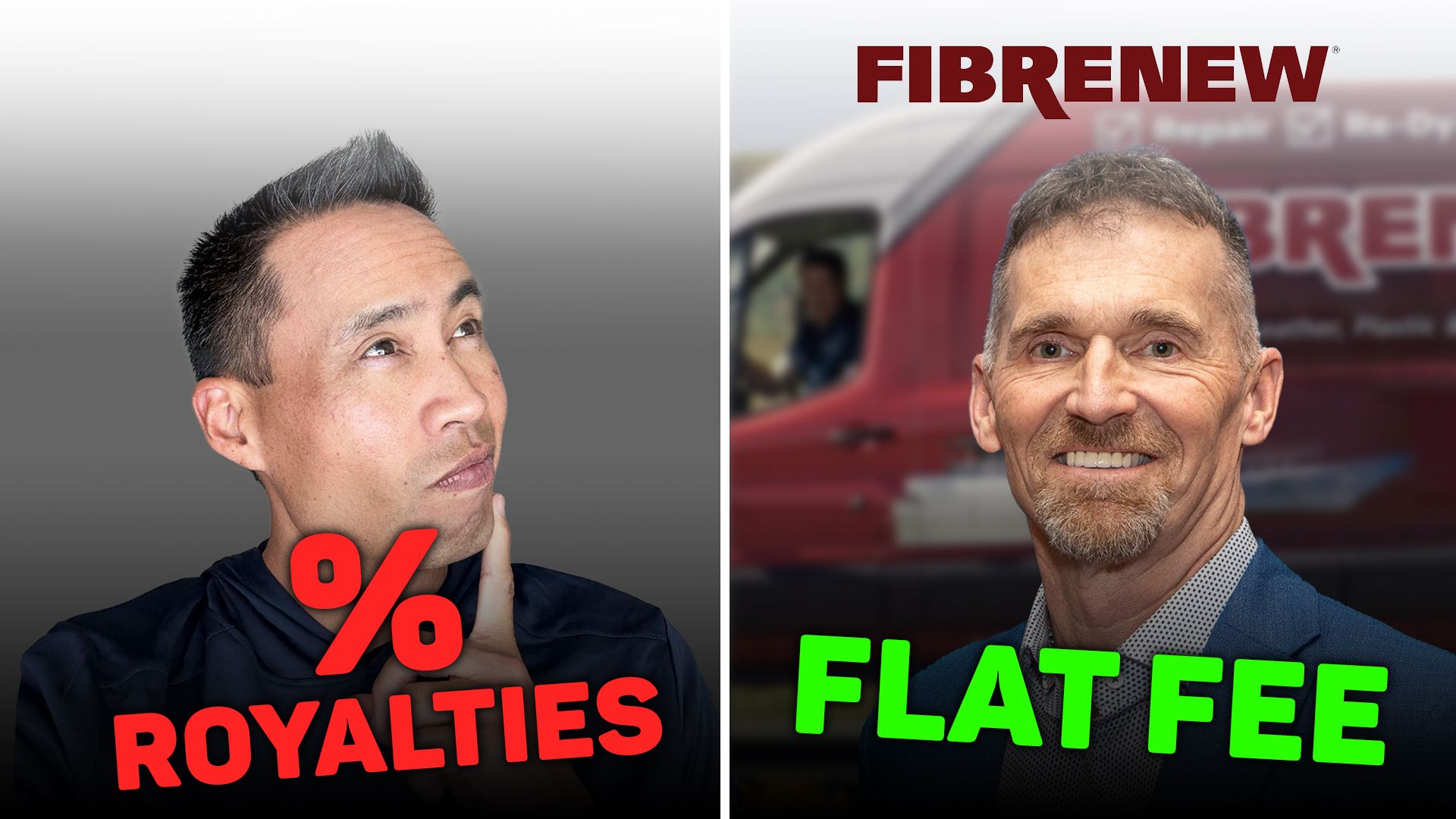
Why He Pays a Flat Fee Instead of % Royalties
Feb 10, 2026This is a transcript from Episode 24 of The Franchise Champion Show. Listen to the full episode on Apple Podcasts, Spotify, or YouTube.
Alan Regala: My guest today chased the Canadian dream of pro hockey until 11 concussions forced him to reinvent himself. He went from sales to furniture into Fibrenew, and over the last seven years has turned what could have been buying himself a job into a real business with a team of nine, full upholstery shop, and years of doing around a million in revenue. He now coaches other franchisees, does validation calls for new candidates, and has built a lifestyle that includes plenty of time in Cabo as a self-described degenerate golfer. Steve Geddes, welcome to the Franchise Champion Show.
Steve Geddes: Thanks Alan, great to be here. I appreciate the nod and makes me sound better than, I guess the next hour we'll let our guests know.
Alan: No, this is going to be good. This is going to be good. I'm really excited to speak with you. Let's get started with, you know, how do you get from hockey to where you're playing semi-pro, trying to work your way up to the big leagues, to getting into franchising?
Steve: Yeah, long route to get here in a way, but I've been in furniture most of my life and that started with way back playing hockey in the East Coast of Canada, Nova Scotia, and you know, trying like most Canadian boys, trying to go pro and playing some low level pro and beating around, went to try to go play in the States. And like you mentioned, concussions and injuries, shoulders and everything else was—it was winning the war and I was struggling. And lo and behold, I was good enough, at least in my local town, to get on the radar of some business guys. A gentleman that owned a furniture store, furniture dealership, had said, you know, come play on my gentleman's hockey team and I'll give you a job in sales, selling furniture. I was close to starving, not making a lot of money. That sounded like a real good idea. I could still play hockey and get a paycheck at the same time.
So he started me right away. And the great part of it was I didn't just jump into sales. I did some business in school and that's what I wanted to do. But he started me on the installation truck, and he said the only way to learn how to sell anything is learn how it goes together. And I've carried that through my entire life as I believe that you can't sell anything if you don't understand what that thing is and how it goes together. So especially in furniture.
I started with a company there and we represented some national companies like Hayworth, which is a big furniture brand. And a company called Smed International out of Calgary, got to know them really well, ended up moving out west and worked for Smed for years. And then went out on my own, had a sales agency selling furniture. My wife is from the Okanagan where I live now in Kelowna, British Columbia.
And it's funny, I found out about Fibrenew kind of in a podcast, because I was traveling throughout the States and I was listening to a podcast one day in my hotel about life after, and an ex-hockey player had bought a Fibrenew franchise.
Alan: Oh my gosh, wow. He just paved the way for you, didn't he?
Steve: Bingo! And I'm like, boy, this would fit with my sales agency. This is a perfect fit because I was selling furniture at the time. I had an installation company installing that. And of course, in that world, nothing's perfect. And we scuff things up. We run things into the back of a truck. So there's always mishaps and mistakes and Fibrenew's like, that's a good fit. I called and I went on the website, I found the number, I called, left a message saying, hey, I'm interested in your franchises. I got a call the next day from a lovely lady who happened to be in the same area code as me and their head office, Fibrenew's head office was literally in the city that I lived in at the time, Calgary, Alberta. And we started the conversation and I said it was something that I was interested in. They had nothing in the markets that I was in, Phoenix and Calgary, but there was something in Kelowna, BC. And we kind of had a loose five-year plan to move back to where my wife was from and a year later we had bought the franchise and had moved the family to Kelowna and here we are seven years later, almost.
Alan: Wow, wow, okay. So tell us about Fibrenew. What exactly is Fibrenew for those that don't know?
Steve: Fibrenew is a leather, vinyl, and plastic repair and restoration company. And the beauty, and you know, in my sales pitches or elevator pitches, I say everybody needs Fibrenew, they just don't know it yet. Because pretty much everybody has leather, vinyl, plastic in their cars, their home, their boats, their airplanes, if they're lucky enough to own a few of them. But it's everywhere, it really is.
You know, Fibrenew's been around for 30-some years restoring. We got our sort of our start in the automotive market where, you know, we started calling on new and used automotive dealers to repair seats and dashes and door panels and all that. And we've really expanded and blown up through that restoration world. And as the world changes and everything becomes more expensive and the world is greener as well, and we try to keep stuff from the landfill, Fibrenew has really exploded into keeping things out of the landfill, restoring it. It's much, much less money to repurpose and fix it than it is to throw it away or to buy new.
And so Fibrenew has been that. We're all over Canada and the US and we're globally as well, but the majority of our franchises are in Canada and the US and we're adding monthly to that. And the great part about Fibrenew is the ability to scale up and scale down. So the franchise model is one that's—I looked at it and I didn't want to buy myself a job. I didn't want to be owner-operator. My son at that time had come on board with me and we wanted to have a shop and we wanted to add full upholstery services and add other techs. And Fibrenew allows us to do that. We have a lot of freedom, although we have some consistency with some of the best products out there to be able to do our repair products with.
Alan: Mm-hmm. Mm-hmm. That's great. Yeah, I mean, it seems like a natural fit for your background and for selling furniture. And it seems like it dovetails perfectly with that. That's interesting. I didn't realize that your son was a part of the business when you had started. Is he still part of the business now?
Steve: He's not, he's moved on. We started—bought. Timing's everything in life and I bought this franchise six months before COVID started. And so things changed abruptly. My son's wife's dad got fairly sick on the East Coast of Canada, so they kind of packed up and moved home. And that's when I made the decision, so like, you know what? The sort of the legacy was I was going to hand it over to my son, it was going to be a family legacy and he was going to keep running it. And that didn't happen. But with my sales background and understanding how to scale up and how to increase companies, which I had done for years with other companies, I just said, you know what, let's see what we can do here. Let's grow this, let's add some staff.
It had already—the ball had started rolling. We had increased sales a lot in the first six months. COVID happened, me like countless others out there thought it was a two-week blip on the radar and things would get back to normal. So lots of work in my shop. I hired a tech right away. We ended up working, you know, obviously just in our shop for a while until things smoothed out. But what I did during that is I went out and found commercial accounts. I went out and started talking to commercial accounts, knowing that business would come back, knowing that I wanted to continually scale up. So my son Zach had moved on and he's still in the East Coast of Canada, but I knew that the opportunity to scale and to build was there in our market. So we just kept going.
Alan: Yeah. That's great. That's great. So it sounds like the commercial accounts is really big for you. And that was really a smart thing to do to build those up, you know, during that timeframe. Is that still tend to be kind of the primary customer of yours is B2B and commercial or do you still work with the residential individuals as well?
Steve: We do both, you know, business to business is my success, my track record. You know, I've got probably 80-20, 85-15% is commercial accounts. I believe that, you know, that's a strong business model. It's strong if you take me out of it as well. And I believe that when you're growing a healthy franchise, you should be from day one looking for that—who's going to own it the next go round, right? So I want to build something outside of myself. You know, commercial accounts are—they look great on the books, obviously they're sustainable, they're repeatable and you can make, you know, a good healthy profit going forward with that much commercial. So I've always thought that I coach that I believe that that's a healthy franchise for Fibrenew.
Alan: Yeah, yeah, that is really smart. That is something that I think is a good lesson for people out there once they're when starting a new business, a new franchise, is thinking about that business without you, you know, thinking that long term and how the business can operate without you there, whether that's the team running it and you're the owner and get to be the owner or that someone looking to buy it, you know, at some point in the future and not having the business not depend on you solely. So that's very smart.
Steve: Yeah, I think a lot of owner-operators and businesses make that mistake that everything revolves around them. And if you take them out, A, you have no income. If you're gone away for two weeks, there's no income. Or more importantly, if something was to happen to you health-wise or anything else, your business goes downhill really fast. So we've tried to use the model. And my wife is my partner. She's not hands-on day-to-day, but she's my business partner. And we work together a lot. And we really wanted to have something that is transferable down the road. And I just think it helps for somebody else's opportunity after us to be able to walk into something that's independent and will stand alone without me being there.
Alan: Yeah, yeah. So let's dive in a little bit deeper with these types of businesses that you're helping. So would this be, you know, because I think that is the thing that most people look for is that recurring revenue, right? That's like those are magic words for a lot of people out there in the corporate world that are like thinking about jumping ship, or maybe they've been laid off and they're looking at getting into a business and that sounds very safe and secure for them. It's that word, you know, those words, recurring revenue. So are these like, give me an example, is this like a hotel for example, or a restaurant or something like that where they're—you're on speed dial for them if something goes wrong and they need some repairs?
Steve: Exactly. And that's the beauty of Fibrenew. We're in so many different markets. You know, our main ones obviously are automotive. So automotive dealers, whether it be Mercedes or BMW or Chevy, you know, those guys are calling us on a regular basis because they have, you know, there's so many opportunities in, you know, for repeat business for us in a dealership. And I coach that, that you go in, you've got the sales staff dealing every day with their customers. Then you've got the service department, you've got the parts department, you've got the detailing department, you've got all those different opportunities to sell our services and our restoration to furniture stores, the exact same thing. You've got warranty work, you've got freight damage, you've got their own customers. But then we're also in marine, so boats, we're in RV, we're in obviously healthcare, hospitality is massive, you know, from restaurants to hotels to retirement homes to gyms, to golf courses.
And again, back to what I said originally, everybody has leather, vinyl and plastic, so it's everywhere. And the crazy part, you know, I never liked to say COVID was good for anybody because it was hard on so many. But what so many facilities did is they used harsh cleaners. Everyone likes the smell of bleach for the perception of clean, right? So so many facilities used the wrong cleaners on their product and it dried it out and it cracked it and it did all these things to the vinyl, which is in most restaurants and medical clinics, physio, chiro, all those. So there's a lot of work in that business to business world to catch up with. That's why I always use the term, there's no ceiling to our business. You know, with all those different markets they're in, you know, a Fibrenew franchise really, and I promise when I'm doing validation calls, the only promise I make is I promise you there's more business in your market than you can get to, there really is. Strategically, we have to figure out how to get there and how to find it. But that's the easy part. There's lots of work out there.
Alan: Wow, that's really cool. It's crazy how many industries you guys can get into, that you are into, how many industries you can help, how many different types of businesses that have the leather, plastic, and vinyl. I mean, it's like, it's everywhere.
Steve: It's everywhere. I mean, you just think the medical market, like how many dental clinics, how many physio, how many chiropractor, all those besides hospitals, right? It's just, it's never-ending. And, you know, until you start talking to a Fibrenew-er and we start having these conversations, nobody really thinks about—there's not too many geeks out there sitting around wondering how much vinyl is in a city, right? But it's everywhere. And it's, you know, vinyl is used because it's antimicrobial. It's easier to clean and that's why it is in healthcare and hospitality. But eventually it breaks down and so you need it repaired. And then if it goes too far, you can then reupholster it. That's why we opened up an upholstery shop to kind of keep that, the cycle of that customer longer.
So I like to look at it as I now have the customer longer than one turn. We go in and we repair it. When it's too far gone, then we can reupholster it. But then I can go back in and repair it when things happen over time. So we can extend the life of that customer as well and get more turns out of each facility.
Alan: That's great. Very smart. So one thing that's really interesting with Fibrenew in particular is that the way that it's set up, I think you mentioned this earlier, you can have a business that is just like buying a job, basically, or you can build it to where you've got a team and it's more than just the owner. Can you speak to what that looks like? I guess on both sides, because I believe a lot of the system is just owner-operator, right? Maybe you describe a little bit what that looks like if someone were to choose that path and who that's right for.
Steve: Yeah, that's—you know, we have a lot of owner-operators. We have a lot of individuals that have looked at it as a second career. Maybe they're done in finance, in tech or something like this. They love working with their hands. I always say, you know, it is a hands-on business. It's not passive income. It's not a passive franchise. And we want somebody that is willing to go out there and work and, you know, has to understand color, that sort of thing. But once you get in, you know, it is mostly labor, our products are our proprietary products in the big scheme of things. Based on jobs that we do, you know it's not a large percentage of the cost of the job, so it's a lot of—you know our profit is based on labor, doing the work itself on site.
So for an owner-operator you can be very successful, you can be very comfortable working mobile. For instance, we are set up to have a kit in a van. You can go out and work at dealerships, at furniture stores, at marinas, wherever it might be. And you can be completely encompassed in your van and go do the work. So you don't need the overhead. And especially starting out, even if you have plans that maybe you want to scale up, you can start the first year, two years, three years as an owner-operator, increase your cash flow, increase your customer base, and then perhaps add on if you want to. We've got lots of owner-operators that have done that for 20, 30 years and have made a great life for themselves, flexible.
The other part I always say about Fibrenew is there's no tax on our success. People get that when I say it. There's no royalties the way that the franchise model is set up. So I can scale up and scale down and the model is based on a different way so that I'm not giving more of it away, if you will.
Alan: Yeah, yeah, I think that's really interesting. I had a candidate go through the process of looking at Fibrenew and there were so many benefits to it. I think it was—it seems like such a great model for people that, you know, that want that path of kind of being owner-operator and being kind of just left alone to some degree. You know, you get the support, you get as much as you want out of the system. And because of the royalty model where it's that you just kind of you just do whatever you know you want to do, obviously within the bounds of the system and maintaining the brand and all that. But you're not being hassled by anyone if you don't want to be.
Steve: Exactly. I mean, you can kind of disappear in your own territory, if you will. And you're right. There's rules and regulations like any franchise. We want to make sure you're doing your repairs right with our products and that sort of thing. But other than that, you can kind of be your own person and do your own thing. And that's pretty awesome.
There is a huge support network set up in Fibrenew, whether it be your neighboring franchises or the support team that Fibrenew has to help out from day one. You know, you've got a list of numbers that you can call and Zoom. Full disclosure, I'm on that support team, so I better be speaking fairly highly of it or else. But I jumped on because I believe so heavily in it. And again, I started, and COVID happened, and I kind of went into that shell myself. It's like I put my head down and I worked, but I forgot that there were so many other people to help me out there that wanted to.
You know, I was lucky enough a few years ago to go to an awards, a franchise award show in Vegas and got to know a lot of different franchise opportunities out there and companies. And then I use that a lot because I'm still blown away by the support at Fibrenew. Like people want to help you and there's no charge for it, right. It truly is they, you know, we want to help each other in the success of the franchise and I think that's still a little bit unique out there with a lot of other models.
Alan: Yeah, yeah, that's great. So then with your business and the way that you decided to run it, you wanted to build something outside of yourself and have a team. What exactly does that look like as far as your team goes and how that's organized within your business?
Steve: Yeah, so I still have the mobile model, if you will. So we have three vehicles on the road. So we're doing mobile service. So my techs today, for instance, there's—I've got one tech, he's at a marina doing some work inside in their facility doing some boat work. I've got another tech who is on site at a customer's house doing a residential job, a respray of their leather with cat scratches. So I still have that. And then I have a full shop. So I do repairs here as well as full upholstery. So I do have, as part of my staff, I have seamstresses on staff that work.
Back to my furniture background, I've been in furniture and I've been part of manufacturers for years and I really understood the manufacturing process of just-in-time manufacturing and understanding that your raw materials come in the door, you pull it apart, you pattern it, you sew it back together and you take it out. You know, my shop isn't massive, but we're able to pump through a lot of product and volume that way for restaurant booths, for medical beds, for boats, because I understand that process.
So I have, you know, seamstresses, I have a few of them that are on the sewing machines, but the rest of my staff are kind of cross-trained. So they understand to take apart the furniture, to pattern it, to cut it, to put it back together. And then I have, you know, two staff that are in here, but they do some tech work, some upholstery work. And so, you know, with a small staff we cross-train and we make sure that we're consistently doing it the same. I have some, you know, we have a great CRM in place through Fibrenew that helps us with job flow and workflow and then, you know, we have a paper trail as well on the shop floor to make sure that we're all being consistent. So small group but well-trained group. Communication obviously is key with anything when you're working on products that you're taking apart and putting it back together.
But the key to it all is we start with the mobile work and then we can just expand on it and do more of it here. We train some customers to drop stuff off. So we'll do a lot of tech work still in here. I've built out a spray booth so we can do all of our dye work and leather work and that in a contained unit within our shop as well. So we're able to do a lot and a little. I think that, again, my manufacturing experience helped me with that. And then as I grew in Fibrenew and understanding what better customers to go after. You know, because there's profitable customers and then there's some that maybe aren't as profitable. And I think as you grow in Fibrenew, you're able to understand what repairs we do really, really well and go after more of that business.
Alan: Yeah, yeah, that makes sense. So then what does your role look like in maybe your wife's role? And that allows you to be able to go off to Cabo and play golf, you know, over a week or two.
Steve: Yeah, I'm more—I run the business now. I'm still the, you know, the sales guy, if you will, but I, you know, when I say that, I believe in business to business and growing your referral network. And so, you know, I teach that I might be the so-called only salesperson in our company, but I've got 70 salespeople out there and that's my referral network, right? So they're always feeding me business back and forth and that's, you know, key people at the marinas and at your automotive dealerships and stuff like this. So I sort of, you know, I'll jump on the tools when I have to and tomorrow I'm out, you know, we're busy this week and I've got to do a couple of repairs myself. But for the most part I'm running it, I'm running the schedule, I am, you know, I'm pricing out the larger projects, I'm working with some of my key accounts on stuff coming down. You know, we've got some very big projects coming up this month so I'm working on that, I'm ordering and liaising with some of the suppliers, that sort of thing.
So more overseeing and managing of the operational flow. And then you pinch hit and you jump in where needed. As they say, I'm still a small business owner. So that means that you get your hands dirty sometimes, you're out on the tools, you're doing what you need to do. But the great part of how I've built it, I've got a shop supervisor, Kaylee, she's interacting with customers coming in, she's working the floor or she's handling the phones. So I can take myself out of that for a week or two and go to Cabo or enjoy men's night on the golf course here in town when we're playing golf. And the beauty of that, and you know, I joke about it but I say it very proudly that I don't have to be here all the time. That means we have a business that's running properly. And if I'm here all the time, if I am involved in everything, I don't think that's a very good model for success down the road because I could fall ill tomorrow, right? And when I am away on vacation or something, we still have revenue, we're still bringing it in. That's why I built the model a little bit larger so that it's not just one person.
Alan: Yeah, yeah, that's smart. I think that's for many people, maybe for most people, that's the dream is to be able to have something that runs, be able to run without you having to be in the daily grind every day. Obviously, yeah.
Steve: Small business though, we're still—the reality is eventually I'm still a part of it, right? I have to come back and get to work. And now my skill set, what I do is transferable as well, right? So for the next person in, it doesn't take too long to get up to speed and do that. The important part is having those key techs that are out doing the Fibrenew repair work on a daily basis, you know, a point of contact inside that can run that for you. You know, and the great part of Fibrenew is it's different every day. Like we're getting different projects in, we're dealing with different customers and finding solutions for them. So it's always fresh that way, which is always good for somebody coming in as well. A little bit longer of a learning curve at times because there's always something different, but once you get in and you get comfortable with it, it does make it an enjoyable day or week or month to always be finding something new in it.
Alan: Yeah, yeah, that's great. I love variety. Problem solving, variety, you know, not necessarily doing the same thing every day is nice. Okay, so you work with a lot of newer franchisees that are just getting started, getting going. For those that, you know, might be struggling, what are the patterns that you see over and over again with newer ones that happen to be struggling? Are there common things that they're doing maybe wrong or is it different in every case?
Steve: No, there's some commonalities there for sure. I think when we look at—back to what I mentioned earlier is there's business out there. There's lots of business. I think, you know, a certain type of person is real comfortable going out and finding that. And then there's a type of person that loves being maybe on the tools and working, right. The key is marrying the two of them together. And I think when we get started, and I use the term all the time, you can be busy, but that doesn't mean you're successful or profitable. You know, you can be busy doing stuff. But as an owner or operator, there's only so many hours in the day. And so you have to be diligent in doing a little bit of everything. And that means a little bit of sales. You have to be driving the business.
And I think the ones that struggle get focused on doing one thing. And I'm so busy doing repairs, I haven't gone out. And as you know, any sales cycle, it's how much you put in, a few of them drop out the bottom. It's just the funnel that works. And it's sales 101 for almost all of us, right. It just is. And if you're not throwing some on the top, there's not gonna be enough coming out the bottom. So people get stuck in that.
The other part of what we see a lot of is, you know, owner-operators that come to us, maybe they came to us from, like I said, a tech job, you know, finance, something that—I don't like to use the word, you know, salesperson, although I'm a degenerate sales guy myself, and I've always been a sales and marketing guy, and I love that. I believe nothing happens in this world before you sell something. However, not everyone's like that and not everyone's comfortable just jumping out and starting to talk. The key we see is people aren't comfortable doing that. We have to coach them on the technical side. We're doing training when you buy the franchise. Then I think where we really support and have to support our new franchisees is being comfortable going out in marketing, going out and finding some network groups to join, to go out and really talk up Fibrenew and be an ambassador to get away from using the term salesperson—to promote the company, find those, to teach them how to build a referral network, to network properly to get that business to business. That's the part that we're really working on now is to understand your business model, understand your P&L. Maybe you've come from a world where you haven't had to do that in the past, that you haven't had to understand that there's just not the gross profit, there's what's left at the end of the day.
So those parts are sort of the commonality. So we have to help them go find the business. And again, that's what I've done for years. I've scaled up businesses. And I love coaching that part, that the business is out there. You just have to strategically find it. You know, that spray and pray mentality of throwing out a Google search and hoping you find the right ones. You know, I'm a little bit more old school where I believe strategically you can go and grassroots market to some networks to find the business. It's out there. And so sometimes we just have to give people a little bit of a push in that area.
I think the skill set for the technical end is done phenomenally with our training group when they leave training after they buy a franchise and we help them sort of get over the hurdle of going out and getting the business.
Alan: Yeah. Yeah, I think I can imagine that for people that are more apt to want to do the technical work and they enjoy that, is the sales and marketing piece. Maybe like you said, is a little bit more uncomfortable. But I think in a business like this, you have to be, you know, you have to be willing to learn and to, you know, to get good enough because clearly you need to have leads coming in and you have customers calling you to be able to have a business that can succeed. So having the desire to learn that portion of the business I think is pretty critical if they're not like you and have that kind of in their blood already from previous experience.
Steve: Yeah, and I try to use the—you know, we just, we bought this franchise, when we went through two weeks of training. And what was training? It was practice, right? We were just practicing, getting good at something. Your sports background, you get that instantly, right? It's like, I'm never gonna be a better golfer if I don't practice, right? I have to practice my skill. Sales and marketing is no different. You have to practice. And you know, I tell new franchise owners, it's gonna feel like you're chewing on your tongue the first presentation you do, right? It's not going to be slick and easy and comfortable. But if you don't practice, you're never gonna get better at it. So just like doing a vinyl repair you have to go out there and it's repetition and it's putting in the reps to get better at doing it.
The cool part about athletes—they get that right away, right, ex-athletes or whatever. We understand that it's—that's how you get better. And so you're right, so some of the folks that come to us maybe haven't had that but once they do it a few times and once they get over that fear factor of it's not in my comfort zone, then they see the results and then it becomes addictive I find in a way that then that gets you just like doing a repair. And yeah, there's lots of hands-on people that come to us and say, I'm not a salesperson. I want nothing to do with that. You don't have to be. But you have to practice being out there.
Alan: Yeah, I love that. I love that tie in also, of course, to athletics and learning and training. You know, no one is born good at any of these things, right? It's like everyone learns them at some point. And it's just a matter of having the right attitude and the right, you know, mindset that, yeah, it's going to take work. It's going to take practice and intentionality to make it work. But these are all learnable things.
Let's go back to hockey and sports for you. What are the things from that stage of your life that have contributed to your success in business?
Steve: Yeah, I was never the best on my teams. I played football and baseball and obviously hockey being Canadian and I was better at that. But I absolutely always loved that the team aspect of it and being with a group and trying to get better and the camaraderie and everything else. And so not only have I built lifelong friends and relationships, it just taught me how to work together. That I'm just a part of. And so my whole sports background was that, is getting better together and working. And I think that's why when I started at Fibrenew, I wanted to be part of that support team because that's what I'm most comfortable doing. And I was lucky to be captain of some of those teams throughout. So it taught me that some lead, some follow, but if you're not all working on the same goal, it's not going to work.
My staff know I've got some goofy sayings up in the lunchroom and downstairs and everything else that I've learned throughout my years, but it's just about working together. For instance, a hockey team, a football team, whatever it might be, you've got your stars and then you've got your plumbers or your grinders that have to be there as well, right? But you're only as good as that third or fourth line. And that's what makes your team. Not to get too over hockey with it, but the Olympics are coming and Canada's favored, so I have to talk a little bit about that. But it's just that whole mentality of working together. And so, you know, when I look at my team, you know, when I tell them I'm not good at certain things, that's why there's a bunch of us here.
I tell the story many times about, you know, when I bought it, I bought a sewing machine and I said, okay, I'll practice sewing. Day three, I said, I'm going to go bankrupt if I do this. I need to go find a superstar. I'm not a very good seamstress. I'm just not. So I went and found a superstar to do that and then I can do what I'm good at. And you have to have ego to be a small business owner, absolutely. But you have to have humility to understand that somebody else is probably better at that than you and you need to have them as part of your team.
Alan: That's great. That's great. I love that. Yeah. The team aspect I think is brilliant. It crosses over really well into business ownership. And yeah, and you get to be, you know, the team captain slash coach in some cases. And, you know, I think that's definitely one of the keys to success in business because you can't just do it on your own if you have a team and you're trying to build something bigger than just you.
Steve: Yeah, and even, you know, we coach owner-operators the same way. If you want to be an owner-operator and that's what you want, great. But you've got 12 hours in the day, you've got 10 hours in the day. You better find a way to get some help someplace, right? Whether that's admin, maybe. And again, back to my wife, she does the finance part of ours. She's our rock that way. She's doing payroll, she's doing those things. Again, because I'm not good at that. And she does some other things outside of Fibrenew as well. But as an owner-operator, if you want to have a balance of life and you want to do some other things and be healthy and happy, you can't work 16 hours a day. You know, is there times that first year that I have and we will, you know, another day? Absolutely, that's what you do as an owner-operator. But you need to find some help, whether that is with a good accountant, whether that's somebody to help you with admin, maybe answering your phone sometimes, whatever. We have, you know, strategic partners and stuff like that at Fibrenew to help you when you recognize that you need that because there is only so many hours in the day so you have to figure out a way to make it as profitable and as efficient as possible.
Alan: Yeah, yeah, that's a really great way to look at that. And it's smart to, you know, even for those owner-operators to still consider like, you know, you still have a team. They may not be, you know, direct employees, but there's other people that you can utilize to help free up your time so that you can do what's most meaningful and impactful in your business. Even if you're the technician as well, but like, admin stuff, bookkeeping, you know, utilizing the support from the franchise or obviously in whatever ways that you can. But, you know, the ability for you to free up your time and to focus on the things that are most important in your business and your in that business model. I think that's really important. You still have a team—it may not be the same type of team as, you know, as like your business, but there's still, there are still others that can help support your business.
Steve: Yeah, and that takes an honest look at yourself. You know, I've had to do it with Fibrenew. You know, I did it about year three, came back from a seminar and got real honest with myself, like, what am I good at and what am I not good at? And then I asked my staff their opinion of what I was good at and what I was not good at. And that was humbling, but it was neat. Not too painful. I kind of knew that, you know, they say, you know, you're a little overwhelming, you're a little passionate. That's a nice way of saying I'm overbearing, I think at times, saying I'm passionate. But they're like, you know, you come down to the shop floor and you're a little over the top, you know, you got so many things going on and that, and I recognize that, so maybe we need a shop supervisor to be that liaison.
No different as an owner-operator. You can be honest with yourself and say, I'm really good at doing repairs. I'm really good at the technical. I love being in the van by myself doing stuff. Well, then get help doing bookkeeping and answering the phone and stuff like this and do what you love to do. That's why we bought a company, right? We didn't buy a company to be miserable. We might as well find out what we love to do and then let others help us with other things.
I think that was, you know, I made the same mistakes as, you know, I coach now with new franchisees. The first year, I tried to do it all. I tried to do stuff that I wasn't very good at. I tried to take on too much and work too late. And then I said, well, that's not why I did this. I bought my own company to build something and to have something, but I better find a balance in there. And that takes some humility to be able to sit back. And I asked my wife, and she tends to be pretty honest with me at times, whether I like it or not, right? And that's good. We need that. We need somebody. That's the other part. We need a mentor. We need somebody to bounce things off of so we can say, hey, should I do this? Should I do this? Because, you know, again, back to, you know, no different than the athlete or somebody like that, the A-type personality. We tend to get so singularly focused at times we don't see it all.
Alan: Yeah. Yeah. I really like your example of asking your team for the feedback, you know, especially when that's hard. You know, that's one of the things I think where discipline comes into play, you know, being able to do difficult things sometimes and get—asking for honest feedback when it might hurt or bruise your ego can be challenging, but it's so important. And I think that does, I think a few things. You know, I've tried to do this as well. When I had my business, every year we'd have an annual meeting and one of the things I would always do is to say, okay, what can we do better for our clients and what could we be doing better for our team?
And I would always try to have that open conversation and get their feedback. And for both of those cases, whether it was the clients or the team members and themselves, we'd get really interesting feedback that would be good, first of all, like good ideas that maybe they hadn't brought to the table before. So things that we could actually implement that would make a better impact on the clients. And then for them, I think even if they didn't have anything specific, it was helpful for them. It just really built a lot of trust and a lot of, you know, the notion that, wow, they care. Like, you know, this owner cares. And it helped the culture, I think, feel like people had the opportunity to be honest and to be open and they weren't going to get—there was no backlash, you know, if they did come up with something that was constructive. You know, there were certainly things that came up that were like, yeah, you know, that's a really good point. I didn't think about that before. And I see how that impacts you, you know, as an installer or as a salesperson or whatever.
I think that's how we ended up coming up with really great solutions for things that I didn't even know were a problem until they came up. But it helped build the culture and build a lot of trust and loyalty. And people stayed longer because they felt that they were really a part of the organization and a member of the team, not just an individual that didn't have any say.
Steve: Yeah, and as we all know, training new staff is so expensive, right? So if we can make it a place that they want to stay and not be running through staff, it's so important. Yeah, and I look back at that—that was kind of, I felt the turning point of our franchise here and the profitability. And again, I think before, and it was—you know, we had a seminar in Nashville where all the Fibrenew folks came together and we had some guest speakers that really, you know, really hit home for me about that, you know, that safe space of asking. And so that's why I did, when I came back, we had a staff meeting and I asked the staff their opinion, you know, in that safe environment where it's like, there's no right or wrong, and this is just your opinion.
And it changed the way I did things because it changed the product mix that we were doing. What I perceived that we were really good at wasn't maybe what the staff perceived that they were really good at. And so we aligned ourselves more with what they were comfortable with. And guess what? We did better repairs quicker, more efficient. And at the end of the day, we all are in business to make money, right? And I tell my staff that, you know, we're here to make money. I can't lose focus of that because at the end of the day, we want to keep doing this. And I want to employ you longer and longer. So we have to make money. So if we can do things that are smarter for all of us, yeah, it makes sense. But we needed that from them because that, just like you said, it brought them into it. Now they're part owners as well. They felt like they were part of the solutions.
Alan: Yeah, that's awesome. So for those out there that are out in the corporate world still at a crossroads, maybe trying to figure out if that's the right path for them or potentially owning a business is maybe a better path. Or maybe for folks that have been laid off recently and they're really reevaluating their situation right now and trying to figure out what that next move is. What advice do you have for them in their search for, you know, potentially a franchise business?
Steve: You know, do your homework, you know, explore as many as you possibly can and really try to think about what you want to do if you want to be an owner. You know, because it is different than being an employee. You know, and there's huge benefits. I mean, I love it myself, but it's not for everyone, right? It's not for everyone. I think, you know, at times we get the thought of being an owner, the thought of owning your own business, you know, there's some glory in that and everything else, but make sure it's for you. And then ask lots of questions.
What I love about what Fibrenew does is in the onboarding section is a drive day. You know, I drive with another franchisee to see a day in the life and see what it's all about. Do that. Find a way with whatever you're looking at to make sure that, you know, a day in the life. Now I do that with all my employees. When I interview somebody and if we think it's a good fit, I'm like, come work with us for a day, half a day. Work with the staff. Don't work with me. I'm a sales guy. I'm going to sell you on this place, guaranteed. But don't listen to me, talk to my staff, see if it's a good fit.
You know, then go away for 24 hours. Don't talk to me, don't call me, I will do the same, I'll respect your time and then we'll get back together and ask my staff what they thought of that person. But I want them to go away and say is that really someplace I want to work and I've had huge success with the ones that said yes I want to work there and it was a good fit both ways. But I've also said, you know, I've had people call me back and say not for me. And no different as an owner, I want to make sure it's the right fit because we're going to invest time and money and maybe part of our savings and everything else, so make sure it's the right fit.
And again, what I loved about Fibrenew is I'm talking to all these other owners. I'm not talking to just a corporate person or perhaps a salesperson. That's great to get the information, talk to other owners, you know, find what the good and the bad. And when I do validation calls, I've talked people out of it. I've, because I believe that's my role is doing validation calls. I've talked to a few people out of looking at Fibrenew and it's like, you know what? I don't think this is for you. I don't think, you know, it's a good fit. Because I'd rather them know now than, you know, they purchase Fibrenew and they see me at a seminar. It's like, dude, you sold me on this. Like what the heck, this isn't a good fit for me. I want to know, right? So whether it's Fibrenew or somebody else, you know, talk to owners, talk to somebody that's doing it and make sure that you see yourself in that role. Because I love being a franchise owner. I never thought before Fibrenew that I was a franchise guy. I just never thought that that was something, but I love it. I love the camaraderie. Again, it's the team thing. You know, obviously that's part of who I am and to be still part of a team all over the place.
But you want to make sure. You want to make sure that it's a fit both ways. And maybe for your family, maybe for your lifestyle and everything else. Because as you know, you are a franchise owner. It's not nine to five. And maybe you've done nine to five so long that that might be a struggle for you. Can you do, you know, 7 a.m. to 7 p.m. some days because that's where the business is that day, right? And then maybe you, you know, you get to take better vacations sometimes too. That's the pro, but there's always a con to that first part. And then I don't think there's any instant success in small business. You have to work at it, right? It's gonna take, you've got to have some time in there for that learning curve before you figure it all out.
Alan: Yeah, yeah, I highly encourage those validation calls. I mean, that is definitely a requirement for everyone going through the process. And, you know, I would say that, you know, these owners, they're not incentivized to, you know, to tell you anything other than the truth. I think that's great, a great testament to you and your honesty, you know, for talking some people out of it that, you know, aren't meant to, you know, to be in the franchise world or be a business owner.
I'm curious to know, for those people, what are the traits of the people that you're telling that you're talking out of buying a franchise? What are the reasons why they might not be a good fit?
Steve: You know, some of them were looking at us more as passive income, wanted to keep their other job and just have this on the side. And I didn't think that was fair to both sides. I don't think, you know, I tell everybody, you know, with Fibrenew, be prepared to be on the tools, if you will, you know, for the first six months, a year, get to know it because back to what we said earlier, I think even if you're going to be in a position like me where I sell it and I, you know, I go out and find customers and everything else, if I don't know how to repair something, how am I going to find the right customer for that repair? How am I going to price that accordingly and everything else? So you have to be in the job. It is a franchise where you need to be in it. And then as you scale and grow, maybe that changes a little bit.
So that was one incident that I just didn't think that they wanted to be there. And they were upfront about that. And they're like, yeah, you know, this was sort of going to be just a side gig. And then, you know, there was a few people that came from other industries that perhaps weren't ready for more of a physical role where we are doing some work and it is hands-on and it's a little bit more blue collar than a pure office job or an admin job or something like this. So I just wanted them to make sure that they were ready for the physical work.
And some people come to us wanting that, right? They've spent too long behind the desk or something. Yeah, they had hobbies and they pull cars apart on the weekend or whatever like this. They're mechanically minded. They want to work with their hands. They understand color. Those are the ones that they want to get in there. And, you know, when they're asking lots of questions. So those are some of them that come to mind right away that they just probably weren't the perfect fit. And, you know, in a short validation call, I think they understood that as well.
Alan: Yeah, yeah, that's great. Yeah, I mean, at the end of the day, it just comes down to fit, right? And finding the right fit for the individual as well as for the franchisor. You know, I always tell people that, you know, franchisors, you know, at least good franchisors should not be looking for anyone who can fog a mirror and, you know, write a check, right? They're looking for people that can be successful, that have that potential to be successful because they want people in their system that are, you know, doing great work for their clients and representing the brand really well. And of course for any individual, you know, they want to find something that they're going to be successful in and enjoy on a day-to-day basis like you're saying. You know, it's not every day is going to be roses, but, you know, on the whole, they should be enjoying themselves. They should be learning and, you know, be and, you know, they should know that they will be challenged at times and they should be up for that challenge. But yeah, it's all about fit at the end of the day.
Steve: Yeah, and it is, you know, and that's part of being honest in validation saying there's some—there's going to be tough days, right? There just is going to be as any owner of any company out there, I don't think anybody would not admit that part. So that part is important and the fit and just trying to understand what you're going to do. And I think, you know, when I went through validation, I remember back now it's seven years, but you know, these people kept telling me, like, you're going to get into it, you're going to get out of it as much as you put into it. And I love that line because I get that. That then brings it back to me and my background.
But I knew that the opportunity was there. And I'm proud of the fact that, and I use this in validation, I have one of the smallest population bases in Fibrenew. I do not have a big geographical market, and I'm one of the, and I've been the largest, you know, sales-wise, the largest franchise in the company. So it does—you don't have to be, you know, downtown LA to be successful, right? You can be a rural franchise and still be successful. You just have to know how to go get it. So that's what I love about Fibrenew is if you know where to go to get the business, you can be successful. You don't need, you know, 10 million people. I've got 190,000, 200,000 people in my market. I don't have a big market. But we've got, you know, great business to business, and that's what the opportunity for us is there.
Alan: Wow. Yeah, yeah, making the most of what you've got. That's awesome. That's fantastic. Well, thank you so much for your time today, Steve, and congrats on being a franchise champion.
Steve: Thank you. I love doing this. I appreciate your time very much.
Alan: Take care.
Steve: Thanks.
Don't miss a beat!
We hate SPAM. We will never sell your information, for any reason.