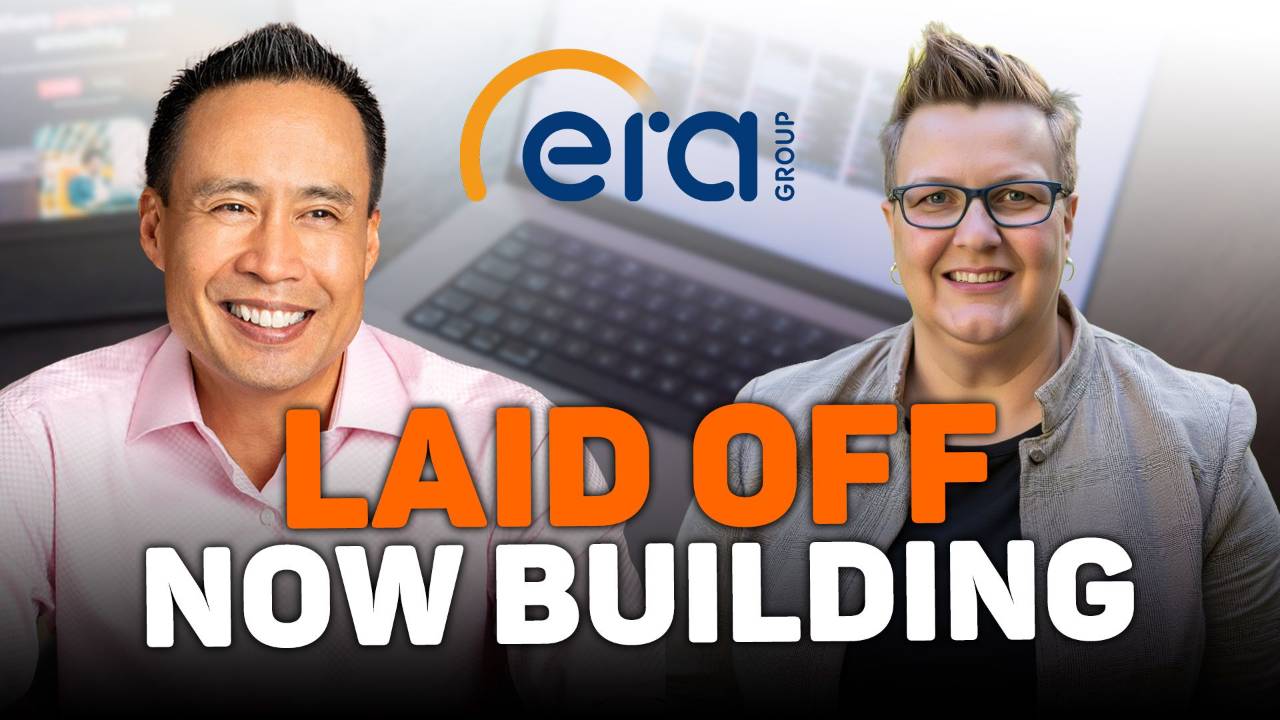
How to Buy a Franchise After a Layoff: Her ERA Group Story
Sep 08, 2026This is a transcript from Episode 50 of The Franchise Champion Show.
Listen to the full episode on Apple Podcasts, Spotify, or YouTube.
Alan Regala: My guest today left a long, successful career in corporate logistics after a layoff she never saw coming. Just a few weeks into her ERA Group franchise, she's building something new in real time, and we're getting her story before the dust even settles. Hallie Savannah, welcome to the show.
Hallie Savannah: Thank you, Alan. Pleasure to be here today.
Alan: Well, I'm excited to have you on the show. You are one of my favorite clients, and you just recently signed with ERA Group not that long ago. I'm super excited to help share your story of how you got to this place. Obviously it's still very early on, but I love the idea of sharing with people what the process looks like, even at the beginning stages, training and all those other things. Help bring some awareness to what all that stuff looks like at the beginning, and then of course hopefully follow your story along as things progress over time.
Alan: So do you mind sharing with us, what was your life like before ERA Group?
Hallie: So if anybody knows anything about logistics or freight forwarding, it's a very demanding career. Your weekends, your holidays, your vacations tend to get consumed with the next hot shipment, something goes wrong, or a customer needs something.
Alan: I want you to pretend like we've got people who know nothing about freight forwarding. Give us a little background on what you were doing, what your industry is.
Hallie: Sure. The simple answer is moving cargo around the world. So when you look at big ships and the containers that are on there, that's what I did. I helped facilitate the movement of those around the globe, in addition to air freight, loading freight onto airplanes. We didn't actually do the physical loading, but when you see airplanes offloading pallets of cargo, that's what we do. We would arrange for that cargo to get on the planes and move it around the globe.
There's a lot that goes into it behind the scenes. You have to make sure that cargo gets picked up on time, gets to the port on time, gets on the vessel on time, and then delivered to the end user so that they can build airplanes or manufacture different products and meet their timelines and commitments to their customers. So there's a lot that goes into making sure things get to where they need to be when they need to be there.
Alan: And it seems like it can be very time consuming depending on what roles you're in.
Hallie: Yeah. Your day-to-day operators, they come in, they do their job well, they put a lot of effort in, and they can go home in the evening. When you're doing account management like I was, or multiple account management, your time after work is also consumed with work because you're not just working in one time zone. You're working globally. So you tend to be having meetings either early in the morning or late at night. Sometimes I've been up at 3 or 4 in the morning taking a meeting with colleagues around the world that fits into their schedules as well.
Alan: Wow. Sounds like a very demanding position. I knew what you did before, but I had no idea how much time that consumed and how many hours that took out of the day. That's a lot. So you did that for quite a long time. How long was that?
Hallie: I got into the industry in 2011. So about 15 years or so, roughly.
Alan: So tell us about the transition. What happened that got you thinking about franchising?
Hallie: So what ultimately got me thinking about franchising was your newsletter, honestly. When I had left my last position, I was part of a RIF, a reduction in force. Which happens, you know, the economy takes a downturn a little bit. Some of the easy pickings are staff, right? To put it bluntly.
Me being in the position that I was, there was also somebody else working on the account from an operational standpoint who was also the branch manager. So he was selected to stay on, which is completely understandable because he had a little bit more role and responsibility outside of just the one account. That made perfect sense from a business standpoint. So no hard feelings in that regard. But it never feels good. No matter the reasoning, it never feels good.
And so after months and months of looking for work, I had seen something in your newsletter. I had no intention of doing a franchise ever, or owning my own business ever. I signed up for your newsletter to help support you in Athlete to Owner because of our connection previously with my partner. So in doing that, I would read your newsletter, and I was like, those sound interesting. Till one day I read about ERA Group and it just struck a chord with me. I was like, all of a sudden, I need to check into that.
So I talked to Noelia, my partner, and was like, what do you think? And she's like, well, let's set up a meeting with Alan. So we did. We had lunch, met up, and talked about it. And that's when I knew that this could become a reality and was something that I could actually do.
Alan: That's a great story. I would love to first have you explain what is ERA Group and what do you do for your clients.
Hallie: Sure. So ERA Group is a group of independent consultants that help companies look at non-core costs and help them find savings there. Basically, it's value through insight. We provide companies with information that can help them look at things other than their core costs.
One of the things we definitely don't look at is staffing. We don't look at staffing unless somebody asks us to, but that's not our forte. Our job is to look at these expenses as a route to keeping staff. So if we make reductions here, maybe you can keep staff over here. It helps with that.
We come in and talk to customers. We find out what their pain points are. We find out what's driving their need to find reductions or support in other areas. And then we work with them and see if we're a good fit, if we can find solutions that help them, and then they ultimately decide what solutions they would like to implement.
That could be anything from office supplies to transportation logistics. It can be janitorial, waste services. There's a whole breadth. We have 40-plus categories where we have expertise. We have over 1,000 consultants globally and we're in over 60 countries. So we have a really deep range of knowledge. And our consultants are director level, C-suite, that upper echelon of the corporate world. Can also be former business owners or former franchisees that come into this. So there's such a deeply rooted knowledge of different areas that we have.
I could go to people anywhere. I could put out the APB, as I call it in my own mind, for needing expertise in, say, packaging, because that's not mine. But we have people that specialize in that. I can reach out to them and gather information, and then they can help me with my client and hopefully provide good solutions that maybe the customer hadn't thought of.
Alan: So you provide insights for companies to help reduce their non-core expenses. That's great. And it sounds like even though you may not be an expert in a particular category, like packaging, the beauty about your system is that you have a whole bunch of other experts within your system that you can bring in with you to help with a particular client. Is that right?
Hallie: Right. And we're looking to optimize your costs. We want to look at that and see if there's any way to optimize that for you, which then in turn gives you money at the end of the day to reinvest back into your company or your people or whatever programs you may need or want to supply.
It's a really great opportunity to see what maybe your teams have not had the opportunity to look at. Not that they can't, but they may be so busy focused on the core expenses that they don't have time to look at those non-core expenses. So we can really help with that, and in so many areas.
Alan: And you have an interesting model as far as how customers pay you. Can you talk about that?
Hallie: Sure. We are not like some of the other companies that come in and charge a fee to walk in the door. We don't do that. We come in and we want to really get to know you. So we'll have conversations with you and get to know you. We'll ask if you are willing to provide your accounts payable data, in which case we can then put that into our proprietary SpinView program. It will take that information, break it out into different categories.
Now, we know there are things we can't touch, taxes, payroll taxes, things like that. So this program really takes those things, breaks it down, and tells us where we can find savings for our customers. And it gives you the tools to see how that can project your savings over, say, a five-year period. For most people it's quite significant.
That's before we even offer to move forward if it seems like a fit. And then if it does, down the road, we do probably several months worth of work before we even ask for a dime. But you have to sign the contract. Once we provide the information, if you decide to move forward, you would sign our engagement letter, and then that's where the real work starts to get down to the nitty gritty. We can tell you transaction numbers. We can tell you where you spend the bulk of your money.
A lot of customers, if they had, say, hypothetically, 100 vendors, the bulk of their business is spent within probably the first 20 providers, covering 80% of their spend. Maybe there's some opportunities there to find better savings. And you don't have to get rid of your current providers if you don't want to, because some people are very attached to their vendors.
So once you sign the engagement letter, our fees start after that. But you don't pay everything up front because it's based on actual savings at the end of the day. We charge our first fee after we've provided you with options, but that's about two months in roughly.
From that point, we work with you on what projects you want to work on. A project is simply, I want to work on office supplies, I want to work on waste management and janitorial, packaging. Each of those can be a separate project, and we can find significant savings in those as well.
Once we've implemented these savings for you, we monitor for an additional 36 months. We don't just hand you something and say, here you go, good luck, best wishes. We're your trusted partner. By showing you this, we're going to stay with you for three years at least. Sometimes you can do a little shorter, but three years is really where we find the value.
So we provide either monthly or quarterly reports and show them the actual savings they're getting based on the benchmarking that we did. And we also make sure they're continuing to do what they need to do, because sometimes with office supplies, for instance, people tend to go a little rogue. One personal order from Staples, one from Office Depot, another from Amazon. And we've found that by buying centralized, you can buy in bulk, which means you get better savings. So we monitor that as well to make sure people aren't going outside of what you really want them to be purchasing.
It works out really well and our clients are very happy. We have lots of reviews and case studies that we can provide for customers that show the value we provide.
Alan: So it sounds like you don't charge a fee up front like most of these other consulting companies do, which is often a very large fee. Your fee is based on their savings. You're basically saying, we're going to save you this amount of money, and our fee comes out of that for some fixed period of time. Is that right?
Hallie: Correct.
Alan: That's fantastic. So really there's no way to lose for a company to work with you. They're getting information up front and not paying for anything. They only pay you if they're saving money.
Hallie: That is correct. If they choose to move forward once we provide them with the SpinView analysis, that's where they can choose to move forward or not.
Alan: So what was it that drew you to this particular franchise brand? Because for a lot of people, they get pulled in one direction or another. And it's interesting, your background was logistics and this isn't a logistics franchise. So what was it about this that drew you to it?
Hallie: So being part of a RIF, like I said earlier, never feels good. And one of the things that drew me to ERA Group was the fact that staffing is not the first place they look. We look at ways to help people stay in their jobs. We don't want to take jobs from people. We want people to stay in their jobs. That was one thing that drew me to ERA when I started researching a little more.
Initially it was the thought of just helping companies be the best that they can be in their industries. To me, that's really a big thing, helping people, helping companies. And I love that.
And not to mention, I didn't have to build a team to do it. I can do it with me. And then I can utilize our network for other expertise that I don't have. So that was really a key point. And I could also bring my logistics knowledge to help customers as well, because a lot of customers need help with logistics, whether it's domestic, international, that sort of thing.
So for me, that was a big draw, that I could actually use that expertise that I have but still not have to be in the day-to-day grind of logistics.
Alan: I love it. It seems like a perfect match. And you mentioned a couple of interesting things. One being this particular franchise is very different than others in that there is not a team that you have to employ, no W-2 employees or independent contractors that you're managing on a day-to-day basis. You're a consultant on your own, but you do have a team of other franchise owners in the system to help with the various technical aspects of things where you're not the expert.
That's a very unique thing in franchising, because most franchises tend to have people locally. But this is a cool one that you could operate from pretty much anywhere.
Hallie: You can. And honestly, for me, I feel like I'm part of a big company, but I'm not. I have my own business that I'm running and I can do things how I see fit for my company. But because we all collaborate and help each other out, and we can also joint venture with other franchisees, that aspect alone makes it feel like you're part of something bigger without being part of a big company.
Alan: So let's hear about the process of exploration. You contacted me and you said, hey, I really like this one particular brand. And for me that's fantastic, that's great. But it's rare that I'm ever like, okay, let's just look at this one. I wanted to make sure if you're going into this process, you have a point of reference. If you've never owned a franchise before, it's probably a good idea to look at more than just one thing, even if the one thing you're really excited about. So tell me what the process was like of exploring this particular brand and anything else, and how you ended up deciding.
Hallie: Sure. So you're right. When we met, you took down some notes and information from me, kind of what I was looking for, and even from a financial aspect what that looked like for me. And from there, you came back with a couple of franchises to look at, one being ERA of course because that was the one I was really drawn to. And the other one was another company.
So you made introductions via email for me, and from there I worked with their teams learning more about them, the discovery phase. One of the things I found out on the other company was they needed me to hire at least two people right away. That to me was a concern. I'm not sure if I want to have employees right away. So I still went through a few more calls, got some more information on what they did, how they did it. And it's not to say that it wasn't a good opportunity, because it was. It just wasn't a fit for me.
So you and I talked about this, and you provided me another one to check out. That one was a little more interesting, a newer franchisor. But it was one that I couldn't really kind of wrap my mind around at first. I ended up talking to you about that, and then finally it clicked as to what they were doing and what they wanted. And I just decided it didn't feel right for me.
Hallie: So I was listening to what was inside. And then the other side of that is when I was talking to a dear friend of mine, I was telling her about ERA, and I started using the term "we." We do this. And I was like, wait, no, I haven't signed anything yet. It's still ERA and then there's me.
And so that to me was a good indicator that ERA was where I belonged, because I felt like I was already there. And that was huge for me, because again, I didn't want to own a business. I didn't want to own a franchise. And so to see myself actually in it and talking from that first-person perspective for ERA was really when it was like, that's it.
Alan: Yeah, that's very telling. You start using "we" instead of "they." That's really cool.
Alan: I'd love to hear what your experience was like in the validation process. Talking to other existing ERA Group owners.
Hallie: Sure. So I talked to three different owners within ERA, all at different tenures. One gal was getting close to retiring. Another gentleman had been there for probably 15 years. And then another one had probably been there 5 to 7 years, somewhere in that range.
So different tenures, because you get different perspectives. And they were also at different levels as far as income, although they never specified what their incomes were, which I understand. However, I was told that they were at different points.
And it was actually really good. They all had really good things to say, but they also said there are some things the company could do better, maybe in this area or that area. So that was interesting to hear that aspect as well.
They also said what they wish they would have done sooner rather than later. And some of that was around internal branding, being known internally to your other franchisees. They wished they would have started that process earlier. In addition, some of them also wished they would have started doing their networking earlier instead of waiting a month or two in.
That was good advice. All stuff I have taken and done for myself. I've already started networking. I've already started my internal branding. So I'm already taking that information and using it to hopefully propel myself a little farther along than some others that are just starting out.
But it was good talking to them. And I think it's a necessary process as well.
Alan: Yeah, it's a must-do for everyone looking into franchising. Talk to some existing owners. Get the feedback on what things are working or not working for them, things that could be better. But also what is working well, what they recommend, especially from people that are high performers in a system. Getting great tips so that you can start off as quickly as possible from the get-go.
Alan: So let's hear, you end up signing with ERA Group. Tell us about training and what that was like.
Hallie: Sure. So the training was in England, in the Kent region, southeast England. It was for two weeks. I think July 6th through the 17th.
The first week, we focused on the methodology of actually doing the analysis, what ERA does for customers. And then the second week was focused on how do we sell that or present that to new clients. So instead of doing the sales and then what we sold, we did what we sell and then how to sell it, which I think is a great way to do it.
It was very hot in England. So a lot of our focus was not only on the information but on the fans in the room. I'll just say that right up front.
Alan: There's not a lot of air conditioning in Europe, I guess.
Hallie: There is not. And so that was always something we talked about every day, as well as the training itself. So that was kind of a fun aspect of it. But it was great to be with the cohort that I was. We had two others from the US, one from Canada, one from the Netherlands, Belgium, and Germany. So there were seven of us altogether.
Alan: Very cool.
Hallie: We had a lot of different perspectives from between North America and Europe. And it was really great to have that insight from different people.
Alan: Yeah, that's great. I know training for any franchise is condensed and it's like drinking from a fire hose. It's tough to get through just because it's a lot of information and you don't always retain all of it.
Alan: So I'd love to hear, what's happened since you've been back? How have the first few weeks gone for you?
Hallie: Sure. The first few weeks have been good. I don't have a client yet. It does take some time to get your first client.
There are also a couple of different roles you can have within ERA Group. As a franchisee you can focus on sales, which we call CAMs, key account managers. You can also focus on what we call EPMs, which are the project managers. Or the SDS, which is a solution delivery specialist. Those are the ones that really do the analysis work. They do the benchmarking and find the savings and connect you with the right vendors.
For me right now, my goal is to get a client. But I'm also looking into SDS work as well, because sometimes that can be a faster road to revenue. But not always. You also have to do a good job so that other franchisees keep coming back and want to use your SDS knowledge and services.
Some franchisees only do SDS work. Others only do CAM and EPM work. And then there are some that do a mix of both. I've gotten some really good advice because I'm looking at probably doing a little bit of both. A franchisee I talked to in Europe said, make sure you mark your calendar for time for both, because if you don't, you'll get too many projects on the SDS side and you won't have time to do your sales side. He said, just make sure you find that good balance for yourself. Don't overwhelm yourself, especially at first.
Alan: That makes sense.
Hallie: So I think there's a lot of really good things to come for me. I've done a lot of networking. I've been to 3 or 4 different networking events already. I joined the GSBA, which is the Greater Seattle Business Association. I also did some things like signed up for the Puget Sound Business Journal, where I can get information about companies and what's going on and who might be needing the type of service that we provide.
I'm trying to do those little things, in addition to researching companies that I find interesting. I think that's a good place to start, because if I find it interesting, I'm going to be excited about it. And then also utilizing my LinkedIn contacts, looking through LinkedIn and seeing who I have on there that might be able to point me to somebody or a particular company.
Advice for Corporate Professionals Thinking About Franchising
Alan: What kind of advice would you have for anyone out there that is maybe still in the corporate world and thinking about getting into franchising or owning a business for themselves?
Hallie: Know that going into it, it's a lot of work. Just setting it up alone was a lot of work. Fortunately, I was able to draw on your knowledge. You had given me some people to talk to and different things that really helped a lot.
And also, if you decide you want to do something like this, find something that you're passionate about. Because if you're passionate about, say for me, helping companies be the best they can, it comes easier. It feels more natural. It's not forced. Because if it's something that you're trying to force, then you may not be as good at it. Or your customers may find it.
I'm spending about 40 hours a week roughly. Maybe a couple of weeks I've spent a little less, but 40 hours a week is a good place. Not to say that I won't do more in the future, but right now, just getting initially going, I'm doing 40 hours a week because I'm doing a lot of researching on companies and different things. And after a while your brain is kind of like, okay, I need to stop, take a break. But I'm always looking. I'm always reading the news, looking at things.
For me, it was easy. I don't know that everybody has that case. But like I said, I wasn't looking. I just signed up for your newsletter to help support you. And lo and behold, I found my next thing. But I always knew there was something more for me out there. I just didn't know what it was. And I didn't think it was this until I found ERA.
Alan: Having known you from before, just how much of a hard worker and diligent and smart person you are, it really delights me to know that you can apply those things to your own business. Even though there's a lot of work building the foundation and a lot of time and effort going in early, in the long run you're going to be successful because I just know your personality and your work ethic.
And regarding the passion thing, it's an interesting word. I would actually take your passion and connect that with your desire to really help people. You obviously have a passion to help people. But I would say the passion is for the purpose maybe, or connecting with the need, the problem that's being solved, versus, I think some people think about passion like, oh man, I love coffee, I've got to open a coffee shop. Or, man, I love ice cream, let me open an ice cream shop. Which is great if that can align with the skill sets and the other things that are needed to operate that kind of business.
But sometimes that passion, like for me with ShelfGenie, I didn't have a passion for shelving. But I did connect with the need. I could see there being a need for shelves that pull out, better, easier access to things. And I was passionate about helping people. So that was a place where I could see the need, I love helping people, that works. And it worked great for me.
So I'm glad you were able to see that connection very early on, wanting to help others, help businesses.
Hallie: Me too. And I have you to thank for that. So I really appreciate it.
Alan: You're welcome. Of course. It was a pleasure working with you through the process. Thank you so much for joining me today, Hallie. It was a pleasure having you on. And congratulations on the start of your journey to becoming a Franchise Champion.
Hallie: Thank you. I appreciate it. Thanks for having me.
Don't miss a beat!
We hate SPAM. We will never sell your information, for any reason.