Is Brothers Gutters The Right Franchise?
Apr 21, 2026This is a transcript from Episode 34 of The Franchise Champion Show. Listen to the full episode on Apple Podcasts, Spotify, or YouTube.
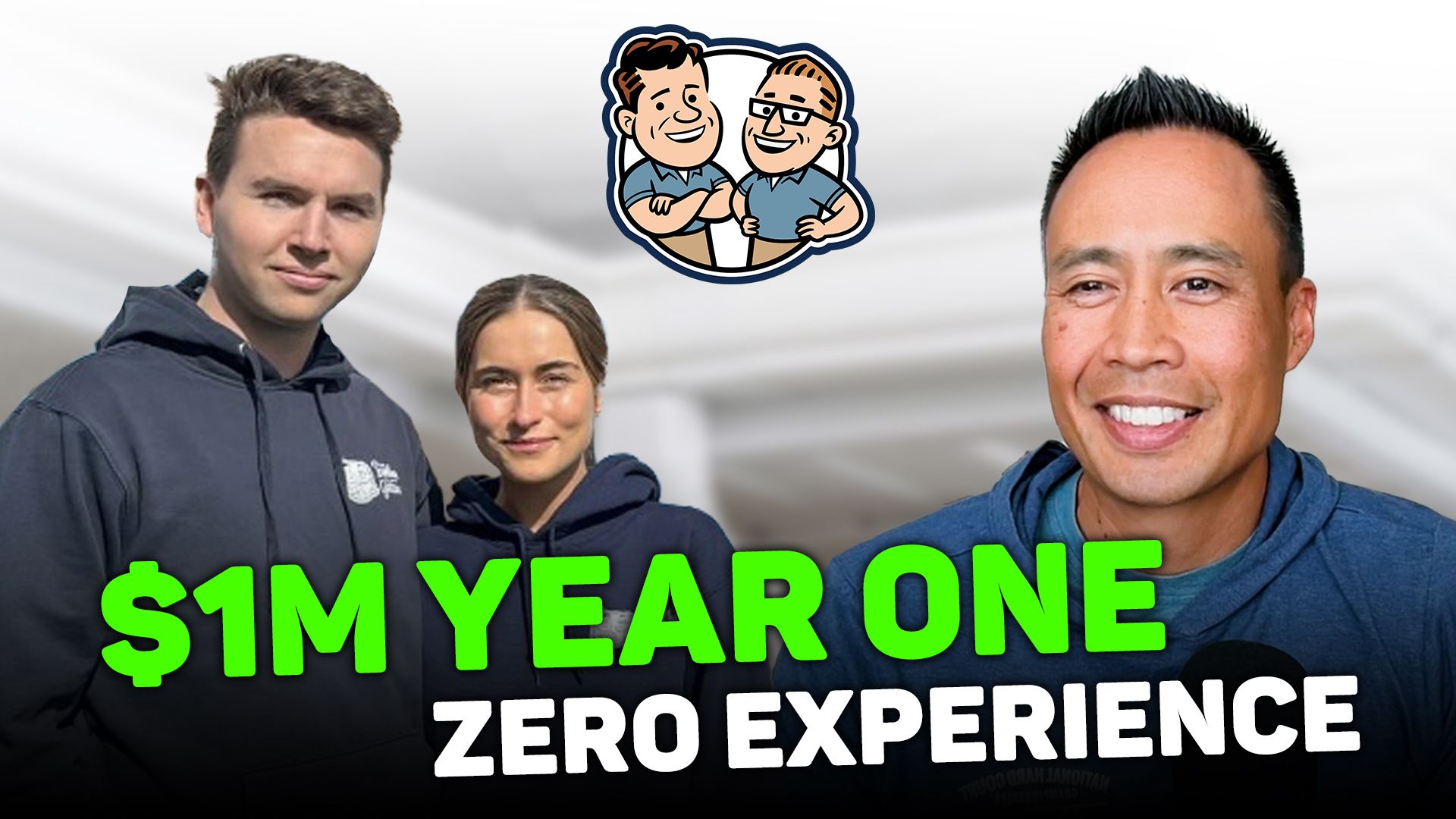
Alan: My guests today did something most people twice their age wouldn't dare. They opened a Brothers That Just Do Gutters franchise in their early 20s with no business background and crossed $1 million in revenue in their very first full year. What's even more remarkable is what they built along the way. Trevor and Lauren Tatko, welcome to the Franchise Champion Show.
Lauren: Thank you. What an intro.
Trevor: Wow, thank you Alan. Appreciate that introduction.
Alan: This is great. I'm super excited to share your story. We chatted a couple of weeks ago and it's just so interesting and inspiring, really. Take us back to before you guys got into franchising. What were each of your backgrounds? Lauren, I'll let you take it.
Lauren: All right. So when we first met, I was finishing up college and Trevor had just graduated. We went to college in the same state but at two separate schools. He went to University of Idaho in northern Idaho, up in Moscow. And I was down in Boise at Boise State, finishing out my Bachelor's of Science in Nursing. Trevor graduated with a degree in math and statistics, like actuarial science.
Alan: Nice. So you guys were rivals from the beginning. Somehow it worked out.
Lauren: For Christmas we got this "House Divided" sign. It's Boise State and Idaho on there. He's legacy U of I and I'm legacy Boise State, so it runs deeper than just the two of us. Our parents constantly make jokes about it.
But yeah, I was still in school and I've always had this entrepreneurial itch, where I would kind of start things throughout my life. My parents were very adamant about me getting a higher-level education, and I'm super grateful for that. They paid my way through school, which was huge. Very privileged to have been able to do that.
When Trevor and I first met, we would always play this game where we'd come up with business ideas or product ideas to sell. Our minds just kind of worked in that similar way. Then I started working as a nurse, but before I get too far into the story, I'll turn it over to Trevor to talk about his background, because he was in the workforce before I was.
Trevor: Yeah, Lauren nailed it. University of Idaho, actuarial science, thinking math and stats would give me a leg up on the business side when I started looking for a job. I graduated and landed a job at Clearwater Analytics. I was there for a couple of years. That's when I met Lauren.
It was very repetitive. I wasn't sure if it was what I wanted to do for the rest of my life. Great team and all of that, but as you'll learn more about as we go through this conversation, Lauren sees something and it's just like, "Why not us? Let's go do that." One thing led to another, and I'm sure we'll dive into how we found this company. But yeah, that's my background.
Alan: Okay. Lauren, catch us up. What happens next?
Lauren: I graduated from nursing school, worked as a CNA in the hospital setting, then graduated and became an emergency department nurse, which I loved because my personality is very much an adrenaline junkie type of person. I'm spontaneous, I love high-stress environments, big crazy things happening. That's where I thrive. I'm a goer. I like to be busy. So it worked out really well.
But throughout that whole process, there was always this thing in the back of my mind saying, this is not what I'm supposed to do with my life. I want something bigger and better.
Trevor and I have always been really into communication between us. We sat down and had a real discussion about what we wanted our life to look like, say, five or ten years from now. Like, do we own private jets? Do we live in an apartment? What does it look like? We wrote it out on a piece of paper.
To be completely honest, Trevor is a simple man. He was like, "I just want to have fun. I just want to live my life." And he decided to marry a woman who is not simple. I said, "No, no, no, we want big, grand things. And we can't get there with the career paths we have."
One of the things we both always talked about was starting a business. So we started exploring that more. And without getting too much into Trevor's side, I know he doesn't like when I talk about this, but when he was at Clearwater, he's a very outgoing person who loves to build relationships with people. His job was very much behind a desk on a computer all day. He got into a rut where he was just really unfulfilled in what he was doing. Not because of the company, just because of the nature of the work.
Because of that, we had that conversation. We want more. We deserve to be happy and chase our dreams. And if someone else can do it, why can't we?
The other thing we talked about incessantly was that we didn't have kids, we didn't have a mortgage, we didn't have car payments. Our parents had paid for us to go to school. We really had no debts at that point.
A lot of people look at us and say, "Why would you do that when you're so young?" And my question is always, "Why would you wait until you have all these things relying on you to take that chance? It's so much scarier then." Now we have mentors who did it the other way and they're like, "I don't know how you factor kids into having a business when you didn't have them before you started." So we're kind of doing it in reverse. But it's a learning process and it's been great.
Alan: I have to commend you. Sitting down and actually designing your life is something most people just never do. You don't go to a class in high school about designing your life. College is the assumption and you just keep going. For you guys to do that on your own, that is fantastic.
And I love the thought you put into the timing of it. I was the same way. I finished grad school, worked in industry for a couple of years, and then made the leap. The mindset was the same: I don't have all these responsibilities yet, I can always go back, so why not do it while I'm young and I've got energy? Kudos to you both for taking that leap early. You're going to be able to enjoy the fruits of your labor for so much longer for having started earlier.
Lauren: One thing we honestly didn't factor in at the time, but that's become really apparent, is that because we were both fresh out of college, we weren't making hundreds of thousands of dollars yet. Now when we talk to other owners, one of their biggest struggles is that they built a life based on a $200,000 or $300,000 income, and the business takes time to grow. You have to live really lean for a while.
The nice part for us is that we're still okay with living like college students. We went straight from college to owning this business. We never had to bridge the gap between a big lifestyle and the early income the business could generate while it was growing. Instead of going big and scaling back, we're just climbing naturally. That's been a huge advantage we didn't even see coming.
Alan: Another good reason to start early if you have the financial means. So how did you actually get from that point to finding this business?
Trevor: To piggyback off Lauren, I came from a save-money, don't-take-on-debt, pay-your-bills-and-invest mindset. When Lauren and I started dating, I was trying to teach her those things. Let's put 15% into retirement, build wealth the safe and well-proven way.
And then she kind of got addicted to finding ways to make money. All of a sudden I'd come home from work and she'd be like, "Oh my gosh, I just listened to this podcast, they talked all about how you can start this business." Next thing I know, Lauren's on BizBuySell, she's on LoopNet. I come home from work and she goes, "Hey Trevor, we have a call in 30 minutes with a dog poop scooping company." I'm just like, what are we doing?
We had no idea what was going on, but that's just Lauren. Jump in and figure it out. If it had just been me, I would still be at that old job. There's no way I would have made that leap.
She started getting the ball rolling, talking to business owners selling companies in Boise. One thing led to another. We eventually learned about franchises and thought, "Maybe that's a good route because it's a proven business model." We don't know anything about business ownership. We barely know anything about our own careers, and we'd only been in the workforce a couple of years.
It came down to finances. We couldn't just go buy a multi-million dollar company. A lot of trades-type or service-based businesses have a lower barrier to entry on the financial side, so we started looking there. We still had to figure out how to fund it. We didn't have $50,000 or $100,000 just lying around. So we started learning about SBA loans and other ways to get into it.
And I should say, all of this happened within about 30 days. When Lauren is locked onto something, it moves fast. We were looking at dog poop scooping companies, and then basically the next day we were ready to sign paperwork. We connected with a guy named Matt Dowd, who's in Florida. He's a franchise broker, but he also happened to be an owner of Brothers Gutters in Florida. We thought, "Okay, this guy is actually in this business himself. He must trust it." We explored it further. This guy talks a million miles an hour. If you get on the phone with him, plan for a 30-minute to two-hour conversation. He told us everything we needed to know about Brothers Gutters.
After a lot of due diligence and calling owners around the nation, we were ready to sign the dotted line.
Lauren: I want to say real quick, I know Trevor was shouting me out, saying he'd still be at his old job if it weren't for me, and I appreciate that. But we have a really great balance. If Trevor wasn't here, we'd be broke and I would have spent all our money on businesses that failed. I run fast and Trevor brings me back down to earth. I go fast, he reels me in, but I pull him along. We balance out really well.
Trevor: In that same vein, I always hear that the name of the game is speed. But I think I actually need to learn the opposite lesson. Sometimes I get an idea and take off like a bullet, and I'm 90% of the way through before Trevor goes, "Whoa, whoa, whoa." And I realize we probably should have done ten more things of due diligence before just diving in. Good and bad.
But it's a good balance. We made the analogy the other day: if it was just me running the company, we'd be flatlined, never getting to that next step. And if it was just Lauren, it would go way up and then crash, way up and then crash. Together we've got this nice steady trajectory.
Alan: That's perfect. It speaks to the advantage of having a good partner in a business like this. Working with your spouse isn't going to be for everybody, but for you two it seems like a great match. So tell us, what is Brothers That Just Do Gutters and how do you impact the lives of your clients?
Trevor: So Brothers That Just Do Gutters is, obviously, a gutter company. We do all things gutters for residential homes, specifically the gutters mounted on the eaves of the roof. We do installation, maintenance, cleanings, and repairs. We work with both commercial and residential clients. When you start out you're heavy in residential, existing homes, and as we've grown we've migrated more into new builds and commercial work.
The biggest thing for us is that we say we're a customer service company that happens to do gutters. The company's tagline is "reinventing contractor service," which means bringing white-collar professionalism to blue-collar trades. Uniforms, speaking respectfully, treating every house like it's our own. You'd be surprised how easy it is to develop a great reputation just by being a reputable, respectful, customer-service-focused company, especially in the trades. There's still a real gap there.
Lauren: Something that was really important to Trevor and me from day one was culture. We wanted to be true to our word from the start. We immediately hired two installers and have grown to about eight employees including Trevor and me, with a goal to reach 10 to 12 this year.
We try hard not to lay people off, even though this is a seasonal business and that's pretty common in the industry. We really try to protect our guys and keep them happy. I don't know if anyone has read "How to Win Friends and Influence People" by Dale Carnegie, but there's a great point in there about how people, like dogs, do better with positive reinforcement than with discipline. That's how we try to run things. We're all a team on the same playing field, genuinely trying to help each other grow and be more successful.
We believe that if we do that internally, it translates directly to the customer experience. When our guys are bought in, loyal, and believe in the values, they want to represent us well. They want to represent themselves well. Customers see it time and time again.
We get told constantly, "You guys must have been in business for ten-plus years." And we're like, "No, two years." We have 175 five-star reviews and nothing lower than that, and honestly it has nothing to do with Trevor and me. It's our installers and sales team doing an amazing job. Nobody writes a review saying "Lauren did a great job." It's always "Armando did a great job" or "Cody was fabulous." That comes back to the culture.
We also have a 100% satisfaction guarantee. We didn't even realize it until about a year in, but when we were still learning and things were messy, we had two customers who were unhappy and we fully refunded them. That's just our standard. It's done wonders for our reputation in the valley, and personally it gives me so much fulfillment. I feel like I can walk into any room and be proud of the company we've built.
Alan: That's the key in the home improvement sector. It's very easy to stand out when you're just doing what you say you're going to do and treating people with respect. And 175 five-star reviews in two years is a real accomplishment. So let's talk about year one. You launched in April of 2024?
Trevor: That's right. April 2024 was when we officially opened doors and did our first project.
Alan: What was that first year like, starting from nothing?
Trevor: Lauren, I'll start and then you'll jump in. Before we even launched, after we'd signed the documents, the timing worked out that Brothers Gutters nationally was doing their annual conference in March of 2024. We weren't set to launch until April, but all the owners said, "You guys should come. You'll meet people, learn things before you open doors." So we flew out to Hilton Head, South Carolina.
We're meeting all these people, and one of the breakout sessions was all about cash flow. Keep in mind, we knew nothing about business. Nothing about invoicing, revenue, or even the basics of cost of goods. We're sitting in this owners-only session and all these established owners are stressed and talking among themselves. Then Lauren grabs the microphone and says, "We're 24 years old. We have no idea what we're doing. What are we supposed to do?"
And that's one of the big reasons we chose Brothers Gutters. Every single one of those owners responded with, "If you guys fail, we fail. We're all doing this together." The power of this franchise is that everybody really wants everybody else to succeed. It's not like two McDonald's down the street competing with each other. Everyone is genuinely trying to lift each other up.
But that plane ride home was brutal. Lauren and I were on different flights for some reason, probably trying to save money. We were on a college budget. I remember sitting alone, holding back tears. "We are so screwed. What are we doing? There's so much money going into this." And that was pretty much what those first few months were like. A lot of going to bed crying, scared of what was going to happen.
We'd come back from a tough day where everything felt like the end of the world. A customer was upset about something and it felt like the final straw. We had a guy walk off a job site in probably month one, and we had to completely pivot. I started going out to do more of the installation work. Lauren had to take on all the sales on top of everything else. Our other installer had to step up and take on more of the day-to-day. Those first few months were very hard.
Looking back though, we ran the business like college students. If we don't have the money for it, we don't spend it. Because of that, we were actually profitable in those first few months. I think technically even in month one. Not because we were doing a ton of revenue, just because we bought only what we needed and paid our guys. But yeah, going to bed crying, not sure what we were getting into, that was real.
Lauren: Yes, to Trevor's point, we cried probably three days out of every week. But I don't want to sugarcoat it because I think so many people do. It's tough. But you just have to keep going. It gets better.
It's like drinking from a firehose. You're learning so fast. Everything feels like imminent death. Everything is a lot. Are we going to keep this installer? Is this guy going to leave? How do we hire? All of these things are so new and coming at you at a million miles an hour.
I almost guarantee that either one of us would have quit alone. But we had each other. We would just alternate. If I was having a mental breakdown, Trevor would be like, "It's okay, we're going to do this, it's going to be fine." Then I'd have a moment of clarity and talk him off the ledge.
There was a period about a month and a half in, maybe a week stretch, where we were both down at the same time. Leads weren't coming in, we were unsure about the call center, and there was just a lot happening personally on top of everything else. I said to Trevor one day, "Are you going to quit tomorrow?" He said no. And I said, "Then buckle up your bootstraps." I kept it PG.
That conversation was a turning point. We realized we can't sit here every day and lament all the things going wrong. We have to find the good, because constantly focusing on what's going wrong will sink the business. You just tackle things one at a time. One foot in front of the other. And then those things that felt so massive at the time, like when our guy walked off the job site, you eventually get to a point where something similar happens and you just think, "Okay, I know how to handle this."
The biggest thing is you have to look yourself in the mirror and say, "Am I going to quit? No? Then get to work."
Trevor: Every time something went wrong, Lauren, especially coming from the emergency department, would put it in perspective for me. I'd be upset about, say, a corner we installed that was leaking. And Lauren would say, "Trevor. No one is dying. It's gutters." That's just a great perspective. The customer is going to live. We're not performing CPR. It's not that big of a deal. Handle one thing at a time and build from there.
[Mid-roll: Alan talks about matching individuals with the right franchise at no cost. Book a call at athletetoowner.com/ready.]
Alan: Lauren, you mentioned grit and the ability to get through tough times. Where did you and Trevor develop that? Because for a lot of people, that's the fear that keeps them from making the leap.
Lauren: Trevor is incredibly attentive on the financial and data side, which I think comes from his math and statistics background. He digs deep. When we say we were profitable in month one, that's at least 85% because of how careful Trevor is with the numbers. He's always running budgets and projections, always tracking where we're at versus our targets. That keeps you from dealing with a problem when you've already crash-landed. You catch it mid-descent.
And for me, I'm really big on proactive communication. If I see a potential problem coming, we're having a conversation about it, no matter how hard it's going to be. Together, those two things, Trevor catching it on the data side and me catching it on the communication side, have been our version of grit.
I also want to share something a little more personal. When we first started the business, we were dating, not even engaged yet. Everyone thought I was crazy for going into business with someone I wasn't married to. We heard horror story after horror story about businesses tearing couples apart.
What we very quickly found was that we didn't have time to just be "Trevor and Lauren, boyfriend and girlfriend." We only had time to be "Trevor and Lauren, business partners." That could have destroyed the relationship if we'd let it go unchecked. I started to see it happening and said, "Trevor, we're sitting down and we're going to figure this out. The business completely relies on us being solid partners in every sense of the word." That conversation led to us scheduling three dates a month. We realized that if you don't schedule it, it doesn't happen.
Grit, at its core, comes from having a solid foundation. Whether that's the health of the relationship or the health of the business, you have to be aware of things and not neglect them because it's easier to ignore them. Otherwise you're dealing with everything only after you've already crash-landed.
Trevor: What Lauren said was perfect. I'll just add that we both had this belief. A belief in the business, but also a belief in our relationship. All these people with horror stories about divorce or failed partnerships, we just blocked that out. We knew what path we were building.
The franchise really helped on the business side. They gave us a clear structure: if you hit these metrics for revenue, material costs, and overhead, you should be profitable on paper. If something is high, you just dissect it and fix it. We knew the numbers could work because it had already been done all over the country by owners doing it every different way. We were like, "We can make that happen here."
And like Lauren said, the behind-the-scenes work on the relationship takes effort too. We used to go on walks before the business. Now we go on walks and it basically becomes a business meeting because we're talking about gutters the entire time, looking at houses, noticing gutters. It finds its way into every part of your life. The three scheduled dates a month have been really important for us.
Alan: You both said it well. Communication has come up a lot, and so has the idea of anticipation, seeing things coming before they become a crisis and doing something about it. That's what designing your life is about too. You get what you tolerate, not what you deserve. And that's a lesson that goes far beyond business.
Lauren, you mentioned going through something personally that shaped your resilience. Are you willing to share that?
Lauren: Yeah, I'll share it. Hopefully I don't cry.
Basically, when I was in college, and honestly I feel like I'd had this in some form since around fifth grade, I developed a really serious eating disorder. It ran rampant in my life. I was suicidal for a period of time. I was in a very dark place. I pushed so many people away. I was always angry, partly because when you're severely undernourished your brain just doesn't have the fuel to function. I struggled with everything. Always cold, couldn't sleep, and it just constantly deteriorated my mind.
I tried everything to get better. And then one day my mom said to me, "How are you not more afraid of dying than you are of getting comfortable?" Because I was so unwilling to get uncomfortable. She was right.
I lost people I love during that time because of my actions. I was just a shell. That's not dramatic, it's just what it was. It was really tough on my family and on me.
Right before I met Trevor, I finally started to really get better. And that became the moment where I thought, "If I can walk back from that brink, I can do anything. Nothing should scare me." Shoot for the stars, land on the moon, because nothing is as scary as having been in that space.
One of the things I realized was that a big trigger for me was not having purpose or feeling fulfilled. That's part of why writing out what you want your life to look like became like personal therapy for me. It gave me direction. It answered the question of what I'm actually working toward.
And it gave me this "why not us?" mentality. When you allow yourself to see that it's a big, beautiful world with so many things you can do, you start to think, "Screw it, why not try?" I've teetered on that brink where I wondered if life was worth it. And then when you fully embrace it, the answer is, "Yes, it absolutely is. Squeeze every drop of goodness out of it."
That's where my drive comes from. People see me as fearless, but it's not that. It's that I've been at my lowest low, and there's not much else that scares me outside of that. And then pairing that with Trevor, who I truly believe is the best partner in the world for me, I thought, "If I can have the best partner, why can't I have the best job, the best house, the best life?" As long as we're together, we can get through anything.
Alan: That's powerful. Thank you for sharing that story. It really is inspiring. And I can feel that pain of where you were before. It's unfortunate that it sometimes takes hitting a real low before you realize just how capable you are. But when you do come out of that, you realize that if I can do that, I can handle this over here too.
All right. Let's talk about how the business actually went in year one. Revenue, what it looked like, where you are now.
Trevor: Year one, I'll frame it as April 2024 to end of 2024. It was slow moving at first. We were just trying to figure out the systems. Those first six months were steady but slow. Then Lauren, as she does, started looking ahead.
In August of 2024, we were at our slowest point. A good month for us is at least $80,000 in revenue. When we first started, we were doing maybe $20,000 to $30,000 a month just keeping things moving. In August we were doing around $20,000. We were paying our guys to walk neighborhoods, put up yard signs and door hangers, just to keep them employed and paid.
Then Lauren said, "The fall is coming. Let's buy another truck." And I'm just like, absolutely not. But she called it.
We ended up buying another truck, got it built out, and that fall was the first time we really felt like, "Okay, this business can be profitable." We had a full crew on one truck pumping out jobs. Then we started running two crews. That first fall was when it clicked.
From April to December 2024, I think we did somewhere between $400,000 and $500,000 in revenue. Then going into 2025, our goal was to hit $1 million for the full year. We built out a full budget and projection for how to get there.
The fall is really where you make up lost ground. At the six-month mark we definitely weren't at $500,000, so technically we weren't on pace. But we knew the fall was coming. And then it hit and it just exploded. The guys were busy, making good money. When our guys are busy and making money, that makes us happy. That's what we want.
Lauren: It honestly breaks my heart when we'd get to the shop and have to tell the guys there's nothing on the books today. Like you failed them. We had weeks of that early on and it was brutal.
Trevor: But that first full year of 2025 we had very few days like that. Maybe none outside of some really cold January and February days. And at the end of the year, we hit the million. We almost hit 1.1. It was a huge, huge success. We were thrilled.
And then it was immediately, "Okay, what's next?" This year we still have a big revenue goal, but we're really focused on building out the team. We brought on a sales person who we think is really going to excel. We promoted one of our installers internally to project manager, and he's taking on more responsibility. The goal is to grow the team, get everyone up to speed, and use that to get to the next level.
One thing the franchise taught us was "become replaceable to get promoted." We pass that on to our guys. We told one of our installers, "We can't move you up until you train the new guy and make him a head installer who can do everything you can do. Then you can take on more." That principle of becoming replaceable to be promoted is something we try to ingrain in everyone.
Alan: That's great. Congrats on hitting that million-dollar mark in year one. It took me three or four years to get there. That's a real achievement.
Last question for each of you: what is one tip for anyone out there thinking about getting out of the corporate world and into their own business, maybe a franchise? Trevor, you go first.
Trevor: My immediate answer is find someone like Lauren who will motivate you into doing it. I would still be at my old job if it weren't for her. You just have to make the jump and start asking the questions. Tell yourself, "I belong in this room. I belong in these conversations."
Lauren always says, "I belong at that table." The table with all the business owners. And if you think about it, as you get to know more business owners, they're all just regular people. They work really hard, but no one's wearing a cape. It's nothing you can't do. You just have to be willing and have the courage to try.
This company has opened a new part of me. I used to want a simple, comfortable life. And I found that building this business has made me want to grow every single day and do things that make me uncomfortable. It's super rewarding.
Every time a barrier came up when we were trying to start, Lauren had a way around it. "We can't afford it." "There's an SBA loan." The next barrier comes up and you just find a way to punch through it. There's always a way. You just have to be curious and creative and go for it.
Lauren: I have two.
First, my parents used to tell me, "You are the five people you surround yourself with." I always thought it was the stupidest thing they'd ever said. Then we started the business and I realized how important it is.
The people we've gotten into the same circles as hold me accountable in ways they don't even realize. They're really hardworking. They're responsible. They're always on time. I'm not naturally great about being on time. But they expect it, so I rise to it. Their actions reflect on you so, so much, even when nothing is said directly.
If you're afraid to be an owner or take on more responsibility, go talk to five people who've done it or are ready to do it. And if you don't have those people around you, find them through podcasts and books. I know it sounds ridiculous, but it goes such a long way. Those are the five people you're surrounding yourself with.
Even when I was going through my darkest time, I listened to podcasts more than I talked to people. One book that helped me tremendously was "10% Happier." It's still ingrained in my soul. When you stop making excuses and just start, even without the perfect resources around you, those things will pull you out of the limited thinking you've gotten used to.
Second thing: it's okay to spend money. Trevor is going to have an aneurysm right now. But it does take money to make money. One of the best things about the franchise was that it forced us to get comfortable with spending money and seeing how it returns. Yes, we paid a deposit to start the business, but it came with so much knowledge. We wouldn't be operating like we're in year five if we hadn't paid for that.
The dance of having margin and then not having it and then having it again is constant. But if there's a calculated risk associated with an investment, it will return. We invested in ten different networking groups when we first started. Three or four survived. But the ones that did have returned maybe 100 times what we put in. It's scary to spend the money and take the chance. But taking the chance is when you get the reward, whether that's financial, emotional, or just the learning itself. Learn from all your mistakes.
Alan: I love it. You're going to make mistakes, but when you learn from them, it makes it okay. Well said. Great words of wisdom. I learned a lot on this conversation and really enjoyed your stories and all the little nuggets that will hopefully help others out there looking to get out of the corporate world and design a life of their own, like you guys have. Thank you so much for joining me today, and congratulations on being franchise champions.
Trevor: Thank you, Alan. Really appreciate it.
Lauren: Thank you.
Don't miss a beat!
We hate SPAM. We will never sell your information, for any reason.