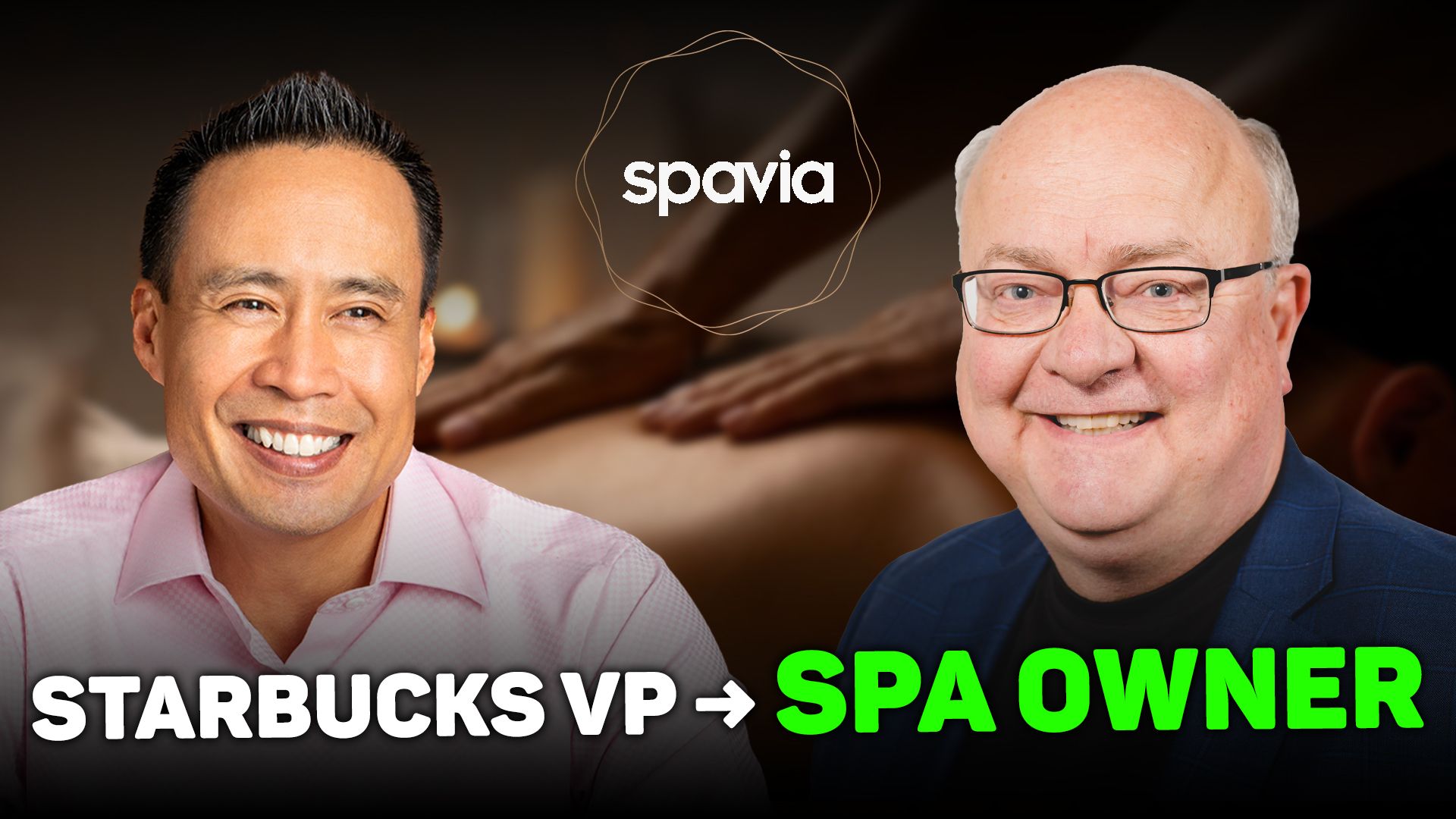
Why Did a Starbucks VP Buy Spavia?
May 26, 2026This is a transcript from Episode 39 of The Franchise Champion Show.
Listen to the full episode on Apple Podcasts, Spotify, or YouTube.
Alan Regala: My guest today spent decades leading operations at some of the biggest names in retail and food service. He took that experience and brought it into franchise ownership with a day spa in Chicago. Today he's a multi-award winner with a track record that speaks for itself. Paul, welcome to the Franchise Champion Show.
Paul Groshko: Alan, thank you for having me. It's a real pleasure.
Alan: I'm excited to learn more about you. Tell me about your background and how you ended up getting into franchising.
Paul: Well, the first 20 years was out in southern Michigan on a dairy farm. I grew up building what I think is a work ethic that has helped sustain me over the years. I got my first job outside of farming in 1981, earned an undergraduate degree at Michigan State in management and marketing, and my journey in business started in food in Washington, D.C.
I've always been the operations guy, which means I've been in the stores. The great thing about Safeway is they teach you starting at the bottom and you work your way up. I started as a night stocker in the dairy aisle at a store in Chevy Chase, D.C., and worked my way up to system manager, store manager, then district manager for my last nine years, running Baltimore and Washington, D.C. inner city stores. We built a number of locations in areas that were food deserts. Somewhere in there, I earned a couple of master's degrees and thought I was going to go work on Wall Street, but at the end of the day, operations is my DNA.
Alan: Very cool. So what happened after Safeway?
Paul: After 25 years, there was this big impact on chain store retail — the Walmart effect. They went from zero to the largest grocery entity in the nation, surpassing Kroger, Albertsons, all of them. There wasn't a lot of movement for me, so I decided I needed to make a change and look at another industry. That's when coffee came calling.
I signed on as a director with Starbucks in Texas and ran North Texas and Oklahoma for a number of years. Then someone recognized that I'd raised my hand for an international opportunity, and I was selected to live in Tokyo as the executive vice president, helping to run country operations for Starbucks International. It was a fabulous coffee culture out there. At the end of the day, coffee is coffee, whether it's Seattle, Shinjuku, or Soho — people love conversation and community. After a number of years, I repatriated back to the U.S., landed in Chicago, worked with Starbucks for a couple more years, and then retired way too early.
Alan: Before we move on, a lot of people don't know the inner workings of Starbucks internationally. Are the locations company-owned, licensed, or franchised?
Paul: At that time there were really three buckets. Company-owned stores accounted for the majority — that's how the business drives culture, systems, and processes. Then there were food service accounts, like a Starbucks inside a Barnes and Noble on a college campus. And then licensing agreements with companies like Kroger and Safeway. In Tokyo, we had a joint venture with a company called the Sazaby Group. It's a model not unlike franchising in many ways.
Alan: Got it. So then you retired — way too early, you said.
Paul: Yes, for about six months. I was 54, 55. I'm the guy with too many books and too little time, always doing something athletic. I just got bored. I needed purpose. And then a franchise consultant was put in front of me, and the world really opened up in terms of what was possible.
Alan: Tell us about that. What did the franchise consultant do for you?
Paul: They clearly understood my profile — who I was, my background, what I aspired to, and what flowed through my DNA, where I'd be a good match and where I'd be happy. When you're at this stage in life and you're investing your savings, you really want to find the right fit. When they pulled back the curtain on the wellness industry, and specifically on the organization I'm with today, it just felt right for both myself and my wife.
Alan: Tell us about Spavia and how you impact the lives of your guests.
Paul: In the wellness industry, we talk about helping to redefine what "spa" means. The word "via" in most languages means pathway or journey, so we think of this as a journey to wellness. Spavia came about in 2005. We define ourselves as resort-style, affordable luxury.
When a guest arrives, they go into a changing area, put on robes and sandals, and then settle into a retreat area before their treatment. There are neck pillows, teas, and light foods so they can warm up and relax before their specialist brings them back for a massage, skincare, waxing, and so on. Afterward, they return to the retreat area and complete that wellness journey in reverse. Along the way, we capture personal preferences for music, pressure, and aromatherapy. We call our customers guests at Spavia — that matters to us.
Alan: That sounds incredible. I can understand why your wife loved this concept.
Paul: Absolutely. And it's so needed. The skin is the largest organ in the body, so why wouldn't we take care of it? Here's a fun fact: there are 43 muscles in the face. It takes 12 to 17 of them to smile. You want to know how many it takes to frown? All 43. So why wouldn't we want to smile? It's so much easier.
In this business and in any franchise, you really need to be a student of continuous learning and be prepared for that. One of the things I love most about Spavia is the level of innovation we continue to introduce year after year. We're currently bringing micro-currents into our skincare services — sending electrical waves into the facial muscles to help firm the skin and reduce fine lines, much like a workout for your face. We're also introducing halotherapy, which is salt therapy that's been around for centuries, and infrared red light therapy. At the same time, we stay rooted in the foundation: Swedish massage, deep tissue, Himalayan hot stones — those are the core of the business.
Alan: When did you open your location?
Paul: I signed the franchise agreement in September of 2014. Someone told me it might take about a year before the business would open, and it was 11 months later, in August of 2015, that we opened our first day spa in Lincoln Park. We were the second location to open outside of Colorado — the first was back in my old stomping grounds in Plano, Texas. The business has continued to grow since then.
Alan: Almost 11 years now. Let's go back to that first year. This was your first business, and you were building out a physical space. What was that like?
Paul: One of the things that drew me to Spavia was that the processes and systems in place weren't too dissimilar from the great coffee company I'd just come from. Even as a $25 billion business, Starbucks still made mistakes. The key is you learn and relearn. Spavia provided connections with CBRE for real estate, which was helpful even though I'd opened hundreds of Starbucks and Safeway locations over 35 years. I didn't know exactly where the right spot was for a day spa, so having that support was invaluable. We narrowed it down to the top two or three options and selected Lincoln Park — great traffic, strong demographics, and significant discretionary income being spent on beauty and wellness services. It's been a very successful location.
There were always professionals aligned with Spavia to assist in development all the way until I literally turned the key on the door and opened it on day one.
Alan: What was that pre-opening period like? Were you nervous, excited?
Paul: I remember doing practicals with massage therapists — interviewing them on the conference table at the local chamber of commerce in Lincoln Park. True story. And that very first employee who gave me a massage? Her daughter is now working for me as an esthetician. It's a great story.
We did a significant amount of early marketing in the neighborhood — taking massage chairs to local organizations and providing complimentary chair massages to build the brand, along with mailers and developing an email list. I even put up a billboard for about a year. You never know until you try. And that's the key in this business, in any business — you've got to be willing to try things and take appropriate risks. You really have to be feet on the ground, introducing yourself and speaking to the brand. And that never stops. You have to be committed to building the brand day after day after day. What you did yesterday was great, but what are you going to do today? You build on successes and learn from the mistakes.
Alan: You can't just kick your feet up and coast, even when things are going well.
Paul: Absolutely. As soon as you do that, you know what happens.
Alan: You were a Division I athlete. What sport did you play?
Paul: I played tennis. Tennis is God's gift to mankind. And I'm sure there were guys who hit some aces past you. You didn't hang your head and mope. You got ready, bounced on your feet, tapped the racket in your hand, and stayed locked in. It's the same in business. I have to stay juiced, and it's nothing contrived — it's in the DNA. As an owner and franchisee, you have a real obligation not just to your guests but to your employee base first and foremost. Their success builds the guest experience, and that's what builds the owner's results.
Alan: Tell me about your team — what it looked like in the beginning and what it looks like today.
Paul: Going back to my earliest days at Safeway, I learned as a 28-year-old store manager in the basement of the Watergate complex in Washington, D.C. — looking up at the Washington Monument with Georgetown crew teams sculling on the Potomac behind me — that you can never stop hiring. You need that mentality even when you're flush. Keep looking for talent and be prepared for transition.
Throughout my career, I've consistently earned awards for highest retention and lowest turnover. I start with the belief that if we're going to have a great business, it has to be built on this base of employees. If I don't prepare them well, how are they going to deliver for the guests? You need to repeat, repeat, repeat on training. And you need to train the trainers — not just the best performers, but the leaders who can teach others.
Spavia's corporate founders, Marty and Allison, have been fantastic in supporting that with online training, on-the-job training, and one-on-one support. There's never not an opportunity for some training or retraining in this business. Even 11 years in, I have team members who've been with me for eight, nine, ten years. I'm proud of that.
The guest advisors — the people up front — are the linchpin of the operation. They begin the journey for our guests and help close it on the back end. No one person drives the success of the experience, but the front of house sets everything in motion. I spend the most time with them on role-playing, modeling, scripts, and constant feedback.
Alan: That makes a lot of sense. You also mentioned the membership model — can you speak to that?
Paul: Yes, great point. We're a membership-based model, which ensures steady work for the specialists in the back and more predictable revenue for the owner. But because people sign up for a membership, there's no guarantee of anything. The conversation has to be one guest at a time, every single day. If you treat every guest as though they're the only one that day, you won't be chasing excellence — you'll be at excellence, and people will be trying to get on your schedule.
Alan: What advice do you have for new franchisees?
Paul: A few things. First, always be hiring. You need that mentality from day one — even when you're fully staffed, keep looking for talent. The other piece as a franchisee is to participate fully. When there's a webinar, be there. When guidance comes through, read it, understand it, and get it out to your team. Just posting it on the wall doesn't guarantee anything — that's just wallpaper. You have to actually lead people through it.
And if you hit a hurdle or something doesn't feel right, fine — but try it before you make a final decision. Think about what Coca-Cola's red would look like today if they'd listened to everyone who had a different opinion. To build a brand, there's a certain amount of conformity required. You have an obligation to at least try, and if something genuinely doesn't work, come to me with an option. Don't just say can't. That word doesn't live in our spa.
Alan: You know, you've been talking about trying things, and that reminds me — I was actually a walk-on to the tennis team at Cal Poly. No scholarship, wasn't even intending to play. But something in me said, "What's the worst that could happen? I don't make the team?" That's how I got on. And it was all because I wasn't afraid to fail or be rejected.
Paul: Absolutely. We're all defined by when we trip on that hurdle and how we get back up. As I was telling someone just the other day, when you're working to make a big decision like this, you've got to be willing to bet on yourself. You've got to have that confidence — stand in front of the mirror and have that come-to-Jesus meeting with yourself.
You may not be an expert in the industry you're entering, but if you have the confidence, you're willing to learn, and you're willing to ask for help, then anything's possible. I like to joke that I couldn't even spell SPF, much less knew what the hell it did when I first got into this business. And here we are. I could talk to you in a corner for three days about massage, skincare, products — the whole thing. So in this chapter of our lives as franchise owners, be willing to learn, be willing to make some mistakes and get back up, and keep going after it.
Alan: Last question. Some people love the idea of owning a business but don't necessarily want to be in daily operations. Can Spavia be run semi-absentee?
Paul: You can absolutely be an owner with a manager you have a high level of confidence in. You need to stay engaged with some level of weekly conversation to make sure things are on track, but yes, you can keep your day job. We have a number of owners like that with managers — some even with their spouse running the business. What matters most in a manager is initiative. Experience in the industry is a bonus, but initiative is non-negotiable.
I spent most of my career in the corporate world and loved it about 80% of the time. But at the end of the day, the corporations really helped set me up to be a successful franchisee. Paired with franchisors like Marty and Allison who genuinely care about their franchisees, it's made all the difference. Some of our best-performing locations are run by managers while owners stay on the sidelines.
Alan: Any final advice for someone who's considering making the leap — whether they're unhappy in corporate or were recently laid off?
Paul: Two or three things. Kick a lot of doors. Work with a great consultant who knows and understands you — explore everything. I'll tell you, one of the franchises I loved most was a Hawaiian burger place in an airport. My wife said no. It was pretty cool though. But we found something with the consultant that matched my ability to operate and my DNA, with that high need to do good.
Go to discovery days. Visit the business more than once to be sure it's really what you want. And don't quit your day job until you're just about to turn the key, or shortly after — give yourself some runway with income coming in.
And lastly, have the right mentality about success. It ain't going to happen on day one. Success is predicated on your commitment to the business and putting into play everything the franchisor has already proven works. Do that, and keep your head around constantly hiring and constantly building the brand, and you will find success. Oh, and make sure the family's on board too. Make sure there's a comfort level with whatever the choice may be.
Alan: Great words of wisdom, Paul. Thank you for sharing your story and your insights, and congratulations on being a Franchise Champion.
Paul: Alan, thank you so much. And thank you for helping to get the good word out there.
Don't miss a beat!
We hate SPAM. We will never sell your information, for any reason.