Is Sir Grout The Best Home Franchise?
Mar 24, 2026This is a transcript from Episode 30 of The Franchise Champion Show. Listen to the full episode on Apple Podcasts, Spotify, or YouTube.
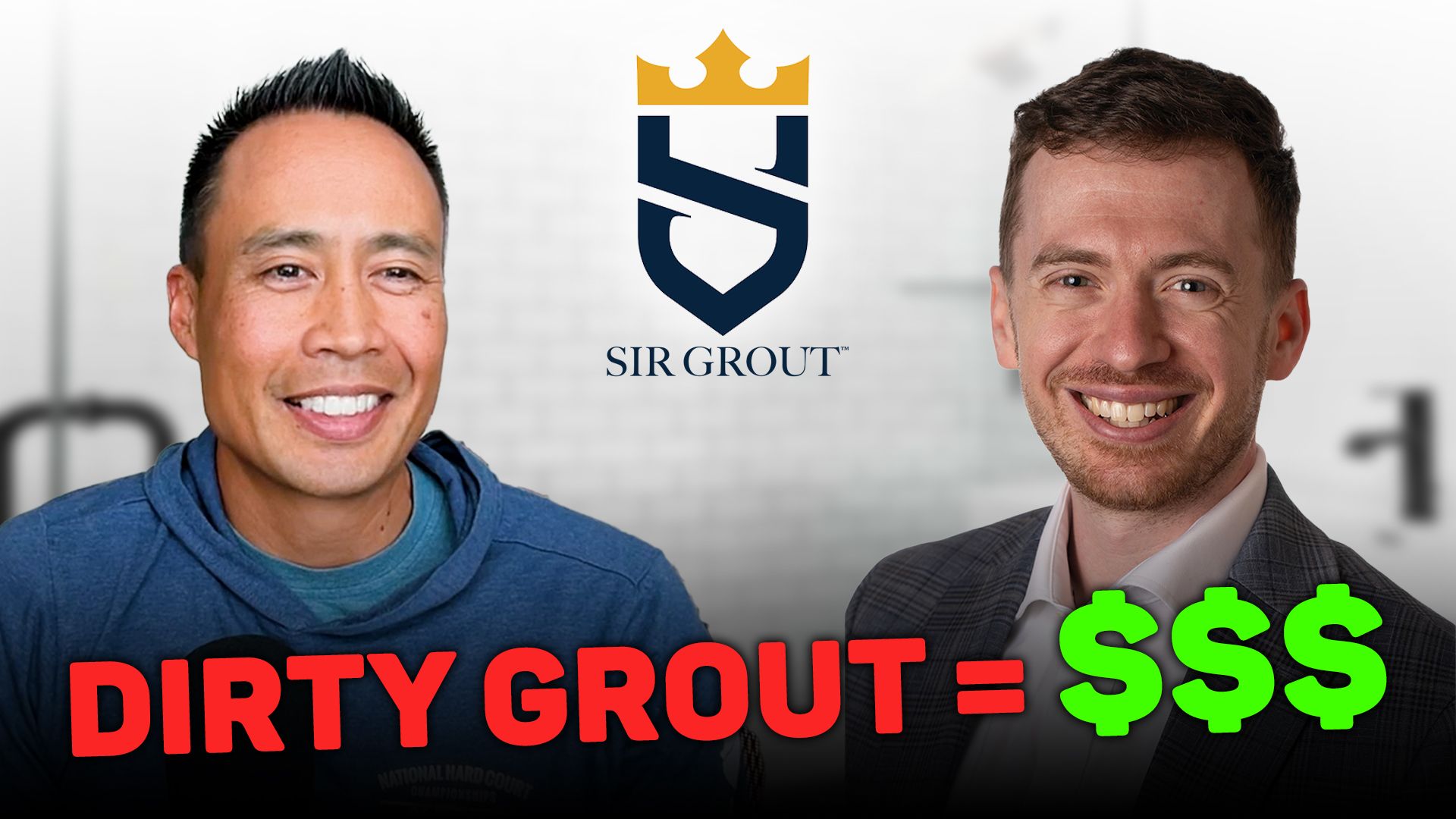
Alan Regala: My guest today grew up with Sir Grout in his DNA. His father was one of the brand's original founders, but that didn't hand him a career. He had to find his own way in, and when he did, he brought a finance background, a fresh perspective, and a front row seat to what it actually takes to grow a franchise system. Today he leads the brand as its Brand Leader, focused on helping franchisees win. Philip Gill, welcome to the Franchise Champion Show.
Philip Gill: Appreciate it, Alan. Glad to be here.
Alan: All right, Phil, take me back to the beginning. I'd love for you to tell us the origin story and lead us into what Sir Grout actually does.
Philip: Yeah, sure. Sir Grout is a bit of a fun story where, like most of the best things that come into our world, it was mostly an accident. My father was an entrepreneur. He had another business, had a piece of equipment from that business he was running, and hit a bit of a wall in terms of where that business was going. So he took that piece of equipment and decided to use it on our front floor.
That steam cleaner was meant to be used for auto detailing. He just wanted to see what would happen when he cleaned the tile and grout right in front of our front door. When he took that steam cleaner to the grout, a lot of dirt came up, and he said to himself, "This is my business."
As it so happens, when he asked around friends and family, a lot of them also said, "Hey, it's really hard to clean tile and grout. Whatever I use doesn't come up as much as I want it to." So he said, "Let me see what I can do."
Sir Grout originally started with friends and family, then went to cleaning. Cleaning evolved to cleaning and sealing. Cleaning and sealing became cleaning, sealing, color sealing, regrouting, re-caulking, stonework, honing, polishing, and full hard surface restoration where it is today.
Alan: Wow, that's great. That's a lot of different services that got added on.
Philip: Absolutely. It's an evolution. And innovation is what drove, and what continues to drive, Sir Grout.
Alan: Great. And when did this all start?
Philip: This started in the early 2000s, around 2004. The business started in the northern New Jersey area, Rockland County, New York, Bergen County, New Jersey, then expanded into Fairfield County, Connecticut. Sir Grout began franchising in 2007 and started making its way across the country.
Alan: Okay, wow. That's amazing. Before we get into the mechanics of the business, I'd love to hear what it was like growing up with your dad as an entrepreneur. What was that family life like?
Philip: I will say, as a kid, it was kind of funny that I really didn't know what my dad did for work. I just knew that he was home, then he was out, then he'd come back dirty, and then he'd play with me. That was my life. My dad worked from home. He had time for me, time for whatever he did. He was on the phone all the time. I didn't know any better.
As I got older and heard more and more names coming into the business, recognizing the deals and the new vendors that became everyday conversation, and seeing each month a new milestone and each year several new locations — it opened my eyes into how big of a world grout, tile, and stone could be.
Even though I didn't necessarily follow in my father's footsteps right away, I was always fascinated by it. So I would go to Sir Grout training even before I was part of the company and build my skills in sales and technical elements — even chemistry, which was really important to understanding how our service works. I took a great interest in the world of franchising and home service even before I entered the business. And then the next thing I knew, I was following my father's path.
Alan: That's fascinating. It sounds like you followed your mom's footsteps into a more traditional path educationally. You studied at the University of Georgia, right?
Philip: That's right. Funny enough, when I was deciding which school to attend, I originally thought I wanted to be an engineer. I was accepted into Georgia Tech early and figured I'd focus on mechanical engineering. But when I looked at the curriculum, I saw a class in my sophomore or junior year that was going to cover refrigeration. And I thought to myself, is my career going to be refrigerators? Is that where my future is going? I said, I don't think so. I want to do business instead.
I happened to get accepted into the Honors College at Georgia, which made the decision a little tougher between Georgia and Georgia Tech. It came down to the football team, so I went to Georgia.
While at school, getting exposed to accounting, marketing, and finance, it all came naturally to me. Something I felt really good doing, something I had talent in. So I followed that path and got into real estate fund administration, investor reporting — classic office work. That's what I was doing on a manager track up until COVID.
Alan: Yeah, COVID changed life for a lot of people.
Philip: It really did. For me personally, it exposed me to the entrepreneurship and home service world. I got my career in franchising started back in 2020, working in another franchise concept that my father happened to be a part of. Once I had my toes dipped into the franchising space and experienced the flexibility, freedom, and creativity that comes with it — while also being able to apply my business and accounting knowledge — there was really no looking back.
I shifted from classic office work to the home service franchising world. I went from working on spreadsheets, capital statements, balance sheets, and profit and loss statements to sanitizing, disinfecting, cleaning, sealing, honing, and polishing. A whole new world that I didn't realize existed.
That franchise concept was focused on sanitizing and disinfecting. It had originally started in the mid-2010s — so the joke was that we didn't secretly start the pandemic to help our business. That was not the case. But it was definitely an impactful time. I have a lot of family in New York City, so that period was very personal for our family as well.
Alan: So you got into that other franchise doing sanitizing and cleaning. How did you end up getting back into Sir Grout?
Philip: Naturally, working closely with the people I did, Sir Grout was always in the background. The model we were trying to follow was the Sir Grout model — knowing how they took an idea, wanted to expand, wanted to innovate, and wanted to be franchisee-focused.
The door opened when I heard that a Sir Grout location was looking to sell. Once I heard that, I raised my hand and said, "Hey, I've been around franchising for a little while now. I really like this model. Between my franchise exposure and my business background, I think I can run my own business."
So I explored the opportunity, took the leap, and became a Sir Grout franchisee in 2021 — just one year into being exposed to franchising. I'll admit I was a little overconfident at the start, thinking I knew everything I needed to know after 12 months. But I learned a lot of lessons quickly, and I don't regret making that leap at all given how much I learned and how much experience I gained.
I saw things from the ground up — installs, sales, management, everything business ownership related. And a couple of years later, I found myself in a position where, having that franchisee experience within Sir Grout, combined with my background in the brand personally, it was a no-brainer to raise my hand for the Brand Leader role. I'm glad I did. I find myself now in an excellent position, working with a fantastic brand growing at a great rate with a tremendous pool of franchisees.
Alan: That's really cool. Do you still own your franchise location?
Philip: I did sell it, actually just over a year ago. I recently celebrated my one-year anniversary of no longer having my franchise. I exited ownership mostly to focus on helping all of the other franchisees in our system continue to grow and reach their goals. It wasn't something I was necessarily planning, but I was approached with the opportunity. I'm really proud of what was built, and it felt like the right time.
Alan: That's really unique. To have someone dedicated to franchisee success who not only grew up in the family that created the brand, but who also owned a location themselves — that's something you don't see with every brand.
Philip: Yeah, it's something I'm very proud of. There are coaching calls I have where I can basically tell franchisees, "I'm looking in your crystal ball. I know what your first year is going to be like. I know what your second year is going to be like. And let me tell you what your third year might look like." That's just from experience. From the ups and downs I had.
And I think anybody who's been a franchisee can relate — the highs of having a great day with your business is a high that can't be matched anywhere else. On the other side, a bad day running your own business is going to be a worse day than you've ever had. It is a roller coaster, no doubt about that. But if you find the satisfaction and keep chasing that feeling of a great day, there's really nothing better in a professional sense.
Alan: Yeah, I agree. When it's something you own, you just care about it so much more. The highs are high and the lows can be low, but you keep getting better at it.
Philip: For sure. When I looked in the mirror on some days, I said, "You did this. You're doing something you were maybe meant to do. There's purpose in what you're doing. You've made people happy. You've changed people's lives. You're supporting individuals who are looking to find their way. You're helping customers who had nowhere else to turn." It's uplifting. It's inspiring. It's motivating. Obviously, there are some days where you face yourself and wonder what you're doing. But those are pushed to the back of your mind. You're always chasing the feeling of: this was something I was meant to do.
Alan: Yeah, those challenging days come up for everybody, but as you get more experienced they become few and far between. I think purpose is really underrated. Most people go into franchising because they're tired of the politics, the red tape, not being paid what they're worth. The financial and time benefits are huge, obviously. But the thing that's underrated is just that feeling of, wow, I built something. That's helping not just me but my community. I have real purpose. I'm serving others.
And with your team — to me, that was one of the most fulfilling parts. Providing a great experience for your customers, but also for the people working with you.
Philip: 100%. Even though I sold my business a year ago, I'm still in contact with the people who worked with me. I don't want to say "for me" because they worked with me. I couldn't have done it without them. Knowing that I impacted their lives, knowing that they looked up to me — it's incredibly fulfilling. That's part of the reason you end up staying in the business.
To give an analogy: you might start playing golf because you think it's going to be fun. But it's when you make an amazing shot that you say, "This is what's going to keep me coming back." And then you hit a couple of shanks in a row and want to quit the sport. That's the roller coaster. Those are the days you push to the back of your mind. But once you get some momentum, find a good rhythm, have the culture and the inspiration — your good days just keep getting better. And that's when you realize: hey, this is something I was meant to do.
Quick pause. If what Philip is saying about the life-changing effects of franchise ownership is resonating with you, we should talk. I work with driven individuals to find the right franchise for their goals, their capital, and their life. No cost to you. Book a call using the link below or head to athletetoowner.com/ready. Now back to Phil.
Alan: Okay, let's get back to the mechanics of the business. How does Sir Grout work from a franchisee standpoint? What does the day-to-day look like?
Philip: Sir Grout has a few different ownership structures. I put them in three categories.
First, we have our owner-operators. These are individuals who do everything top to bottom — they go out and quote a customer for a future job, then go to another customer's house to perform an install. A lot of heavy work goes into that, from developing personal relationships to achieve a sale, to achieving a quality result, maintaining consistent business, getting reviews, getting referrals. Definitely for people who like working with their hands and working face to face every day.
Second, we have ownership where the owner doesn't do the installs themselves but still performs the sales. This is very popular because you know the business top to bottom. You're the one making the longest-lasting early impression on what this business is going to be. You set the table for your installers to execute.
Third, we have executive owners. They have both an install team and a sales team — general managers or sales representatives handling sales and general business management, including managing installers, inventory, the calendar, and routes.
Different varieties, but from a day-to-day perspective, to take a quote from a medical professional I know: the anatomy of every day is the same, but no day is the same. Just like no body is the same. Even though we're going out to perform similar services — cleaning, sealing, honing, polishing — no customer is the same, no day is the same. Every day is a new adventure. Sir Grout keeps things entertaining. You never know what you're going to see when you're looking at kitchens, floors, and bathrooms — indoor and outdoor — in terms of grout, tile, and stone.
Alan: Got it. Is grout still the majority of the work?
Philip: Sir Grout started as a grout company focusing solely on grout, but we've evolved into full hard surface restoration. Cleaning grout is still a majority of what we do, whether it's floors or showers, indoor or outdoor — cleaning, sealing grout, or regrouting with specialty grout. We also perform services with high-durable coatings and different types of sealants for specific tile surfaces. When we treat grout, we often want to treat the tile too. They go hand in hand — peanut butter and jelly, grout and tile.
We also do a lot of work around stone and natural stone — etch repair, stain repair, scratch repair. Stone is a significant portion of our business, covering countertops, floors, inside, outside, a wide variety of treatments. So while a majority of our work is grout and tile, a good portion is also stone. Sir Grout is focused on the grout. But as a hard surface restoration company, we want to work with your tile, your countertops, anything that's a hard surface — ceramic, porcelain, natural stone. We've got services to cover all of it.
Alan: Is it mostly direct-to-consumer or business-to-business?
Philip: Mostly direct-to-consumer. Sir Grout was founded as a residential solution and we've certainly stayed mostly in the residential space. We have expanded a bit into commercial — the services translate very easily from residential to commercial. But our name and brand have grown through the residential space.
Alan: Got it. I know you have different ownership models — owner-operator doing everything, someone focused on sales with installers, and the executive model where someone's overseeing at a higher level. What does it take to be successful in Sir Grout? What are the higher-performing franchisees doing?
Philip: Great question, and I love getting it because my answers seem so simple on the surface. But they apply not just to Sir Grout — to franchising in general.
First: follow the system. When we tell you to perform a service using steps one through seven, exactly as we say, that will get you to the end result. If you skip a step or change a step, you're going to have a harder time. I promise you — over 20 years of being in business, we tried different steps. Some didn't work, some did. That's why each step exists.
What I like to say for Sir Grout is: we have the recipe for the cake. We tell you to use sugar, butter, and flour. If you want to throw in a pinch of vanilla after you've got the basics covered — okay, that's the benefit of having your own business. But if you're going to tell me you're going to replace sugar with maple syrup and expect the same result, we're going to have a hard time getting there.
Now, of course — if you do it anyway and tell me it's 20 times better with maple syrup, I'll erase sugar, put in maple syrup, and call that my system from now on. But we haven't had that happen yet. Either way, our greatest franchisees are the ones who, when they got started, followed the process. They followed the system. Reinventing the wheel is not going to get you very far.
Second: be fearless. That fearlessness comes with expanding your comfort zone. It can be as simple as "I've never done sales before, but I'm going to try it." Or "I've never done installs, but I'm going to try it." It can be even broader — saying yes to things you never thought you would, like going into commercial when you've only done residential. If you only focus on what you're comfortable doing, you won't be able to advance. You have to be willing to ask questions you might have never thought to ask. You kind of have to become a bit of a different person. A bigger risk-taker.
Alan: I love that. One of the most interesting things about business ownership is — assuming you've never owned a business before — you're becoming a better leader. You're growing. There's this element of personal development that happens naturally through the course of owning and growing a business that most people don't really think about. Expanding your comfort zone is real. You have to build muscle. You have to stretch and tear it a little to grow.
Philip: 100%. Now, obviously I'm not saying every Sir Grout owner has to go skydiving before buying a franchise. We're not saying get that far out of your comfort zone. But this is going to be an experience you've likely never had before — whether it's home services, tile and grout, or franchising in general. You're going to find your comfort zone and your bubble within that new adventure. But you have to stretch it. Because if you don't stretch it, you will max out. You'll reach your limit and say, "This is where I'm good." But if you really want to get to the upper echelon, to be the top of the top — it's going to be the people who experiment, take risks, and try different things. Yes, they might get burned. Yes, they might have scars. But at the same time, they're able to reach heights that most others can't.
Alan: Yeah, this is where grit comes in. Understanding that when you're learning something new, it's not going to be perfect the first time. Expect it to flop. If you set that expectation — knowing you're going to struggle the first few times in a sales role you've never been in before — and you keep at it, get feedback, and get a little better each time, you will get better.
Philip: Yeah. One of my favorite stories from franchisees is when they have a returning customer call them back for another room. They show up, walk into the bathroom from their original job, look at the floor and the shower, and go — "Never mind, let's not look at this because... I did that? There's no way I did that. I wouldn't do that now. When I come back to do the other room, I'm fixing this one too." That's what happens. As you practice and get better — and funny enough, even developing the habit of practice itself takes work. You might not be someone who ever studied for two weeks before a test instead of the night before. Those are qualities you have to stretch yourself to build if you want to fully succeed in owning your own business.
Specifically for Sir Grout, that means: practice, study, learn, evaluate yourself. Get a little uncomfortable asking yourself if you're reaching your max potential. Are you taking risks? Are you doing everything you can to maximize how you're contributing to the business?
Alan: Love it. So how many locations do you have now, and what are you looking for in ideal franchise owners?
Philip: Sir Grout now has — I like to use round numbers — about 40 owners in about 60 locations. We're closing in on 100 total units across the country. So I say 40, 60, 100.
As for who I'm looking for: people who not only possess the qualities I just mentioned, but who want to be part of a franchise community. Sir Grout has a franchise community in its DNA. There's a lot of support from our very first franchise owners to our most recent. There's an element of understanding that we are here to help each other — that we lift the tide so all ships get raised.
People who are transparent, willing to learn, and who recognize that, hey, this isn't the most glamorous type of business. Nobody wakes up in the morning and says, "I really need grout and tile in my life." But for the ones who see the potential, who see the value — those are the people who say: "This is a hidden gem. This is something people need."
The joke from the original founders is that the three inevitabilities in life are death, taxes, and dirty grout. Everybody has this problem. And there is an affliction you get once you discover Sir Grout — once you learn about the brand, you can't escape looking at tile, grout, countertops, and stone. If you're the type of person who gets afflicted immediately, even before learning about Sir Grout, that's someone I want in this system. You're going to drive the attention this business needs. You're going to raise awareness for a solution that many people don't know exists — an alternative to full replacement or reconstruction that can save homeowners significant money.
I'm also looking for someone who has fun exploring this. Yes, owning a business is work. But you have to revel in the fact that you're doing it. When you get that, and know you're working within a community with a support staff that's been part of this brand from the beginning — you can find real enjoyment in what you do. If you can see the entertainment in the challenges you face, and celebrate when you start overcoming them — that's every franchise dream. Anyone who sees that and wants to be part of it, that's definitely someone we want.
Alan: That's great. Culture is so important. Whether you're looking at Sir Grout or any brand, you want to make sure the culture and the people are the right fit. A strong community like what Sir Grout has is going to help make owners successful. Well, thank you so much for joining me today, Phil. Congrats on being a Franchise Champion.
Philip: I appreciate it. Thank you for having me on. This was great. Love to do this again sometime.
Alan: Sounds great. We'll have you back in another year or two to check in.
Don't miss a beat!
We hate SPAM. We will never sell your information, for any reason.